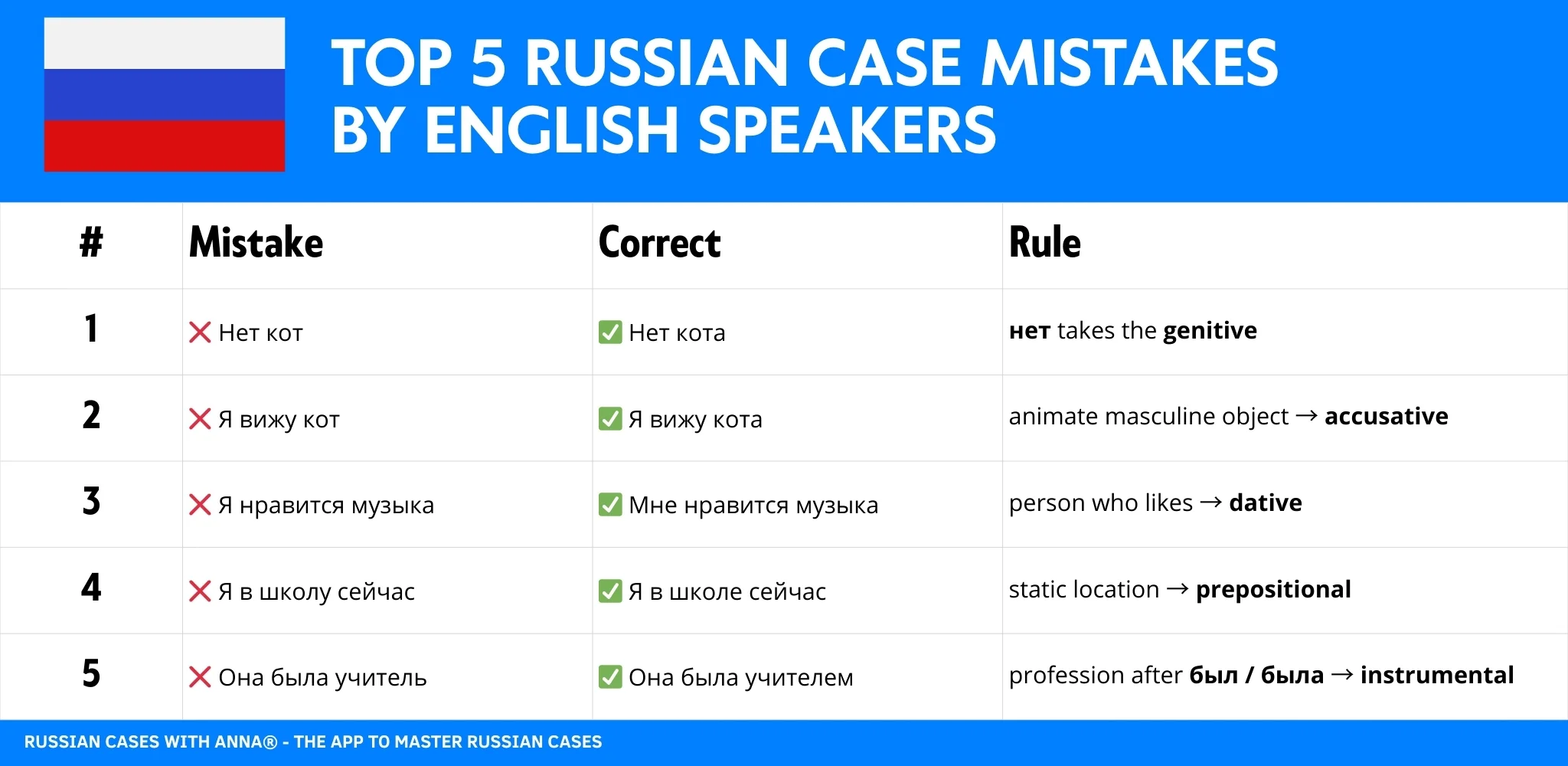
Top 10 Mistakes English Speakers Make with Russian Cases (And How to Fix Them)
The most common Russian grammar errors — diagnosed and cured. This article compiles the 10 most frequent Russian case errors made by English speakers — documented from thousands of learner interactions, language forums, and grammar exercises.
Each mistake is presented with the wrong form, the correct form, and a clear explanation of why the mistake happens and how to avoid it permanently. Use this as a diagnostic checklist — how many of these are you making?

- 10 most common Russian case mistakes with wrong vs correct examples
- Why each mistake happens (root cause analysis)
- How to fix each mistake permanently
- Quick reference table of all 10 mistakes
- 5 practical strategies to stop making these errors
- Self-test to assess your level
Why English Speakers Struggle with Russian Cases
Before we get to the mistakes, it's worth understanding why Russian cases are so hard for English speakers specifically:
- English has almost no inflection — word order (not endings) signals grammatical role. Russian uses both.
- English learners have no intuition for 'what case does this need?' — that instinct has to be built from scratch.
- Russian has 6 cases, and every noun, adjective, pronoun, and numeral declines for each. That's a lot of forms.
- Some Russian grammatical constructions are conceptually inverted from English (like нравиться — 'to like').
- The animate/inanimate distinction in the accusative has no English equivalent.
The 10 Most Common Russian Case Mistakes
Understanding these root causes helps. Now let's look at the 10 specific mistakes they produce.
MISTAKE #1: Using the Nominative After НЕТ
MISTAKE #2: Using the Nominative as a Direct Object
MISTAKE #3: Animate Masculine: Treating It Like an Inanimate
MISTAKE #4: Using Я with НРАВИТЬСЯ Instead of Мне
MISTAKE #5: Using в + Accusative for Location (Instead of Prepositional)
MISTAKE #6: Using Nominative for Professions After Был/Стала/Работает
MISTAKE #7: Adding -ОВ to All Nouns in the Genitive Plural
MISTAKE #8: Using the Wrong Case After Numbers
MISTAKE #9: Using -Е Instead of -ИИ for Nouns in -ий/-ие/-ия
MISTAKE #10: Using Accusative with ЗАНИМАТЬСЯ and Other Reflexive Verbs
Bonus Mistakes That Didn't Make the Top 10
Honourable mentions — mistakes that are very common but slightly less universal than the top 10:
- Forgetting to add Н- to pronouns after prepositions: к ему ✗ → к нему ✓ | от ей ✗ → от неё ✓
- Mixing up из (from inside) and от (from a person): из врача ✗ → от врача ✓
- Using dative instead of genitive for possession: книга другу ✗ → книга друга ✓
- Forgetting adjective agreement in case: Я вижу красивый женщину ✗ → красивую женщину ✓
- Using accusative instead of prepositional with о: о что ты думаешь? ✗ → о чём ты думаешь? ✓
- Forgetting fleeting vowels in genitive plural: ручков ✗ → ручек ✓ | окнов ✗ → окон ✓
Quick Reference: All 10 Mistakes at a Glance
Use this table as a checklist when reviewing your Russian writing or speaking:
| # | Mistake pattern | Wrong | Correct | Core rule |
|---|---|---|---|---|
| #1 | нет + nominative | нет кот | нет кота | нет always takes genitive |
| #2 | Direct object → nominative | Я вижу кот | Я вижу кота | Transitive verbs take accusative |
| #3 | Animate acc. = nominative | Я вижу студент | Я вижу студента | Animate masc. acc. = genitive form |
| #4 | я нравится (wrong liker) | Я нравится музыка | Мне нравится музыка | The person who likes → dative |
| #5 | Direction = prepositional | Я в школу сейчас | Я в школе сейчас | Static location → prepositional |
| #6 | Professions after был/стала | Она была учитель | Она была учителем | Past быть + profession → instrumental |
| #7 | Genitive plural → -ов | много женщинов | много женщин | Fem. -а nouns → zero ending in gen. pl. |
| #8 | Numbers: all take same case | пять стол | пять столов | 5+ takes genitive plural |
| #9 | -ий/-ие/-ия → -е | в России → wrong | в России → correct | These nouns take -ИИ, not -Е |
| #10 | Заниматься + accusative | заниматься музыку | заниматься музыкой | заниматься always takes instrumental |
How to Stop Making These Mistakes: 5 Practical Strategies
1. Learn Grammar Rules, Not Just Vocabulary
Most of these mistakes stem from learning Russian words without their grammatical context. When you learn нет, also learn that нет always takes genitive. When you learn заниматься, learn it as заниматься + instrumental. Package rules with the words they govern.
2. Use the "Case Question" Trick
Before using a noun in a sentence, ask the case question out loud: Кого? Что? (accusative) — Кому? Чему? (dative) — Кем? Чем? (instrumental). This activates the case system consciously and slows down the automatic English-patterning reflex.
3. Drill the Trickiest Patterns Separately
Three patterns cause 80% of errors: нет + genitive, accusative animate vs. inanimate, and direction (accusative) vs. location (prepositional). Create dedicated drills for each of these and practice them until they become automatic.
4. Read Russian and Hunt for Case Endings
Active reading — where you identify the case of every noun you encounter — is one of the most effective ways to build case intuition. When you read Я вижу студента, don't just process the meaning. Note: студента = accusative animate = genitive form. Over time, this becomes instinct.
5. Get Corrected Immediately
Case errors that go uncorrected fossilize — they become habits that get harder to break the longer they persist. Use an app, a tutor, or a language exchange partner to get real-time feedback. The sooner a mistake is corrected, the less likely it is to solidify.
Self-test: How many mistakes are you making?
Go through the top 10 list and honestly assess each one. Score yourself:
- 0–2 mistakes: Advanced learner — focus on bonus mistakes and fine-tuning
- 3–5 mistakes: Intermediate — pick the top 3 most frequent ones and drill them first
- 6–8 mistakes: Beginner-intermediate — start with mistakes #1, #2, #5 (most frequent)
- 9–10 mistakes: Beginner — use our structured app to drill cases systematically
Frequently asked questions
- Why are Russian cases so hard for English speakers?
- Russian cases are hard for English speakers because English abandoned its case system centuries ago. Modern English marks grammatical role almost entirely through word order — 'the dog bites the man' vs. 'the man bites the dog'. Russian marks it through noun endings. English speakers have no grammatical intuition for cases at all — it must be built from scratch, and that takes time and deliberate practice.
- How long does it take to master Russian cases?
- Most learners reach comfortable accuracy with the most common cases (nominative, accusative, genitive) within 6–12 months of consistent study. Full command of all 6 cases, including the irregular genitive plural and all the locative exceptions, typically takes 2–4 years of serious study. However, significant progress on the most frequent patterns can be made in just a few months with focused practice.
- What is the most common Russian case mistake?
- Based on learner error analysis, the single most common mistake is using the nominative after нет — saying Нет кот instead of Нет кота. The second most common is failing to change the direct object to the accusative (Я вижу кот instead of кота). These two mistakes occur in almost every sentence a beginner constructs, making them the highest-priority items to fix.
Fix your Russian case mistakes with targeted drills in our mobile app. Smart exercises that identify your specific weak spots and practice them to mastery. Available on Android and iOS.