How to Practice Russian Cases: 5 Proven Methods to Finally Make Them Stick
You've read the grammar explanations. You've studied the tables. You understand how Russian cases work — in theory. And then you open your mouth, or start writing, and everything falls apart. The endings vanish. The rules blur. You freeze.
This is the knowing-doing gap: understanding a rule and automatically applying it in real speech are completely different skills. This guide gives you 5 proven methods to practice Russian cases in ways that actually work.

- Why Russian cases don't stick with traditional study methods
- 5 proven methods for practicing Russian cases effectively
- A 12-week case study plan from beginner to confident user
- The role of spaced repetition in case memorization
- How to use a Russian cases app to accelerate your learning
- Common practice mistakes that waste your time
Why Russian Cases Don't Stick with Traditional Study
Most learners study Russian cases by reading grammar explanations and trying to memorize tables. This approach has a fundamental problem: passive recognition is not the same as active production. You can recognize that студента is the accusative of студент without being able to produce it automatically under time pressure.
Effective case practice requires: Active retrieval — forcing yourself to produce the form, not just recognize it. Spaced repetition — returning to the same forms at increasing intervals. Contextual exposure — seeing forms used in real Russian, not just isolated tables. Error correction — getting immediate feedback when you're wrong. Volume — enough repetitions that the form becomes automatic.
The 5 methods below incorporate all of these principles.
Method #1: Spaced Repetition Flashcards for Case Endings
The scientifically proven method for long-term retention.
Why it works
Spaced repetition (SRS) is the most evidence-backed method for memorizing linguistic forms. It works by showing you each item at the optimal moment — just before you're about to forget it.
For Russian cases, this means drilling на столе, without a table → you recall это стол в предложном падеже → на столе. Over 30-60 repetitions, the form becomes automatic.
How to do it
Use a Russian cases app with built-in SRS, or create Anki decks for each case. Start with the most frequent forms: accusative of common nouns, genitive singular, dative pronouns.
Add new cards gradually — don't try to load all 6 cases at once. Review daily for 15-20 minutes maximum.
Timeframe & best for
Timeframe: Results visible in 2-4 weeks of daily practice. Automatic recall typically established in 3-6 months. Best for: All levels. Especially effective for beginners building the foundation of case endings.
Method #2: Case-Specific Sentence Drills
Targeted practice that isolates one case pattern at a time.
Why it works
Drilling one case at a time — rather than practicing all 6 simultaneously — dramatically reduces cognitive load and accelerates mastery.
When you focus exclusively on, say, dative after нравиться for a week, your brain dedicates its full pattern-recognition capacity to that one structure. By the time you move on, it's nearly automatic.
How to do it
Pick one case and one construction per week. Write 20 sentences using that construction daily.
Example week: Genitive week — write 20 sentences with нет + genitive. Accusative animate week — 20 sentences with Я вижу + animate noun. Dative week — 20 sentences with нравится. Correct your mistakes and rewrite.
Timeframe & best for
Timeframe: One focused week per case construction. Full cycle through all major constructions: 8-12 weeks. Best for: Beginners to intermediate. Ideal for learners who know the rules but struggle to apply them.
Method #3: Active Reading with Case Identification
Building intuition through massive contextual input.
Why it works
Reading Russian with active case identification is how you move from knowing rules to developing intuition.
When you read a sentence and consciously identify the case of each noun, you're doing two things simultaneously: processing meaning AND reinforcing grammatical patterns. After enough exposure, you start to "feel" when an ending is wrong — exactly like a native speaker.
How to do it
Read 1-2 paragraphs of Russian text per day. For each noun you encounter, mentally (or physically) identify its case. Focus on nouns and pronouns.
Start with graded readers or simple Russian news articles. Gradually increase difficulty. Russian short stories (рассказы) are excellent for this.
Timeframe & best for
Timeframe: Cumulative — intuition builds over months. Expect to notice patterns within 4-6 weeks of consistent practice. Best for: Intermediate and advanced. Requires basic case knowledge to benefit from analysis.
Method #4: Writing Practice with Self-Correction
Forcing conscious rule application builds active grammar.
Why it works
Writing forces you to actively apply case rules rather than passively recognize them.
The act of composing a Russian sentence — choosing the right ending, second-guessing yourself, looking it up — creates stronger memory traces than reading the same form. Self-correction adds a powerful error-identification loop.
How to do it
Keep a Russian journal — 3-5 sentences per day about your life. After writing, go back and check every noun's case. Ask: what is the grammatical role? Which preposition is it following? Is the ending correct?
Use a grammar reference to check. Highlight every case change you made. Track which cases you still get wrong most often.
Timeframe & best for
Timeframe: Ongoing. Writing accuracy typically improves significantly within 6-8 weeks of daily practice. Best for: Intermediate. Works best once you know the basic rules and need to consolidate them.
Method #5: Speaking Practice with Immediate Feedback
The fastest route to real-world fluency.
Why it works
Speaking is the most demanding case environment because you must produce the correct ending in real time, under conversational pressure. This is where case knowledge truly becomes language ability.
The key ingredient is immediate feedback — knowing when you've made an error before the pattern fossilizes. A Russian tutor, a language exchange partner, or a corrective AI tool all provide this.
How to do it
Have 2-3 speaking sessions per week. Ask your partner to correct case errors specifically — not all errors, just cases. Record yourself speaking Russian and listen back; you'll often catch your own mistakes.
Use structured activities: describe your apartment (prepositions + prepositional/instrumental), describe a photo (accusative), role-play giving gifts (dative). Gradually push yourself to speak faster.
Timeframe & best for
Timeframe: Real-time case accuracy typically improves within 4-8 weeks of regular speaking practice with correction. Best for: Intermediate to advanced. Requires enough case knowledge to understand corrections.
Comparing the 5 Methods
Each method targets a different aspect of case learning. The best learners combine multiple methods:
| Method | Effectiveness | Time investment | Best level | What it's best for |
|---|---|---|---|---|
| Spaced Repetition App | ⭐⭐⭐⭐⭐ | 10-20 min/day | All levels | Best for building automatic recall of endings |
| Case-specific drills | ⭐⭐⭐⭐ | 15-30 min/session | Beginner–Intermediate | Targets specific case patterns systematically |
| Active reading | ⭐⭐⭐⭐⭐ | 30+ min/day | Intermediate+ | Builds intuition through massive input |
| Writing practice | ⭐⭐⭐⭐ | 20-30 min/day | Intermediate+ | Forces conscious application of rules |
| Speaking practice | ⭐⭐⭐⭐⭐ | 30+ min/session | All levels | Real-time feedback closes the feedback loop |
- Recommended combination for fastest results: Daily SRS app (15 min) + weekly case-specific drill (20 min) + speaking session (2×/week). Add active reading once you reach intermediate level. This combination covers all five principles: retrieval, spacing, context, feedback, and volume.
12-Week Russian Cases Study Plan
A structured plan to take you from basic case awareness to confident usage in 12 weeks. Each phase focuses on one or two cases with specific daily exercises:
| Weeks | Case focus | Core activities | Daily practice exercise |
|---|---|---|---|
| 1–2 | Nominative + Accusative | Flashcards for accusative endings (all genders). Focus: fem. -а→-у, animate masc. rule. | Identify all accusative nouns in 5 Russian sentences per day. |
| 3–4 | Genitive case | Drill нет + genitive. Memorize genitive singular endings. Start genitive plural patterns. | Write 5 sentences using нет + genitive. Read 1 paragraph, mark all genitives. |
| 5–6 | Dative case | Нравиться construction. Age expressions. Indirect objects. | 10 нравиться sentences. 5 age sentences. Translate English sentences with give/tell/show. |
| 7–8 | Instrumental case | Profession pattern. С + instrumental. Time adverbs (утром, летом). | 10 profession sentences. 10 "with" sentences. Use time adverbs in journal. |
| 9–10 | Prepositional case | В/НА location. О + topic. -ИИ ending rule. | 5 location sentences (в). 5 location (на). 5 "о чём" sentences. Map 10 country names. |
| 11–12 | Integration | Mixed case drills. Preposition-case mapping. Error correction review. | Write a 100-word paragraph using all 6 cases. Self-check every noun's case. |
Common Practice Mistakes That Waste Your Time
Mistake 1: Studying All 6 Cases at Once
This is the most common mistake. Trying to learn all six cases simultaneously fragments your attention and prevents any single case from becoming automatic. Learn one case thoroughly before moving to the next.
Mistake 2: Only Reading Grammar Explanations
Reading about cases is not practicing cases. You can spend hours reading grammar tables without gaining any ability to produce correct forms. Grammar explanations are necessary but they are the map, not the territory. Practice means producing forms actively.
Mistake 3: Skipping Revision
Many learners drill a case intensively for a week, then never return to it. Without spaced revision, the forms fade. The SRS method handles this automatically; if you're using manual drills, schedule weekly review sessions for completed cases.
Mistake 4: Avoiding Speaking Until Your Cases Are "Ready"
Cases are never fully ready. Learners who wait until their cases are perfect before speaking typically never speak. The speaking environment itself accelerates case learning through error correction and real-world pressure. Start speaking imperfectly and improve through practice.
Mistake 5: Not Tracking Your Specific Errors
Most learners make the same case errors repeatedly. If you don't track which cases you consistently get wrong, you'll practice the wrong things. Keep an error log — when you make a case mistake, write it down. Review your log weekly and focus your drilling on your documented weak spots.
The Role of a Russian Cases App
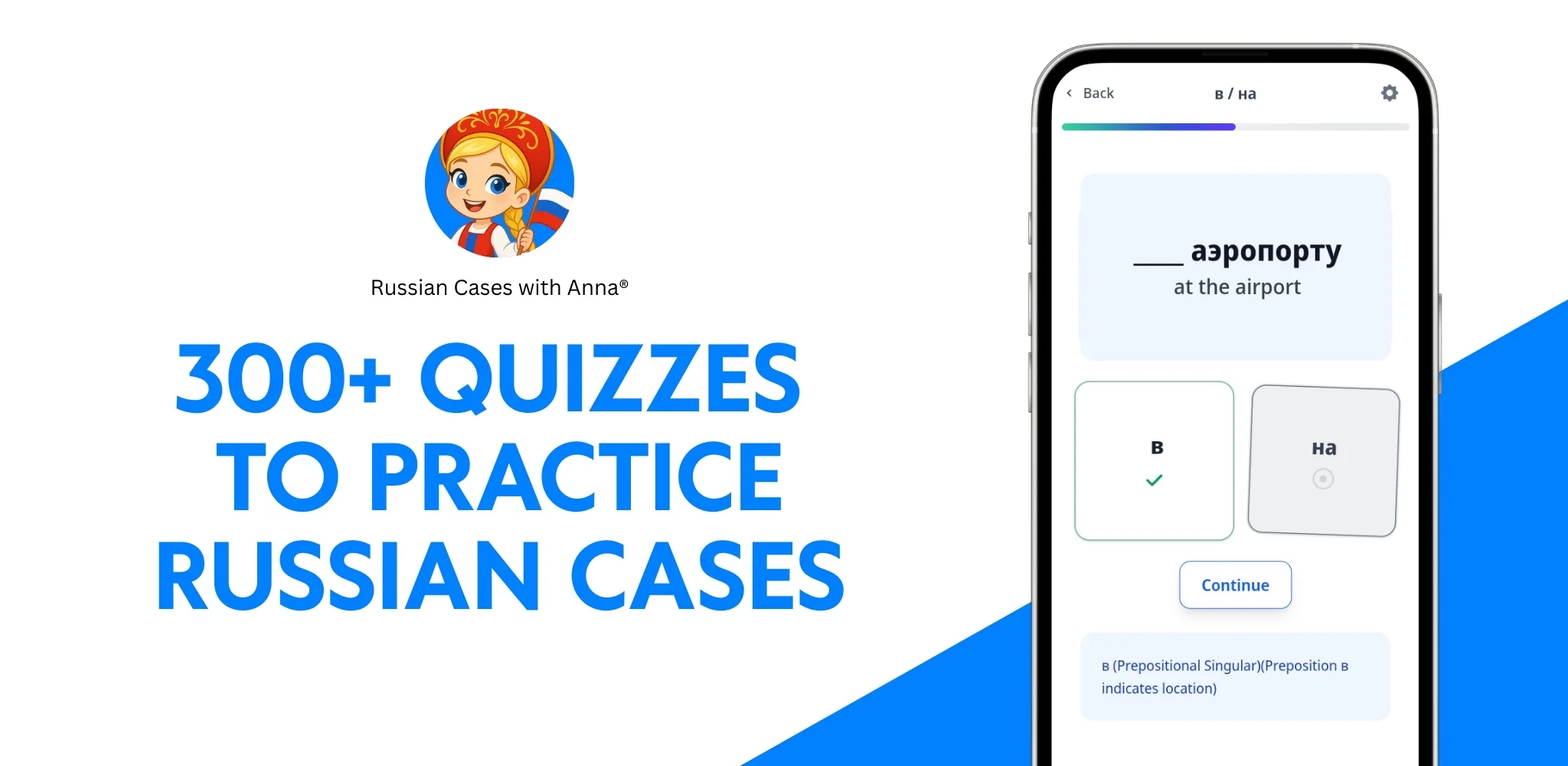
Mobile apps designed specifically for Russian cases offer a significant advantage over general language learning apps: they focus exclusively on the grammar that matters most and use intelligent repetition to identify and drill your specific weak spots.
- Spaced repetition system (SRS) — the app should adapt to your performance
- All 6 cases covered — with both singular and plural forms
- Real Russian sentences as context — not just isolated words
- Animate/inanimate distinction for the accusative
- Adjective declension as well as noun declension
- Progress tracking — so you can see improvement over time
- Offline capability — for practice anywhere, anytime
Frequently asked questions
- How long does it take to learn Russian cases?
- With consistent daily practice (20-30 minutes per day), most learners develop solid command of the most common case patterns within 3-6 months. Full mastery of all 6 cases, including irregular genitive plural, locative forms, and all preposition-case pairings, typically takes 12-24 months. The key variable is the quality of practice — active production and spaced repetition dramatically outperform passive study.
- What is the best way to memorize Russian case endings?
- The most effective method is spaced repetition combined with sentence-level practice. Don't try to memorize endings in isolation — memorize them in the context of real sentences. When you learn that стол → столе in the prepositional, remember книга на столе (the book is on the table) as a complete unit. Contextual memory is far more durable than abstract table memorization.
- Which Russian case should I learn first?
- Start with the nominative (you already know it — it's the dictionary form), then accusative (the most common case for direct objects), then genitive (the most versatile case). This sequence covers the cases you'll need for basic communication. Add dative, instrumental, and prepositional in that order as your foundation solidifies.
- Is there an app specifically for Russian cases?
- Yes — there are apps specifically designed for drilling Russian case declensions. The best ones focus on all 6 cases, include adjective declension, use spaced repetition to target your weaknesses, and provide real Russian sentences as context. Our app is built for exactly this purpose and is available on both Android and iOS.
Russian cases become automatic the same way any complex skill becomes automatic: through deliberate, varied, consistent practice with real feedback. The five methods in this guide — spaced repetition, case-specific drills, active reading, writing practice, and speaking with correction — cover every angle of the learning process.
The 12-week plan gives you a structured path from beginner confusion to confident case usage. Follow it, track your errors, focus on your weak spots, and review regularly. In three months, you will be a different Russian speaker.
Continue with the rest of our Russian grammar series: