Russian Genitive Case: Rules, Endings & 32 Real Examples
If you could only master one Russian case beyond the nominative, make it the genitive. The Russian genitive case is by far the most frequently used case after the nominative — it appears in possession structures, negation, quantities, dates, and after more prepositions than any other case.
This guide covers everything: the rules, all the endings, the irregular forms that trip everyone up, and 32 real Russian example sentences so you can see exactly how the genitive case works in practice.

- What the Russian genitive case is and when to use it (7 core uses)
- Genitive singular endings — all noun genders with examples
- Genitive plural endings — including the "zero ending" and fleeting vowels
- 11 irregular genitive plurals to memorize (человек → людей, глаз → глаз, etc.)
- 16 prepositions that require the genitive
- Numbers & quantities with the genitive (2/3/4 vs 5+, 21, 22, 25…)
- Genitive vs accusative — the animate masculine trap
- У + genitive construction for "to have" in Russian
What Is the Russian Genitive Case?
The genitive case (Родительный падеж — literally, the 'birth/origin case') is the second of the six Russian cases. Its name hints at its primary function: showing origin, belonging, or relation — answering the questions Кого? (Of whom?) and Чего? (Of what?). In English, we express genitive relationships using the word 'of' or the possessive apostrophe-s ('s).
Russian accomplishes this entirely through word endings — no extra word needed. Example: The name of the city = название города (города is город in the genitive case).
Quick answer
The genitive case in Russian answers the questions Кого? (Of whom?) and Чего? (Of what?).
It is used primarily to express possession, absence, quantity, and is required after a large number of common prepositions.
7 Core Uses of the Russian Genitive Case
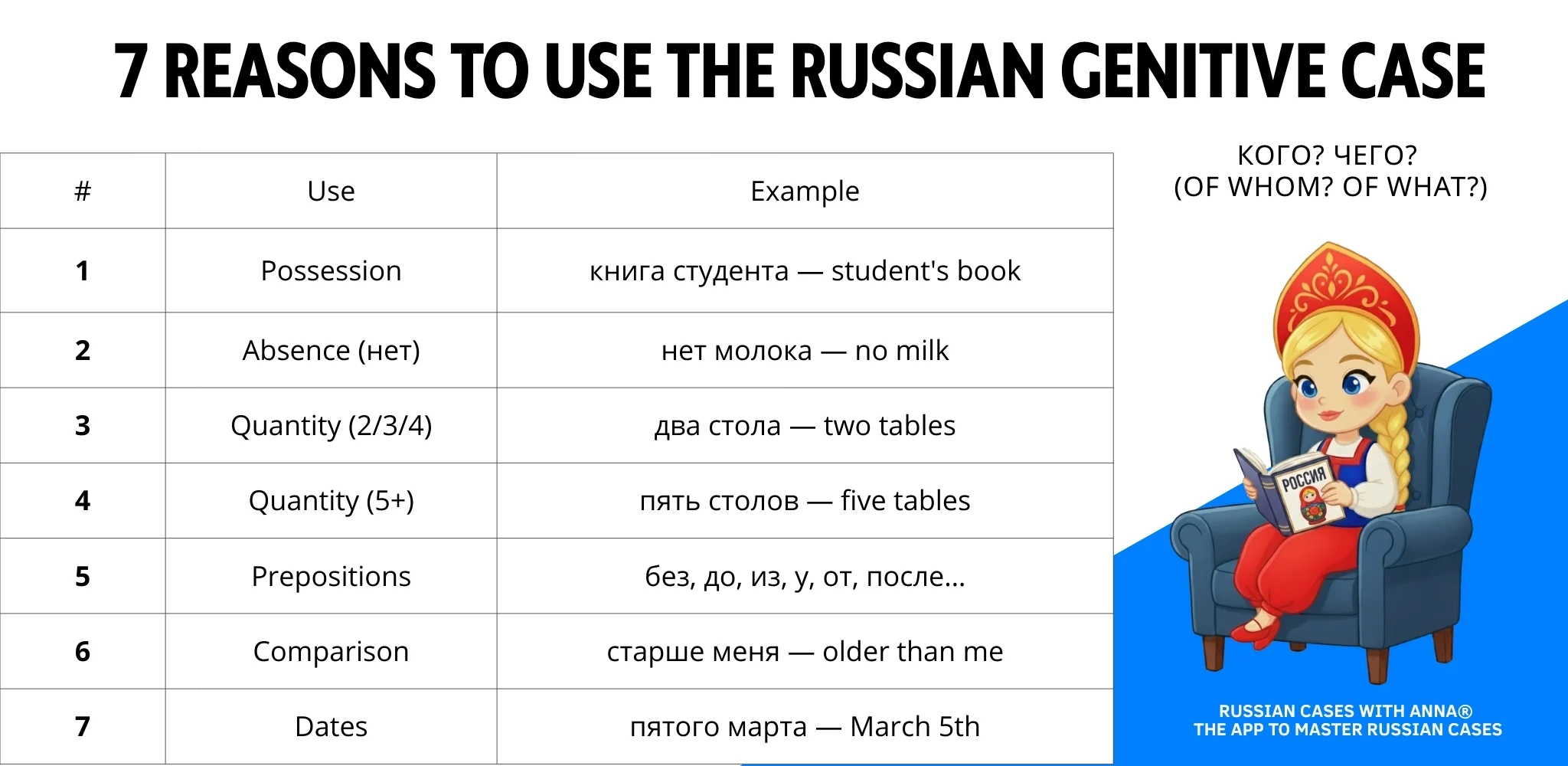
The genitive case is the most versatile case in Russian.
It appears in possession, negation, quantities, prepositions, comparisons, dates, and with certain verbs.
Use 1 — Possession and Belonging
The genitive case replaces the English 'of' or the possessive 's. Whenever one noun belongs to another, the owner goes into the genitive.
- дом отца — the father's house (lit: the house of the father)
- столица России — the capital of Russia
- конец фильма — the end of the film
Use 2 — Absence and Negation (нет, не было, не будет)
Whenever you say something does not exist, is not available, or is absent, the Russian genitive case is required. The structures нет, не было, and не будет always take the genitive.
- У меня нет машины. — I don't have a car. (нет + genitive)
- Здесь нет сахара. — There's no sugar here.
- Его не было дома. — He wasn't at home. (не было + genitive)
- Завтра не будет дождя. — There won't be rain tomorrow.
Use 3 — Quantity, Numbers, and Measure
The genitive case is required after most numbers and quantity words.
After 1: nominative singular. After 2, 3, 4: genitive singular. After 5–20 and larger numbers: genitive plural. After много, мало, несколько, сколько: genitive plural.
Use 4 — Prepositions
More prepositions require the genitive than any other case. Key examples: без, до, из, у, от, после, для, кроме. See the full table in the Prepositions section below.
Use 5 — Comparison
In Russian, comparisons using the comparative adjective take the genitive: Он старше меня. — He is older than me. (меня = genitive of я)
Use 6 — Dates
The genitive case is used when specifying a date — the day and month both take the genitive: Он родился пятого марта. — He was born on March 5th.
Use 7 — Certain Verbs (Genitive Objects)
A small but important set of Russian verbs take their object in the genitive: ждать (to wait for), желать (to wish), бояться (to be afraid of), избегать (to avoid), достигать (to achieve).
Genitive Case Endings — Singular
The table below shows how to form the genitive singular for every Russian noun type. Identify the noun's gender and its final letter(s) in the nominative, then apply the correct ending.
Note: the 8-letter spelling rule replaces Ы with И after Г, К, Х, Ж, Ш, Щ, Ч, Ц.
| Noun type | Ending | Formation | Result | Example in context |
|---|---|---|---|---|
| Masculine hard | -а | стол → стол+а | стола | нет стола — there's no table |
| Masculine soft | -я | гений → гени+я | гения | без гения — without a genius |
| Masculine in -ж/ш/щ/ч | -а | нож → нож+а | ножа | без ножа — without a knife |
| Feminine -а (hard) | -ы | книга → книг+ы | книги | нет книги — there is no book |
| Feminine -а (after г/к/х/ж/ш/щ/ч/ц) | -и | подруга → подруг+и | подруги | без подруги — without a friend (f.) |
| Feminine -я | -и | неделя → недел+и | недели | нет недели — there is no week |
| Feminine -ь | -и | ночь → ноч+и | ночи | до ночи — until night |
| Neuter -о | -а | окно → окн+а | окна | нет окна — there is no window |
| Neuter -е | -я | море → мор+я | моря | до моря — to the sea |
| Neuter -мя | -ени | имя → имен+и | имени | без имени — without a name |
Genitive Case Endings — Plural (The Hardest Part)
The genitive plural is widely considered the most difficult area of Russian declension. It has more forms and more exceptions than any other case.
Many feminine -а nouns and neuter -о nouns have a zero ending (-Ø) — the stem stands alone. With окон and яблок, a fleeting vowel О is inserted between consonants to aid pronunciation.
| Noun type | Ending | Formation | Result | Example in context |
|---|---|---|---|---|
| Masculine hard | -ов | стол → стол+ов | столов | пять столов — five tables |
| Masculine in -ж/ш/щ/ч/ц (stressed) | -ей | нож → нож+ей | ножей | несколько ножей — several knives |
| Masculine in -ж/ш/щ/ч/ц (unstressed) | -ей | врач → врач+ей | врачей | много врачей — many doctors |
| Masculine soft -й | -ев | музей → музе+ев | музеев | три музея — three museums |
| Masculine soft -ь | -ей | словарь → словар+ей | словарей | много словарей — many dictionaries |
| Feminine -а (hard) | -Ø (zero) | женщина → женщин | женщин | много женщин — many women |
| Feminine -а (after к/г) | -Ø | подруга → подруг | подруг | нет подруг — no friends (f.) |
| Feminine -я | -ей / -й | неделя → недель | недель | несколько недель — several weeks |
| Feminine -ь | -ей | ночь → ноч+ей | ночей | пять ночей — five nights |
| Neuter -о (hard) | -Ø | окно → окон | окон | много окон — many windows |
| Neuter -е | -ей | море → мор+ей | морей | пять морей — five seas |
| Neuter -ие/-ия | -ий | здание → здани+й | зданий | много зданий — many buildings |
Irregular Genitive Plurals — Must-Know List
Some of the most common Russian nouns have highly irregular genitive plural forms that must simply be memorized. These are high-frequency words.
| Nominative singular | Genitive plural | Example | Note |
|---|---|---|---|
| человек (person) | людей | много людей | suppletion from люди |
| ребёнок (child) | детей | много детей | suppletion from дети |
| глаз (eye) | глаз | пара глаз | zero ending (not глазов) |
| раз (time/instance) | раз | несколько раз | zero ending (not разов) |
| солдат (soldier) | солдат | отряд солдат | zero ending |
| носок (sock) | носков | пара носков | keeps -ов |
| чулок (stocking) | чулок | пара чулок | zero ending (not чулков) |
| яблоко (apple) | яблок | килограмм яблок | zero ending |
| имя (name) | имён | список имён | neuter -мя type |
| мать (mother) | матерей | двое матерей | special declension |
| дочь (daughter) | дочерей | трое дочерей | special declension |
Russian Genitive Case Prepositions — Complete List
The following prepositions always require the genitive case. Memory tip — the acronym БДИ-УОП-ДК: Без · До · Из · У · От · После · Для · Кроме.
These 8 prepositions cover 90% of genitive preposition usage.
| Prep. | Meaning | With a noun | Full example + translation |
|---|---|---|---|
| без | without | без молока | Я пью чай без молока. — I drink tea without milk. |
| до | until / before / up to | до урока | Позвони мне до урока. — Call me before the lesson. |
| из | from (inside of) | из России | Он приехал из России. — He came from Russia. |
| с | from (off a surface) | с полки | Книга упала с полки. — The book fell off the shelf. |
| у | at / near / by | у меня | У меня есть кошка. — I have a cat. |
| от | from (a person/source) | от друга | Письмо от друга. — A letter from a friend. |
| после | after | после работы | После работы я устал. — After work I was tired. |
| для | for (the benefit of) | для тебя | Это подарок для тебя. — This is a gift for you. |
| кроме | except / besides | кроме меня | Все кроме меня пришли. — Everyone except me came. |
| вокруг | around | вокруг города | Мы ехали вокруг города. — We drove around the city. |
| мимо | past / by | мимо школы | Он прошёл мимо школы. — He walked past the school. |
| вместо | instead of | вместо кофе | Выпей воды вместо кофе. — Drink water instead of coffee. |
| напротив | opposite / across from | напротив банка | Кафе напротив банка. — The café is across from the bank. |
| из-за | because of / from behind | из-за дождя | Из-за дождя мы остались дома. — Because of the rain we stayed home. |
| из-под | from under | из-под стола | Кот вылез из-под стола. — The cat crawled out from under the table. |
| ради | for the sake of | ради тебя | Ради твоего счастья. — For the sake of your happiness. |
Russian Numbers and the Genitive Case
Counting in Russian requires the genitive case — and the exact form (singular or plural) depends on the number.
Russian counts in "groups": numbers ending in 1 use the nominative; 2–4 use genitive singular; 5–0 use genitive plural.
| Number / Quantifier | Case required | Example (стол) | Translation |
|---|---|---|---|
| 1 | Nominative singular | один стол | one table |
| 2, 3, 4 | Genitive singular | два стола / три стола | two / three tables |
| 5–20 | Genitive plural | пять столов | five tables |
| 21, 31, 41… (ends in 1) | Nominative singular | двадцать один стол | twenty-one tables |
| 22–24, 32–34… (ends in 2-4) | Genitive singular | двадцать два стола | twenty-two tables |
| 25–30, etc. (ends in 5–9, 0) | Genitive plural | двадцать пять столов | twenty-five tables |
| 100, 200, 1000… | Genitive plural | сто столов | a hundred tables |
| много / несколько / мало | Genitive plural | много столов | many / several / few tables |
| сколько / столько | Genitive plural | сколько столов? | how many tables? |
Genitive vs. Accusative: How to Tell Them Apart
One of the most common points of confusion is distinguishing the genitive from the accusative. For animate masculine nouns, the accusative form is identical to the genitive — the form студента can be either case.
Context and sentence structure tell you which it is.
| Situation | Russian sentence | Explanation |
|---|---|---|
| Possession / belonging | Это книга студента. | This is the student's book. (genitive marks the owner) |
| Absence (нет) | Нет студента. | There is no student. (нет always takes genitive) |
| Direct object (animate) | Я вижу студента. | I see the student. (accusative of animate masc. = genitive form) |
| Direct object (inanim.) | Я вижу стол. | I see the table. (accusative of inanimate = nominative — no genitive) |
| After numerals 2–4 | Я вижу двух студентов. | I see two students. (animate → genitive plural with numerals) |
| Partial genitive | Хочешь чаю? | Do you want some tea? (partitive — genitive expresses 'some of') |
32 Real Russian Genitive Case Examples
Below are 32 authentic Russian sentences demonstrating every major use of the genitive case. Each includes transliteration and translation. 1–5: Possession | 6–10: Absence/negation | 11–15: Quantity & numbers | 16–22: Prepositions | 23–32: Expressions & miscellaneous.
| # | Russian | Transliteration | Translation & notes |
|---|---|---|---|
| 1 | Это машина моего брата. | Eto mashina moyego brata. | This is my brother's car. (брат → брата, gen. sg. masc.) |
| 2 | Адрес нашей компании. | Adres nashey kompanii. | Our company's address. (компания → компании) |
| 3 | Столица России — Москва. | Stolitsa Rossii — Moskva. | The capital of Russia is Moscow. (Россия → России) |
| 4 | Конец фильма был неожиданным. | Konets filma byl neozhidannym. | The end of the film was unexpected. (фильм → фильма) |
| 5 | Цвет её глаз — карий. | Tsvet yeyo glaz — kariy. | The color of her eyes is brown. (глаза → глаз, gen. pl.) |
| 6 | У меня нет времени. | U menya net vremeni. | I have no time. (время → времени, neuter -мя) |
| 7 | Здесь нет молока. | Zdes' net moloka. | There's no milk here. (молоко → молока) |
| 8 | Я не видел его несколько дней. | Ya ne videl yego neskolko dney. | I hadn't seen him for several days. (день → дней) |
| 9 | В холодильнике нет яиц. | V kholodilnike net yaits. | There are no eggs in the fridge. (яйцо → яиц, gen. pl.) |
| 10 | Без тебя мне плохо. | Bez tebya mne plokho. | I feel bad without you. (ты → тебя, gen. pronoun) |
| 11 | Два стакана воды, пожалуйста. | Dva stakana vody, pozhaluysta. | Two glasses of water, please. (два + gen. sg.) |
| 12 | Пять минут ходьбы отсюда. | Pyat' minut khod'by otsyuda. | Five minutes' walk from here. (пять + gen. pl.) |
| 13 | Много людей пришло на концерт. | Mnogo lyudey prishlo na kontsert. | Many people came to the concert. (много + людей) |
| 14 | Несколько студентов опоздало. | Neskolko studentov opozdalo. | Several students were late. (несколько + gen. pl.) |
| 15 | Килограмм помидоров. | Kilogramm pomidorov. | A kilogram of tomatoes. (помидоры → помидоров) |
| 16 | Она пришла из Германии. | Ona prishla iz Germanii. | She came from Germany. (из + gen.) |
| 17 | До свидания! | Do svidaniya! | Goodbye! Lit: Until the meeting. (до + gen.) |
| 18 | Без усилий нет результатов. | Bez usiliy net rezultatov. | No pain, no gain. (без + gen. pl.) |
| 19 | У врача очередь. | U vracha ochered'. | There's a queue at the doctor's. (у + gen.) |
| 20 | После дождя — солнце. | Posle dozhdya — solntse. | After rain comes sunshine. (после + gen.) |
| 21 | Вокруг парка — красивые дома. | Vokrug parka — krasivye doma. | Beautiful houses surround the park. (вокруг + gen.) |
| 22 | Из-за пробок я опоздал. | Iz-za probok ya opozdal. | I was late because of traffic jams. (из-за + gen.) |
| 23 | Ни слова правды. | Ni slova pravdy. | Not a word of truth. (genitive of negation) |
| 24 | Не было смысла спорить. | Ne bylo smysla sporit'. | There was no point in arguing. (не было + gen.) |
| 25 | Час от часу не легче. | Chas ot chasu ne legche. | It keeps getting harder. (idiomatic: от + gen.) |
| 26 | Ради твоего счастья. | Radi tvoyego schastya. | For the sake of your happiness. (ради + gen.) |
| 27 | Сколько стоит бутылка воды? | Skolko stoit butylka vody? | How much is a bottle of water? (воды = gen. sg. of вода) |
| 28 | Мне не хватает денег. | Mne ne khvatayet deneg. | I don't have enough money. (не хватает + gen.) |
| 29 | Желаю тебе счастья и здоровья! | Zhelayu tebe schastya i zdorovya! | I wish you happiness and health! (желать + gen.) |
| 30 | Начало нового года. | Nachalo novogo goda. | The start of the new year. (gen. chain: нового + года) |
| 31 | У неё голубые глаза. | U neyo golubye glaza. | She has blue eyes. (у + gen. pronoun construction) |
| 32 | Вкус победы. | Vkus pobedy. | The taste of victory. (победа → победы, gen. sg.) |
Russian Possession Grammar: У + Genitive (To Have)
Russian has two main ways to express possession, both using the genitive. Construction 1 — Noun + Genitive: машина друга — the friend's car (lit: car of friend). Construction 2 — У + Genitive + есть: Used to say that someone possesses something.
Russian does not have a direct verb for 'to have'. Instead: У [person in genitive] есть [thing].
The У construction in all tenses
Present: У меня есть кошка. (I have a cat — есть is often omitted in speech). Past: У меня была кошка. (I had a cat — была agrees with кошка). Future: У меня будет кошка. (I will have a cat).
Negation — present: У меня нет кошки. (нет + genitive). Negation — past: У меня не было кошки. Negation — future: У меня не будет кошки.
Top 7 Genitive Case Mistakes (And How to Fix Them)
The most common errors learners make with the genitive case:
- Using nominative after НЕТ — Нет кот. ✗ → Нет кота. ✓ (нет always takes genitive)
- Forgetting the 8-letter spelling rule — книгы ✗ → книги ✓ (after г → и not ы)
- Wrong number agreement — пять стол ✗ → пять столов ✓ (5+ requires genitive plural)
- Using -ов for feminine zero-ending nouns — много женщинов ✗ → много женщин ✓
- Confusing из and от — из means "from inside / from a place"; от means "from a person or source". Он пришёл от врача vs. Он вернулся из больницы.
- Using accusative instead of genitive after comparison — Он старше я ✗ → Он старше меня ✓
- Forgetting fleeting vowels in genitive plural — окнов ✗ → окон ✓; ручков ✗ → ручек ✓
Frequently asked questions
- What is the Russian genitive case used for?
- The Russian genitive case is used for possession (книга студента — the student's book), absence/negation (нет воды — no water), quantity and numbers (два стакана — two glasses; много людей — many people), after numerous prepositions (без, до, из, у, от, после, для…), comparisons (старше меня — older than me), and dates.
- How do I form the genitive plural in Russian?
- Genitive plural formation depends on the noun type: masculine hard-stem nouns add -ов (стол → столов); masculine/feminine soft nouns often add -ей (ночь → ночей; словарь → словарей); feminine -а nouns have a zero ending (женщина → женщин, книга → книг). Neuter -о nouns also have zero endings with occasional fleeting vowels (окно → окон). This is the hardest part of Russian declension.
- Is the Russian genitive case the same as the accusative?
- Not exactly, but they overlap for animate masculine nouns: Я вижу студента (accusative) and Нет студента (genitive) use the same form студента. For inanimate nouns, the accusative of masculine equals the nominative (Я вижу стол), while the genitive adds -а (Нет стола). For feminine nouns, accusative changes -а to -у (Я читаю книгу), while genitive changes -а to -ы/-и (Нет книги).
- What verbs require the genitive case in Russian?
- Several common Russian verbs take their object in the genitive: бояться (to be afraid of), ждать (to wait for), желать (to wish), избегать (to avoid), достигать (to achieve/reach), лишать (to deprive of), касаться (to touch/concern), and хотеть in some partitive constructions (хочешь чаю? — do you want some tea?).
- How do you say 'I have' in Russian?
- Russian does not have a direct verb for "to have". Use the construction У + [person in genitive] + есть + [thing]: У меня есть машина (I have a car). For negation: У меня нет машины (I don't have a car) — the thing not owned goes into the genitive after нет.
The Russian genitive case is the workhorse of the Russian case system. It handles possession, negation, quantity, comparison, dates, and is required by more prepositions than any other case.
To recap: genitive singular — masculine → -а/-я | feminine → -ы/-и | neuter → -а/-я. Genitive plural — memorize the patterns and high-frequency exceptions. After НЕТ, НЕ БЫЛО, НЕ БУДЕТ: always genitive. After 2/3/4: genitive singular | after 5+, много, несколько: genitive plural. Key prepositions: без, до, из, у, от, после, для, кроме.
Ready to continue? Explore the other cases in our complete Russian grammar series: