Russian Instrumental Case: When to Use It and Why It's Easier Than You Think
Of all the Russian cases, the instrumental has a reputation for being intimidating. Learners see endings like -ом, -ей, -ью, -ями and feel overwhelmed.
But the instrumental case has some of the most regular, predictable endings in Russian — and once you understand its core uses, it becomes one of the more logical cases to work with. This guide will demystify it completely.

- What the instrumental case is and its 6 core uses
- Instrumental endings for nouns — all genders, singular & plural
- Instrumental endings for adjectives
- Professions and roles with the instrumental (работать врачом, стать учителем)
- С + instrumental — how to say "with" in Russian
- All prepositions that require the instrumental (за, перед, над, под, между)
- Time expressions with the instrumental (утром, летом, ночью)
- 15 key verbs that take the instrumental
- 30 real Russian example sentences with transliteration
Quick Answer
The instrumental case answers Кем? (By whom?) and Чем? (By what? / With what?).
It is used for instruments and means, accompaniment (with с), professions and roles (after быть/стать), and is required by several important prepositions (за, перед, над, под, между).
What Is the Russian Instrumental Case?
The instrumental case (Творительный падеж — from творить, "to create/do") is the fifth of the six Russian cases. Its name reveals its original purpose: marking the instrument or tool by which an action is performed.
Core example: Он пишет ручкой. — He writes with a pen. (ручка → ручкой — the pen is the instrument)
The instrumental case is used for:
- Instrument or means of action (писать ручкой — to write with a pen)
- Accompaniment with С (идти с другом — to go with a friend)
- Profession or role after быть/стать/работать (быть врачом — to be a doctor)
- Time expressions (утром — in the morning, летом — in summer, ночью — at night)
- Spatial position after за, перед, над, под, между (за столом — at the table)
- Verbs of reflexive engagement (заниматься, интересоваться, гордиться…)
Russian Instrumental Case Endings — Nouns
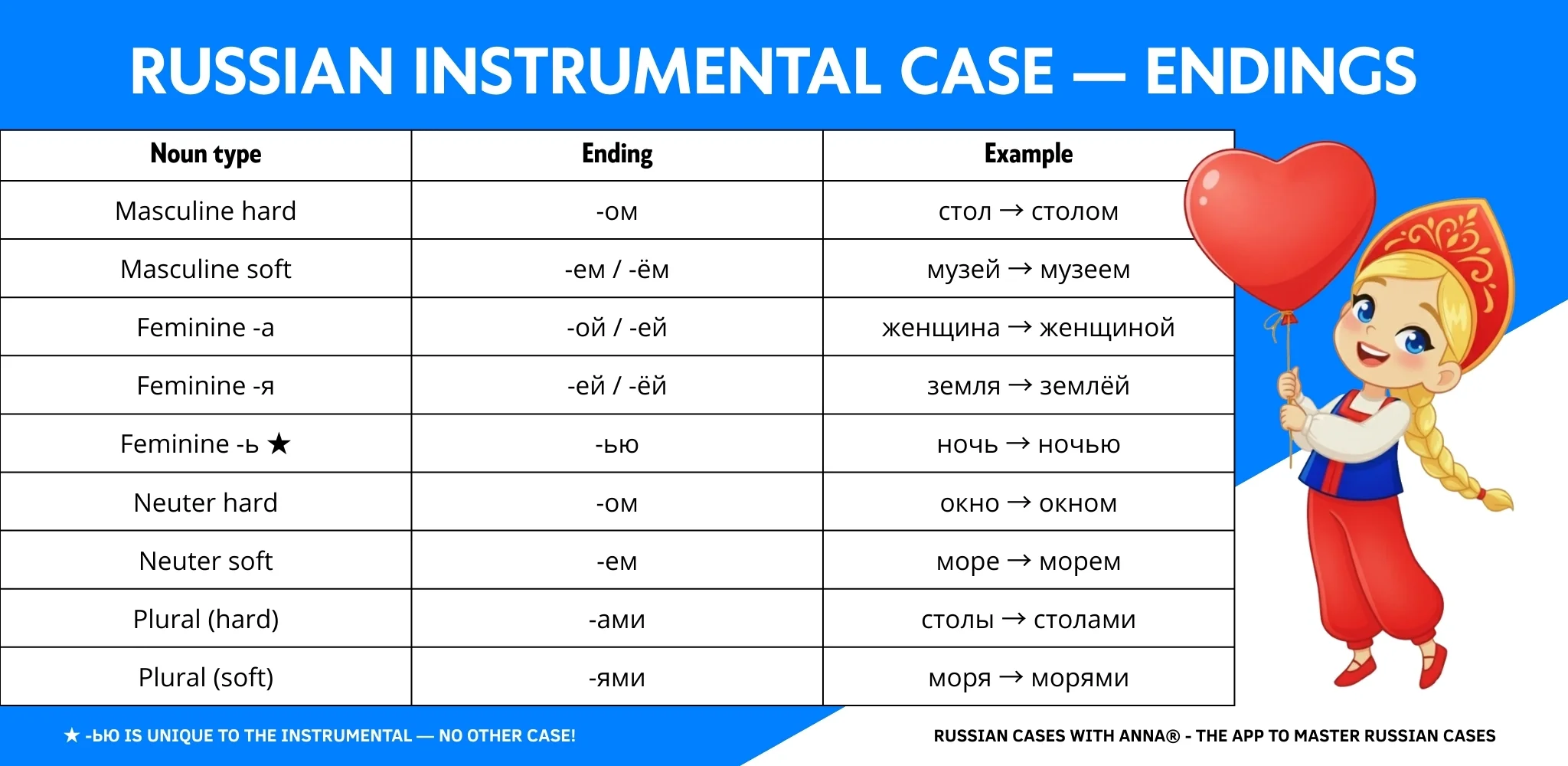
Here is the complete table of instrumental endings for Russian nouns.
The patterns are consistent, and the plural is the same for all genders (-ами/-ями).
| Noun type | Ending | Formation | Result | Example in context |
|---|---|---|---|---|
| Masc. hard (consonant) | -ом | стол → стол+ом | столом | Он пишет карандашом. — He writes with a pencil. |
| Masc. soft (-й) | -ем | музей → музе+ем | музеем | перед музеем — in front of the museum |
| Masc. soft (-ь) | -ем | словарь → словар+ём | словарём | Он машет словарём. — He waves the dictionary. |
| Masc. after ж/ш/щ/ч/ц | -ем (unstressed) | врач → врач+ом | врачом | Он работает врачом. — He works as a doctor. |
| Fem. hard (-а) | -ой / -ею | женщина → женщин+ой | женщиной | с красивой женщиной — with a beautiful woman |
| Fem. soft (-я) | -ей / -ею | земля → земл+ёй | землёй | под землёй — under the ground |
| Fem. (-ь) | -ью | ночь → ноч+ью | ночью | ночью — at night / by night |
| Neuter hard (-о) | -ом | окно → окн+ом | окном | за окном — outside the window |
| Neuter soft (-е) | -ем | море → мор+ем | морем | за морем — overseas / beyond the sea |
| Plural (hard) | -ами | столы → стол+ами | столами | между столами — between the tables |
| Plural (soft) | -ями | моря → мор+ями | морями | над морями — above the seas |
- Masculine & Neuter (hard stem) — -ОМ: стол→столом, окно→окном
- Masculine & Neuter (soft stem) — -ЕМ/-ЁМ: музей→музеем, море→морем
- Feminine -а — -ОЙ: женщина→женщиной
- Feminine -я — -ЕЙ: земля→землёй
- Feminine -ь — -ЬЮ: ночь→ночью (unique to instrumental!)
- Plural (hard stem) — -АМИ: столы→столами
- Plural (soft stem) — -ЯМИ: моря→морями
Russian Instrumental Case Endings — Adjectives
Adjectives agree with their noun in gender, number, and case.
In the instrumental, the endings are distinctive and consistent:
| Gender/Number | Ending | Adj. form | Full phrase | Meaning |
|---|---|---|---|---|
| Masc./Neuter hard | -ым | новый → новым | новым другом | with a new friend |
| Masc./Neuter soft | -им | синий → синим | синим морем | with the blue sea |
| Feminine hard | -ой / -ою | красивая → красивой | с красивой девушкой | with a beautiful girl |
| Feminine soft | -ей | летняя → летней | летней ночью | on a summer night |
| Plural all genders | -ыми / -ими | новые → новыми | новыми словами | with new words |
- Full phrase example: Я горжусь умным сыном — I am proud of my intelligent son. (умным = masc. instr. adj.; сыном = masc. instr. noun)
Professions and Roles with the Instrumental
One of the most distinctive uses of the Russian instrumental case is to express a person's profession, role, or status — especially after the verbs быть (to be), стать (to become), работать (to work as), and назначить (to appoint).
In English we say "He is a doctor". In Russian, the predicate noun goes into the instrumental: Он был врачом (He was a doctor — instrumental required).
Present vs. past/future tense rule
- Present with omitted быть: nominative is common (Он — врач. / Она — учитель.)
- Past (был/была): instrumental is required (Он был врачом. / Она была учителем.)
- Future (будет): instrumental is required (Он будет врачом.)
- After стать: always instrumental (Она стала врачом.)
- After работать: always instrumental (Он работает врачом.)
| Profession (nominative) | Russian sentence | Translation | Grammar note |
|---|---|---|---|
| врач (doctor) | Он работает врачом. | He works as a doctor. | Masc. → -ом |
| учитель (teacher) | Она работает учительницей. | She works as a teacher. | Fem. profession → -ей |
| инженер (engineer) | Мой брат — инженером. | My brother is an engineer. | Predicate with быть → instrumental |
| переводчик (translator) | Она стала переводчиком. | She became a translator. | Стать + instrumental |
| президент (president) | Он был президентом. | He was president. | Быть in past + instrumental |
| директор (director) | Её назначили директором. | She was appointed director. | Назначить + instrumental |
С + Instrumental: How to Say "With" in Russian
The preposition с (with) followed by the instrumental case is one of the most common constructions in Russian.
It expresses accompaniment — doing something together with someone or something.
Examples
Я иду с другом. — I am going with a friend. | Выпей чай с лимоном. — Drink tea with lemon. | Мы живём с родителями. — We live with our parents.
Кофе с молоком. — Coffee with milk. | Бутерброд с сыром. — A sandwich with cheese.
С vs. СО — when to use which
- С is the standard form: с другом, с мамой, с молоком
- СО is used before consonant clusters (especially starting with с/з/ш): со мной, со временем, со вкусом
- Also: со мной (инстр.) vs. с тобой (инстр.) vs. с ним/с ней/с ними (Н- rule with prepositions)
- The с + instrumental "ingredients" pattern: Russian uses с + instrumental to describe food and drinks: суп с грибами — mushroom soup | пицца с сыром — cheese pizza | чай с лимоном и мёдом — tea with lemon and honey
Russian Instrumental Prepositions — Complete Reference
Eight major Russian prepositions require the instrumental case. Most express spatial position — where something is located in relation to something else.
⚠️ Dual-case prepositions: За, под, перед, над can take either instrumental OR accusative. Instrumental = static position (where something IS): за столом, под столом. Accusative = motion toward (where something is GOING): сесть за стол, положить под стол. Memory trick: Instrumental = I'm already THERE. Accusative = I'm going THERE.
| Prep. | Meaning | With a noun | Full example + translation |
|---|---|---|---|
| с | with / together with | с другом, с молоком | Я иду с другом. — I am going with a friend. |
| со | with (before clusters) | со мной, со временем | Иди со мной! — Come with me! |
| за | behind / at (position) | за столом, за дверью | Он сидит за столом. — He is sitting at the table. |
| перед | in front of / before | перед домом, перед сном | Стой перед домом. — Stand in front of the house. |
| над | above / over | над городом, над столом | Самолёт летит над городом. — The plane flies above the city. |
| под | under (position) | под столом, под землёй | Кот под столом. — The cat is under the table. |
| между | between | между домами, между нами | Это между нами. — This is between us. |
| рядом с | next to / beside | рядом с домом | Кафе рядом с метро. — The café is next to the metro. |
Time Expressions with the Instrumental
Russian uses the instrumental case for many time adverbs — particularly for parts of the day and seasons. These are extremely common in everyday speech and worth memorizing as fixed forms.
They are technically instrumental forms of nouns: утро → утром (morning → in the morning), вечер → вечером, ночь → ночью (note the -ЬЮ ending!), лето → летом, зима → зимой, осень → осенью.
| Russian expressions | Example sentence + translation |
|---|---|
| утром, вечером, ночью | Утром я пью кофе. — In the morning I drink coffee. |
| весной, летом, осенью, зимой | Летом жарко. — In summer it is hot. |
| днём, ночью | Он работает ночью. — He works at night. |
| годом раньше / позже | Годом раньше он уехал. — A year earlier he left. |
- Fixed forms to memorize: утром, днём, вечером, ночью | весной, летом, осенью, зимой
15 Key Verbs That Require the Instrumental Case
A significant group of Russian verbs take their object in the instrumental, not the accusative.
These are mostly reflexive verbs (-ся ending) that express engagement, passion, or attitude toward something:
| Verb | Example | Translation | Note |
|---|---|---|---|
| заниматься | Я занимаюсь русским языком. | I study Russian. | Reflexive verb of engagement |
| интересоваться | Она интересуется историей. | She is interested in history. | Object of interest |
| гордиться | Мы гордимся тобой. | We are proud of you. | Object of pride |
| восхищаться | Он восхищается закатом. | He admires the sunset. | Object of admiration |
| увлекаться | Он увлекается музыкой. | He is into music. | Passion / hobby |
| пользоваться | Я пользуюсь словарём. | I use a dictionary. | Tool or resource used |
| владеть | Она владеет тремя языками. | She speaks three languages. | Mastery / possession |
| управлять | Он управляет машиной. | He drives a car. | Control of a vehicle |
| являться | Москва является столицей. | Moscow is the capital. | Formal = быть |
| служить | Это служит примером. | This serves as an example. | Role / function |
| стать | Она стала врачом. | She became a doctor. | Change of state → profession |
| быть | Он был студентом. | He was a student. | Past/future "to be" |
| называть | Все называют его гением. | Everyone calls him a genius. | Naming / labeling |
| считать | Я считаю его другом. | I consider him a friend. | Opinion / judgment |
| махать | Она машет рукой. | She waves her hand. | Body part used in action |
30 Real Russian Instrumental Case Examples
Below are 30 authentic sentences demonstrating every major use of the instrumental. 1–5: Instrument/tool | 6–10: Professions | 11–14: С + accompaniment | 15–20: Spatial prepositions | 21–23: Time expressions | 24–30: Verbs taking instrumental.
| # | Russian sentence | Transliteration | Translation & notes |
|---|---|---|---|
| 1 | Он пишет ручкой. | On pishet ruchkoy. | He writes with a pen. (ручка → ручкой) |
| 2 | Я режу хлеб ножом. | Ya rezhu khleb nozhom. | I cut bread with a knife. |
| 3 | Мы едем поездом. | My yedyom poyezdom. | We travel by train. |
| 4 | Она рисует карандашом. | Ona risuyet karandashom. | She draws with a pencil. |
| 5 | Открой дверь ключом. | Otkroy dver klyuchom. | Open the door with the key. |
| 6 | Он работает врачом. | On rabotayet vrachom. | He works as a doctor. |
| 7 | Она стала учительницей. | Ona stala uchitelnitsyey. | She became a teacher. |
| 8 | Мой отец был инженером. | Moy otets byl inzhenyerom. | My father was an engineer. |
| 9 | Его назначили директором. | Yego naznachili direktorom. | He was appointed director. |
| 10 | Я хочу стать космонавтом. | Ya khochu stat kosmonavtom. | I want to become an astronaut. |
| 11 | Я иду с другом. | Ya idu s drugom. | I am going with a friend. |
| 12 | Он пришёл с женой. | On prishol s zhonoy. | He came with his wife. |
| 13 | Выпей кофе с молоком. | Vypey kofe s molokom. | Have coffee with milk. |
| 14 | Мы живём с родителями. | My zhivyom s roditelyami. | We live with our parents. |
| 15 | Книга лежит под лампой. | Kniga lezhit pod lampoy. | The book is under the lamp. (под + instr.) |
| 16 | Они сидят за столом. | Oni sidyat za stolom. | They are sitting at the table. |
| 17 | Самолёт летит над облаками. | Samolyot letit nad oblakami. | The plane flies above the clouds. |
| 18 | Дом стоит перед лесом. | Dom stoit pered lesom. | The house stands before the forest. |
| 19 | Мы договорились между собой. | My dogovorilis mezhdu soboy. | We agreed among ourselves. |
| 20 | Кафе рядом с банком. | Kafe ryadom s bankom. | The café is next to the bank. |
| 21 | Утром я бегаю в парке. | Utrom ya begayu v parke. | In the morning I jog in the park. |
| 22 | Летом мы ездим на море. | Letom my yezdim na more. | In summer we go to the sea. |
| 23 | Ночью город красив. | Nochyu gorod krasiv. | At night the city is beautiful. |
| 24 | Я занимаюсь спортом. | Ya zanimayus sportom. | I do sports. |
| 25 | Она гордится сыном. | Ona gorditsya synom. | She is proud of her son. |
| 26 | Мы восхищаемся закатом. | My voskhishchaemsa zakatom. | We admire the sunset. |
| 27 | Он увлекается музыкой. | On uvlekayetsya muzykoy. | He is passionate about music. |
| 28 | Пахнет свежей травой. | Pakhnet svezhey travoy. | It smells of fresh grass. |
| 29 | Она машет рукой на прощание. | Ona mashet rukoy na proshchaniye. | She waves her hand in farewell. |
| 30 | Он стал известным писателем. | On stal izvestnym pisatelem. | He became a famous writer. |
Top 5 Instrumental Case Mistakes (And How to Fix Them)
- Using nominative for profession after был/стала — Она была учитель ✗ → Она была учителем ✓ (past быть requires instrumental)
- Forgetting -ЬЮ for feminine -ь nouns — ночь → ночью ✓ (the -ЬЮ ending is unique)
- Wrong spatial case — Он за стол ✗ → Он за столом ✓ (static position → instrumental)
- Forgetting adjective agreement — горжусь умный сын ✗ → горжусь умным сыном ✓ (both noun and adj. take instrumental)
- Using accusative with заниматься — Я занимаюсь музыку ✗ → Я занимаюсь музыкой ✓ (заниматься always takes instrumental)
Frequently asked questions
- What is the Russian instrumental case used for?
- The Russian instrumental case is used for: the instrument or means by which an action is performed (писать ручкой), accompaniment with с (с другом), profession or role after быть/стать/работать (работать врачом), time expressions (утром, летом, ночью), spatial positions with prepositions за/перед/над/под/между, and with reflexive verbs like заниматься, гордиться, интересоваться.
- How do you say professions in Russian?
- Use the instrumental case of the profession noun after the relevant verb: работать + instrumental (работает врачом), стать + instrumental (стала учителем), быть in past/future + instrumental (был инженером). In the present tense with omitted быть, the nominative is also acceptable: Он — врач.
- How do you use с + instrumental in Russian?
- С + instrumental expresses accompaniment — doing something with someone or describing something that comes with something else. Examples: Я иду с другом, Кофе с молоком, Мы живём с родителями. Before consonant clusters, с becomes со: со мной, со временем.
- What is the difference between instrumental and accusative for position prepositions?
- Prepositions like за, под, перед, над can take either instrumental or accusative. Instrumental = static position (where something is): книга под столом. Accusative = motion toward: положи книгу под стол. Instrumental = I'm already THERE. Accusative = I'm going THERE.
- Noun endings: masc./neuter -ОМ/-ЕМ | fem. -ОЙ/-ЕЙ | fem. -ь → -ЬЮ | plural -АМИ/-ЯМИ
- С + instrumental = "with someone/something"
- Professions/roles after работать, стать, быть (past/future) → always instrumental
- Time: утром, вечером, ночью, летом, зимой, осенью
- Position prepositions: за/перед/над/под/между + instrumental (static)
- Verbs: заниматься, гордиться, интересоваться, восхищаться + instrumental
Continue with the rest of our Russian grammar series: