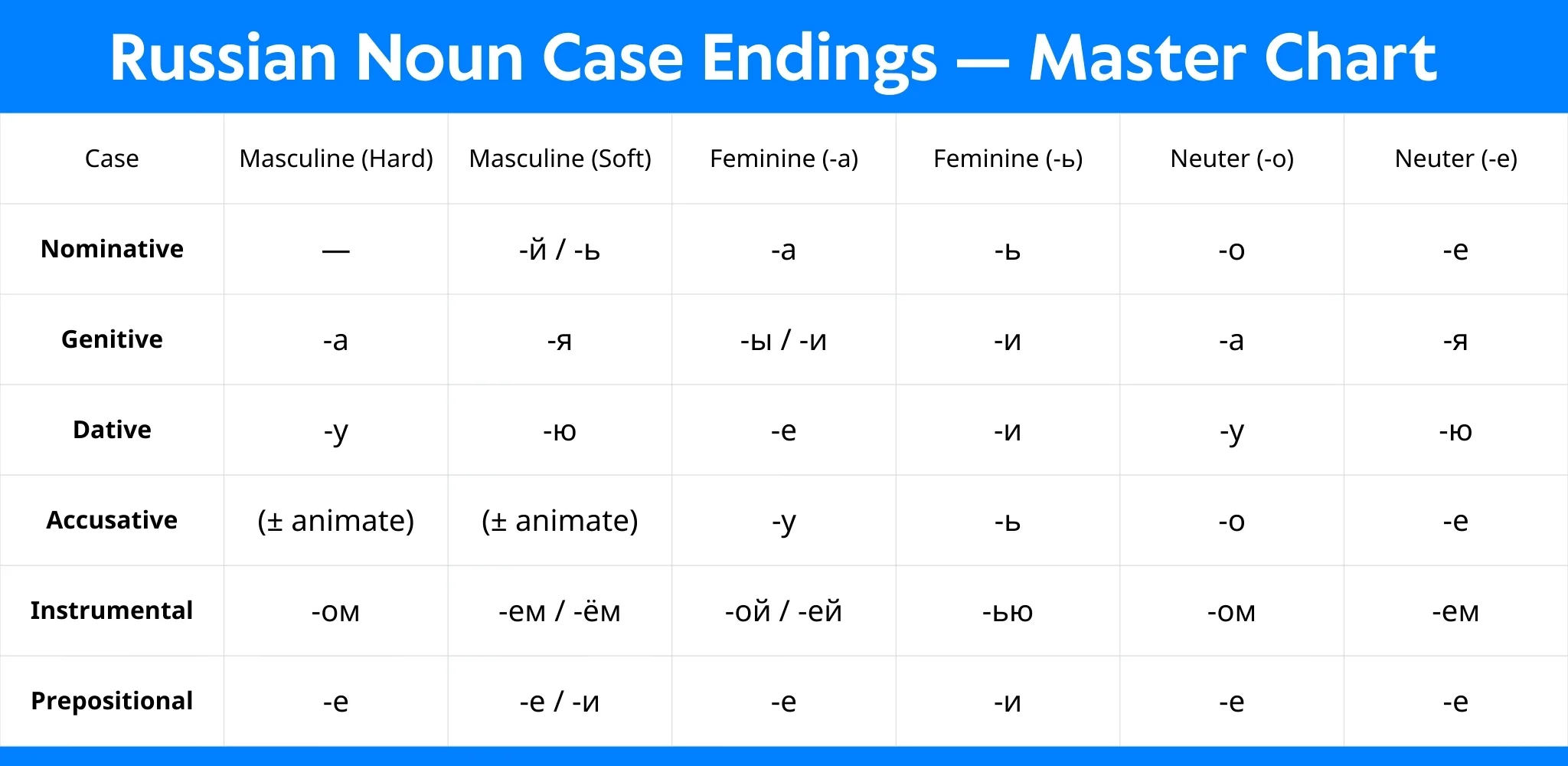
Russian Case Endings: The Ultimate Cheat Sheet
Mastering Russian case endings is the backbone of Russian grammar. Whether you are a complete beginner trying to understand what cases are, or an intermediate learner who keeps mixing up endings, this cheat sheet gives you every declension table you need in one place.
Bookmark this page. Print it out. Screenshot it. This is the Russian declension chart resource you will come back to again and again.

- Complete Russian noun declension table (all genders, singular & plural)
- Russian adjective declension chart (hard & soft stems)
- Personal pronoun declension (я, ты, он, она, мы, вы, они)
- Possessive pronoun declension (мой, наш — and how to derive the others)
- Demonstrative pronouns (этот / тот)
- Preposition → case reference table
- Key spelling rules that affect endings
Part 1: Russian Noun Case Endings — Complete Chart
The table below shows the Russian noun endings for all 6 cases, all genders (masculine, feminine, neuter), both singular and plural.
Hard stems (most common) and soft stems are shown separately.
How to read this table
M. Hard = Masculine hard stem (стол, брат). M. Soft = Masculine soft stem (музей, гений). F. Hard = Feminine in -а (женщина, книга). F. Soft = Feminine in -я (неделя, земля). F. (-ь) = Feminine soft sign (ночь, дочь).
N. (-о) = Neuter hard (окно, слово). N. (-е) = Neuter soft (море, поле).
| Case | M. Hard | M. Soft | F. Hard (-а) | F. Soft (-я) | F. (-ь) | N. (-о) | N. (-е) |
|---|---|---|---|---|---|---|---|
| SINGULAR | |||||||
| Nominative | -Ø | -й / -ь | -а | -я | -ь | -о | -е |
| Genitive | -а | -я | -ы / -и | -и | -и | -а | -я |
| Dative | -у | -ю | -е / -и | -е / -и | -и | -у | -ю |
| Accusative (inanim.) | = Nom. | = Nom. | -у | -ю | -ь | = Nom. | = Nom. |
| Accusative (anim.) | = Gen. | = Gen. | -у | -ю | -ь | = Nom. | = Nom. |
| Instrumental | -ом | -ем / -ём | -ой / -ей | -ей | -ью | -ом | -ем |
| Prepositional | -е | -е / -и | -е / -и | -е / -и | -и | -е | -е |
| PLURAL | |||||||
| Nominative | -ы / -и | -и | -ы / -и | -и | -и | -а / -я | -я |
| Genitive | -ов / -ев | -ев / -ей | -Ø / -ей | -ей | -ей | -Ø / -ей | -ей |
| Dative | -ам | -ям | -ам | -ям | -ям | -ам | -ям |
| Accusative | = Nom./Gen. | = Nom./Gen. | = Nom./Gen. | = Nom./Gen. | = Nom./Gen. | = Nom./Gen. | = Nom./Gen. |
| Instrumental | -ами | -ями | -ами | -ями | -ями | -ами | -ями |
| Prepositional | -ах | -ях | -ах | -ях | -ях | -ах | -ях |
- Accusative animate (masc.): animate masculine nouns take the genitive form in the accusative. Inanimate masculine nouns stay identical to the nominative.
- Accusative plural: inanimate plurals = nominative plural; animate plurals = genitive plural.
- Genitive plural zero ending: many feminine -а nouns have a zero ending in genitive plural (женщина → женщин). This is one of the trickiest areas of Russian declension.
- 8-letter spelling rule: after г, к, х, ж, ш, щ, ч, ц — write И not Ы (e.g., книги not книгы).
- 7-letter spelling rule: after ж, ш, щ, ч, ц — write А not Я, У not Ю in stressed positions.
Part 2: Russian Adjective Declension Chart
Russian adjectives must agree with the noun they modify in gender, number, and case.
Below is the full Russian adjective declension chart for hard-stem and soft-stem adjectives.
Hard vs. Soft adjective stems
Adjectives fall into two groups based on their stem:
- Hard stem (красный, новый, старый) — Nominative M: -ый/-ой | Endings use Ы, О, У
- Soft stem (синий, последний, летний) — Nominative M: -ий | Endings use И, Е, Ю
| Case | M. Hard | M. Soft | Fem. Hard | Fem. Soft | Neuter | Plural |
|---|---|---|---|---|---|---|
| Nominative | -ый/-ой | -ий | -ая | -яя | -ое | -ые/-ие |
| Genitive | -ого | -его | -ой | -ей | -ого | -ых/-их |
| Dative | -ому | -ему | -ой | -ей | -ому | -ым/-им |
| Acc. (inan.) | = Nom. | = Nom. | -ую | -юю | = Nom. | = Nom. |
| Acc. (anim.) | = Gen. | = Gen. | -ую | -юю | = Nom. | = Gen. |
| Instrumental | -ым | -им | -ой/-ей | -ей | -ым | -ыми/-ими |
| Prepositional | -ом | -ем | -ой/-ей | -ей | -ом | -ых/-их |
- Hard adjective example — новый (new): новый / нового / новому / новый(ого) / новым / новом
- Soft adjective example — синий (blue): синий / синего / синему / синий(его) / синим / синем
- Stress-shifted adjectives (like молодой): nominative ends in -ой instead of -ый, but all other endings follow the hard pattern identically.
- Adjective-noun agreement: the adjective ALWAYS matches its noun. красная книга (gen: красной книги) — every word in the phrase declines together.
- Short-form adjectives: Russian also has short-form adjectives (краток, красив) used predicatively (after быть). These do not decline by case.
Part 3: Russian Personal Pronoun Declension
Personal pronouns change dramatically across Russian cases — far more than nouns or adjectives. These must be memorized individually.
The table below gives the full declension for all Russian personal pronouns.
| Case | я (I) | ты (you) | он/оно (he/it) | она (she) | мы (we) | вы (you pl.) | они (they) |
|---|---|---|---|---|---|---|---|
| Nominative | я | ты | он/оно | она | мы | вы | они |
| Genitive | меня | тебя | его | её | нас | вас | их |
| Dative | мне | тебе | ему | ей | нам | вам | им |
| Accusative | меня | тебя | его | её | нас | вас | их |
| Instrumental | мной | тобой | им | ей | нами | вами | ими |
| Prepositional | мне | тебе | нём | ней | нас | вас | них |
- Н- prefix rule: when a third-person pronoun (он, она, оно, они) follows a preposition, an Н- is added: у него (not у его), к ней (not к ей), с ними (not с ими).
- Genitive = Accusative for personal pronouns: меня, тебя, его, её, нас, вас, их are identical for both cases.
- Prepositional forms: after о/об — обо мне, о тебе, о нём, о ней, о нас, о вас, о них.
Part 4: Russian Possessive Pronoun Declension (мой, наш)
Possessive pronouns in Russian also decline for case, gender, and number. The table below covers мой (my) and наш (our) — the two most irregular and important sets.
The others follow similar patterns: твой (your, informal) — declines exactly like мой. ваш (your, formal/plural) — declines exactly like наш. его / её / их (his / her / their) — these do NOT decline! They remain unchanged in all cases.
| Case | Masc. | Neuter | Fem. | Plural |
|---|---|---|---|---|
| МОЙ — my | ||||
| Nominative | мой | моё | моя | мои |
| Genitive | моего | моего | моей | моих |
| Dative | моему | моему | моей | моим |
| Acc. (inan.) | мой | моё | мою | мои |
| Acc. (anim.) | моего | моё | мою | моих |
| Instrumental | моим | моим | моей | моими |
| Prepositional | моём | моём | моей | моих |
| НАШ — our | ||||
| Nominative | наш | наше | наша | наши |
| Genitive | нашего | нашего | нашей | наших |
| Dative | нашему | нашему | нашей | нашим |
| Acc. (inan.) | наш | наше | нашу | наши |
| Acc. (anim.) | нашего | наше | нашу | наших |
| Instrumental | нашим | нашим | нашей | нашими |
| Prepositional | нашем | нашем | нашей | наших |
Part 5: Demonstrative Pronoun Declension (этот / тот)
Этот (this) and тот (that) are demonstrative pronouns that also function as determiners.
They decline for case, gender, and number and are extremely common in spoken Russian.
| Case | этот (M) | это (N) | эта (F) | эти (Pl) | тот (M) / та (F) | те (Pl) |
|---|---|---|---|---|---|---|
| Nominative | этот | это | эта | эти | тот / та | те |
| Genitive | этого | этого | этой | этих | того / той | тех |
| Dative | этому | этому | этой | этим | тому / той | тем |
| Acc. (inan.) | этот | это | эту | эти | тот / ту | те |
| Acc. (anim.) | этого | это | эту | этих | того / ту | тех |
| Instrumental | этим | этим | этой | этими | тем / той | теми |
| Prepositional | этом | этом | этой | этих | том / той | тех |
Part 6: Russian Prepositions → Case Quick-Reference
This table maps every major Russian preposition to the case it requires.
Learning prepositions together with their case is essential — it eliminates one of the biggest sources of error for Russian learners.
Important: В and НА are dual-case prepositions
в / на + Accusative = DIRECTION (motion toward a place). в / на + Prepositional = LOCATION (being in/at a place).
Example: Я иду в школу. (going → accusative) vs. Я в школе. (being there → prepositional).
| Case | Prepositions | Examples |
|---|---|---|
| Genitive | без, до, из, у, от, после, для, кроме, вокруг, вместо, мимо | из России, без воды, после урока |
| Dative | к, по, благодаря, вопреки, согласно, навстречу | к другу, по улице, благодаря тебе |
| Accusative | в, на (direction), за, через, под (motion), про, о (hit/bump) | в школу, на работу, через час |
| Instrumental | с, за (position), над, под (position), перед, между, рядом с | с другом, над столом, перед домом |
| Prepositional | в, на (location), о/об, при, по (after certain verbs) | в Москве, о работе, при советах |
Part 7: The 7 Spelling Rules That Affect Case Endings
Russian spelling rules can override the expected case ending.
Every Russian learner needs to know these rules — they explain why certain nouns and adjectives do not follow the standard pattern.
Rule 1: The 8-Letter Rule (Spelling Rule К, Г, Х, Ж, Ш, Щ, Ч, Ц)
After г, к, х, ж, ш, щ, ч, ц — always write И instead of Ы. книга → книги (not книгы), ручка → ручки (not ручкы).
This affects nominative plural, genitive singular of feminine nouns, and adjective endings.
Rule 2: The 7-Letter Rule (Ж, Ш, Щ, Ч, Ц — Stressed Vowels)
After ж, ш, щ, ч, ц — write А not Я, У not Ю (in stressed syllables); write Е not О in unstressed syllables.
Instrumental singular feminine: большой → большой (stressed -ой is fine), but тушь → тушью. This rule interacts with the instrumental endings -ом/-ем for neuter nouns.
Rule 3: Fleeting Vowels
Some nouns lose a vowel (о or е) when declined — this is called a fleeting vowel (беглая гласная).
отец → отца (the е disappears). день → дня (the е disappears). лёд → льда (the е/ё disappears).
Rule 4: Ь (Soft Sign) Behavior
Feminine nouns ending in -ь do not drop the soft sign before case endings — instead, it merges into the ending.
ночь → ночи (genitive/dative/prepositional), ночью (instrumental). The -ью in the instrumental is characteristic of these nouns.
Rule 5: The Prepositional -У Ending (Locative Remnant)
A small group of masculine nouns use an irregular -у/-ю ending in the prepositional when expressing location (not topic). в лесу (in the forest) — not в лесе. в году (in the year). на берегу (on the shore). на полу (on the floor).
This only applies with в/на + location. О + these nouns uses the regular -е: о лесе (about the forest).
How to Use This Cheat Sheet Effectively
Step 1 — Start with Nouns
The noun declension table is the foundation. Master it first. Focus on the most common patterns: masculine hard stem (-стол), feminine hard stem (-книга), and neuter hard stem (-окно).
These cover the majority of Russian nouns.
Step 2 — Learn Adjectives Next
Once you know noun endings, adjective endings become much easier — they follow a similar logic.
Focus on hard-stem adjectives (новый) first, then add soft-stem (синий).
Step 3 — Memorize Pronouns Separately
Pronoun forms are irregular and must be memorized individually. They do not follow the noun or adjective patterns.
Use flashcards or a spaced repetition app to drill pronoun declensions.
Step 4 — Prepositions Lock In the Cases
Prepositions are the fastest shortcut for correct case usage: if you know that без always takes the genitive and к always takes the dative, you have already locked in the case.
Make the preposition → case pairings your top priority.
Step 5 — Practice with Real Sentences
Tables alone are not enough. After drilling the endings, practice them in real Russian sentences.
Read texts, listen to audio, and pay attention to how native speakers use declined forms in context.
Frequently asked questions
- What is the hardest Russian case ending to learn?
- The genitive plural is widely considered the most difficult because it has multiple competing forms depending on the noun class. For example, feminine nouns in -а have a zero ending (женщина → женщин), while others add -ей (ночь → ночей) or -ов/-ев (for certain masculine nouns).
- Do Russian adjectives always match the noun?
- Yes, always. A Russian adjective must agree with its noun in gender, number, and case. If the noun changes its ending, the adjective must change too. This is called grammatical agreement and is non-negotiable in Russian.
- Are there Russian nouns that do not decline at all?
- Yes. A small set of borrowed foreign words (несклоняемые существительные) never change: кофе (coffee), метро (metro), пальто (coat), такси (taxi), кино (cinema). These are an exception to the Russian case system.
- How do I know if a noun is animate or inanimate?
- Animate nouns are people and animals (человек, кот, студент, врач). Inanimate nouns are objects, concepts, and abstractions (стол, книга, любовь, время). Russian grammar considers some things as animate that English speakers would not expect — e.g. some card game and chess pieces.
- What is the difference between the genitive and accusative for animate nouns?
- For animate masculine nouns, the accusative form is identical to the genitive. This is the famous animate accusative = genitive rule. Example: студент → студента (gen.) = студента (acc.). The only way to tell which case it is is by the sentence structure.
This Russian case endings cheat sheet covers everything you need: all 6 cases for nouns (all genders, singular and plural), adjectives (hard and soft stems), personal pronouns, possessive pronouns, demonstrative pronouns, and preposition-case pairings.
Keep this reference close as you study. The more you use it alongside real Russian practice, the sooner these endings will move from conscious memory to automatic recognition.
For a complete explanation of what each case means and how to use it, explore our full guides: