Mastering the Russian Dative Case (Дательный падеж)
To truly master the **Dative Case** (Дательный падеж), you need to look beyond just "giving." In Russian, the Dative is the case of **feelings, age, and necessity.**
Mastering the Russian Dative Case (Дательный падеж)
The Dative case primarily answers the questions Кому? (To whom?) and Чему? (To what?). While it often marks the indirect object, it is also essential for expressing impersonal states and age.
To form the Dative, you usually modify the ending of the Nominative (dictionary) form.
| Gender | Nominative Ending | Dative Singular | Example |
|---|---|---|---|
| Masculine | Consonant / -й / -ь | -у / -ю | брат → брату / чай → чаю |
| Feminine | -а / -я | -е | сестра → сестре |
| Feminine (Special) | -ия / -ь | -и | Россия → России / ночь → ночи |
| Neuter | -о / -е | -у / -ю | письмо → письму |
| Plural (All) | (Various) | -ам / -ям | друзья → друзьям / книги → книгам |
Personal Pronouns (The "Feelings" Case)
Unlike English, Russian uses the Dative for many everyday expressions. You don't "have" an age or a feeling; they "happen" to you.
- Мне (To me)
- Тебе (To you - informal)
- Ему / Ей (To him / To her)
- Нам (To us)
- Вам (To you - formal/plural)
- Им (To them)
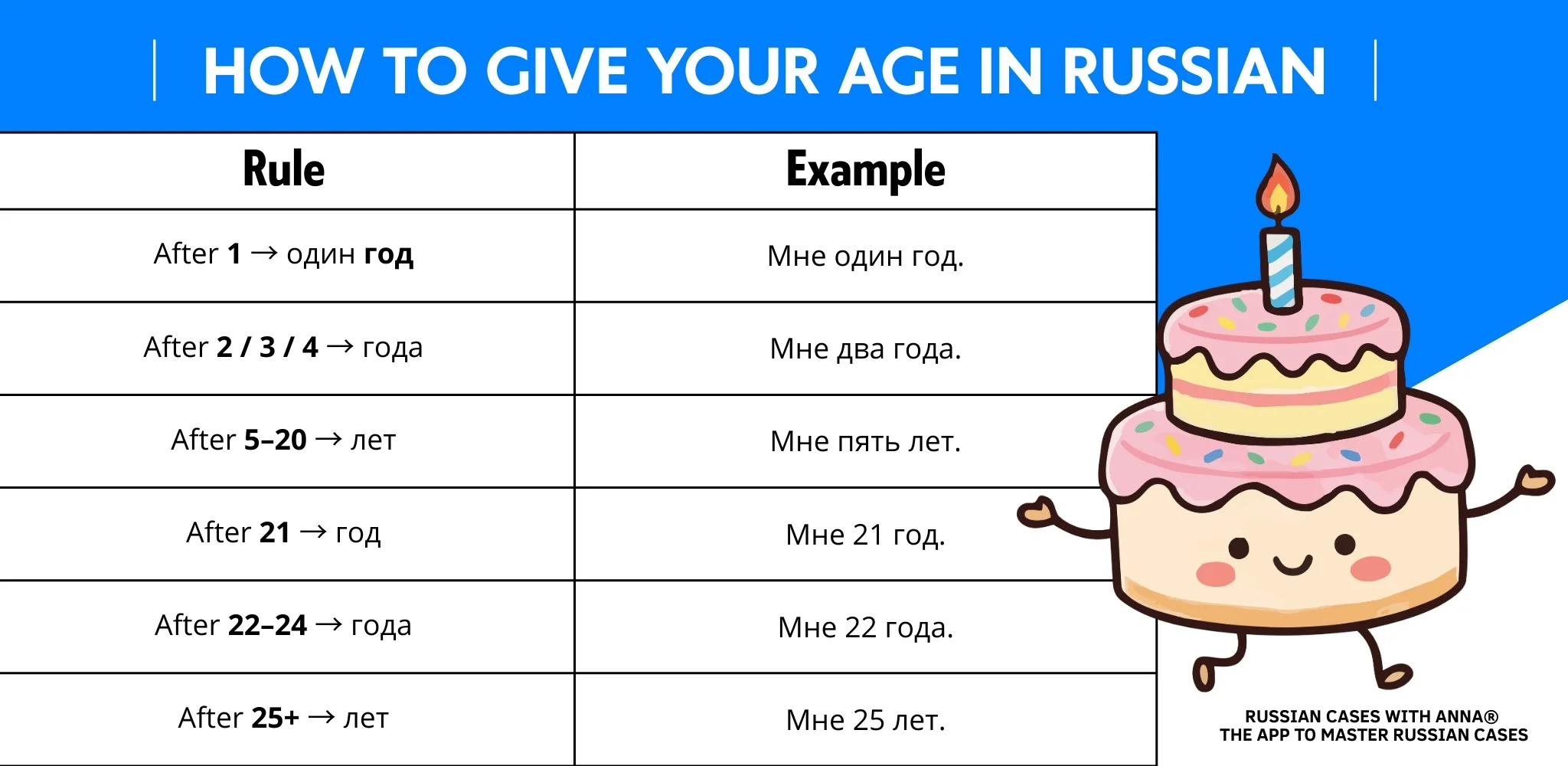
Example (Age): Мне двадцать лет. (I am 20 years old — *lit. "To me are 20 years"*).
Adjective Declension
If you are giving something to a "kind friend," the adjective must agree with the Dative noun.
- Masculine/Neuter: Ends in -ому / -ему. *Ex: новому другу* (to the new friend).
- Feminine: Ends in -ой / -ей. *Ex: хорошей подруге* (to the good friend).
- Plural: Ends in -ым / -им. *Ex: старым людям* (to old people).
Advanced Usage & Impersonal Constructions
This is where the Dative gets interesting. It is used for impersonal states where there is no active "subject" doing an action.
A. Physical & Emotional States
If you feel cold, bored, or happy, the person feeling it goes in the Dative.
- Мне холодно. (I am cold).
- Тебе скучно? (Are you bored?).
- Ей весело. (She is having fun).
B. Necessity (Нужно / Надо)
When you need to do something, use the Dative.
- Нам нужно идти. (We need to go).
- Ивану надо работать. (Ivan has to work).
C. The Verb "To Like" (Нравиться)
In Russian, you don't "like" things; things "are pleasing to you."
- Мне нравится этот город. (I like this city — *lit. "To me is pleasing this city"*).
Prepositions: K and ПО
The Dative is used with these key prepositions:
- К (Toward/To): Used when moving toward a person or a specific destination. *Я иду к врачу* (I am going to the doctor).
- ПО (Along/By/According to): Movement: Гулять по парку (To walk through/around the park). Communication: Говорить по телефону (To talk on the phone). Subject Matter: Урок по математике (Math lesson).
Quick Check: The "Neuter -мя" Exception
Nouns ending in -мя (like *имя* - name, or *время* - time) follow a special pattern:
- Имя → Имени
- Время → Времени
*Example:* Приятно по имени. (It's nice [to call someone] by name).
The Dative case goes far beyond "giving" — it is essential for expressing feelings, age, necessity, and impersonal states in Russian. With regular practice of these endings, pronouns, and preposition combinations, you will quickly improve your Russian grammar.
If you want to practice all six cases with interactive exercises, the app Russian Cases with Anna may help.