
Russian Accusative Case: Direct Objects, Animate vs. Inanimate & Motion Verbs
The Russian accusative case is the second most important case to master after the genitive — and in many ways, it is the most intuitive. It marks the direct object of a sentence: the person or thing that is directly affected by the verb's action.
But the accusative has a twist that catches every Russian learner off-guard: the animate vs. inanimate distinction. For masculine nouns, animate and inanimate objects decline differently in the accusative — and understanding this rule is essential for speaking Russian correctly.

- What the Russian accusative case is and its 4 core uses
- Accusative case endings for all noun genders (singular & plural)
- The animate vs. inanimate distinction — the #1 source of confusion
- Russian motion verbs and how they use the accusative
- В and НА with the accusative (direction) vs. prepositional (location)
- All 9 prepositions that require the accusative
- Time expressions with the accusative
- 15 must-know verbs that take accusative direct objects
- 30 real Russian examples with transliteration and translation
- Accusative vs. genitive — how to tell them apart
Quick Answer
The accusative case in Russian answers the questions Кого? (Whom?) and Что? (What?). It marks direct objects, expresses direction with в and на, and appears in time expressions.
Its key complexity is the animate vs. inanimate distinction for masculine nouns.
What Is the Russian Accusative Case?
The accusative case (Винительный падеж) is the fourth of the six Russian cases. Its primary job is to mark the direct object of a transitive verb — the noun that receives the action directly.
In English, we don't change the word based on its role. In Russian, the noun changes its ending to signal that it's the direct object.
The accusative case is used for:
- Direct objects of transitive verbs (Я вижу кота. — I see the cat.)
- Direction with в and на (Я иду в школу. — I am going to school.)
- Time expressions (всю неделю — all week; через час — in an hour)
- Days of the week with в (в понедельник — on Monday)
- After several specific prepositions: за, через, про, под, сквозь, спустя, о
Russian Accusative Case Endings — Complete Table
The accusative endings depend on the noun's gender, its stem (hard or soft), and — crucially for masculine nouns — whether the noun is animate or inanimate.
Here is the full reference table:
| Noun type | Rule | Nominative | Accusative | Example sentence |
|---|---|---|---|---|
| Masc. inanimate (hard) | = Nom. (no change) | стол | стол | Я вижу стол. — I see the table. |
| Masc. inanimate (soft) | = Nom. (no change) | музей | музей | Я вижу музей. — I see the museum. |
| Masc. animate (hard) | = Gen. (-а) | студент | студента | Я вижу студента. — I see the student. |
| Masc. animate (soft) | = Gen. (-я) | гений | гения | Я вижу гения. — I see the genius. |
| Fem. hard (-а) | -у | женщина | женщину | Я вижу женщину. — I see the woman. |
| Fem. soft (-я) | -ю | земля | землю | Я вижу землю. — I see the earth. |
| Fem. (-ь) inanimate | = Nom. (-ь) | ночь | ночь | Я люблю ночь. — I love the night. |
| Fem. (-ь) animate | = Nom. (-ь) | мышь | мышь | Я вижу мышь. — I see the mouse. |
| Neuter (hard -о) | = Nom. (-о) | окно | окно | Я вижу окно. — I see the window. |
| Neuter (soft -е) | = Nom. (-е) | море | море | Я вижу море. — I see the sea. |
| Plural inanimate | = Nom. pl. | столы | столы | Я вижу столы. — I see the tables. |
| Plural animate | = Gen. pl. | студенты | студентов | Я вижу студентов. — I see the students. |
- Feminine -а — -а → -у: книга → книгу
- Feminine -я — -я → -ю: неделя → неделю
- Masculine inanimate — no change (nominative): стол → стол
- Masculine animate — genitive form: студент → студента
- Neuter and feminine -ь — no change (= nominative)
Animate vs. Inanimate: The Most Important Accusative Rule
Animate masculine nouns (people and animals) take the genitive form in the accusative case. Inanimate masculine nouns stay unchanged (nominative form).
This is the defining feature of the Russian accusative — and the #1 source of mistakes.
What Counts as Animate?
In Russian grammar, animate means people and animals — living beings.
However, there are some surprising exceptions:
| Noun | Animate / Inanimate | Accusative form | Note |
|---|---|---|---|
| 🤝 друг (friend) | animate | Я вижу друга. | Accusative = genitive form (друга) |
| 👨⚕️ врач (doctor) | animate | Я слушаю врача. | Accusative = genitive form (врача) |
| 🐱 кот (cat) | animate | Я глажу кота. | Animals are animate (кота) |
| 👶 ребёнок (child) | animate | Мама видит ребёнка. | Accusative = genitive (ребёнка) |
| 🏛️ президент (president) | animate | Я уважаю президента. | People are always animate |
| 🪑 стол (table) | inanimate | Я вижу стол. | Accusative = nominative (no change) |
| 🎬 фильм (film) | inanimate | Я смотрю фильм. | Accusative = nominative (no change) |
| 🏙️ город (city) | inanimate | Я люблю этот город. | Places are inanimate |
| 💀 труп (corpse) | inanimate | Детектив нашёл труп. | Corpses are grammatically inanimate! |
| 🪆 кукла (doll) | inanimate | Девочка любит куклу. | Toys are inanimate (куклу — fem.) |
| 🃏 туз (ace in cards) | animate* | Он поставил туза. | Card game pieces = animate by convention! |
| ♕ ферзь (queen in chess) | animate* | Он взял ферзя. | Chess pieces = animate by convention! |
- Animate (unexpected): playing cards (туз, король, дама), chess pieces (ферзь, конь)
- Inanimate (unexpected): труп (corpse), кукла (doll), снеговик (snowman)
- Inanimate plural — nominative plural: Я вижу столы
- Animate plural — genitive plural: Я вижу студентов
Russian Motion Verbs and the Accusative Case
Verbs of motion use в or на + accusative to indicate where someone or something is going. Russian has a rich system of motion verbs.
All use в/на + accusative for direction:
| Verb | Meaning | Example with В/НА + acc. | Translation |
|---|---|---|---|
| идти / ходить | 🚶 to go (on foot) | Я иду в школу. | I am going to school (right now) |
| ехать / ездить | 🚗 to go (by vehicle) | Мы едем на работу. | We are going to work |
| бежать / бегать | 🏃 to run | Он бежит на стадион. | He is running to the stadium |
| лететь / летать | ✈️ to fly | Самолёт летит в Москву. | The plane is flying to Moscow |
| плыть / плавать | 🏊 to swim / sail | Корабль плывёт в порт. | The ship is sailing into port |
| везти / возить | 🚐 to carry (vehicle) | Он везёт детей в школу. | He is driving the children to school |
| нести / носить | 📦 to carry (on foot) | Она несёт цветы на стол. | She is carrying flowers to the table |
| ползти / ползать | 🐛 to crawl | Ребёнок ползёт на диван. | The child is crawling onto the sofa |
| прийти (perf.) | 🎯 to arrive / come | Приходи на вечеринку! | Come to the party! |
| вернуться (perf.) | ↩️ to return | Он вернулся в город. | He returned to the city |
- Unidirectional (one trip, right now): идти, ехать, лететь — Я иду в школу.
- Multidirectional (habitual, back-and-forth): ходить, ездить, летать — Я хожу в школу каждый день.
- Both use в + accusative for direction — the case rule is the same.
В and НА with the Accusative: Direction vs. Location
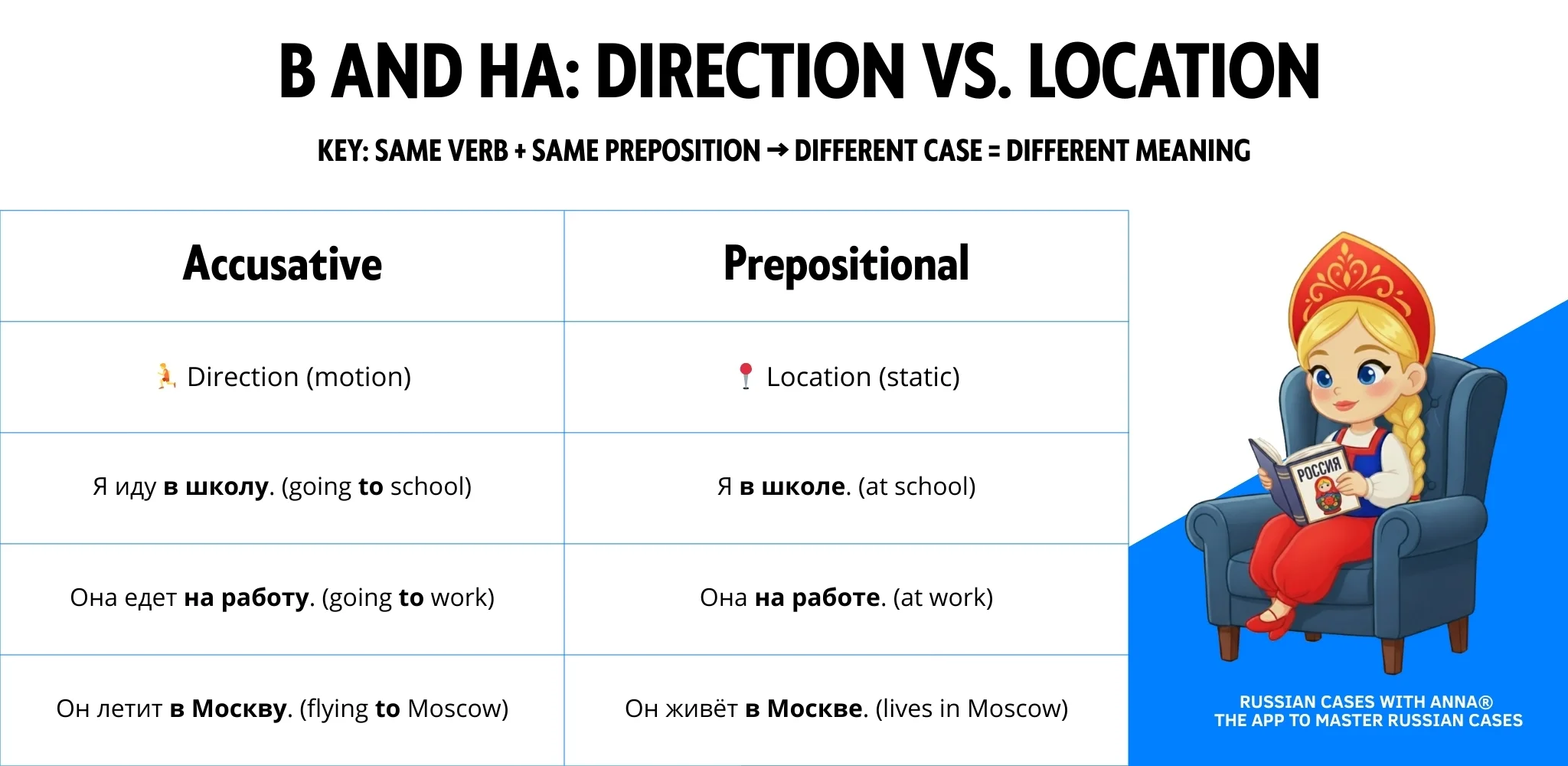
The prepositions в and на are each used with two different cases depending on whether the sentence expresses direction (movement toward) or location (being somewhere).
Study these pairs carefully:
В vs. НА — Which One to Use for Location?
Use В (in/inside) for: enclosed spaces, countries, cities, buildings — в доме, в России, в школе. Use НА (on/at) for: open spaces, events, islands, some institutions — на улице, на концерте, на Кубе, на работе, на почте, на рынке.
Some nouns simply require на by convention — memorize these.
| Construction | Russian example | Meaning | Translation |
|---|---|---|---|
| в + Accusative | Я иду в магазин. | Direction: into / to | I am going to the store. |
| в + Prepositional | Я нахожусь в магазине. | Location: inside / at | I am at the store. |
| на + Accusative | Она едет на работу. | Direction: onto / to | She is going to work. |
| на + Prepositional | Она работает на заводе. | Location: on / at | She works at the factory. |
| в + Accusative | Дети пошли в школу. | Direction: to school | The children went to school. |
| в + Prepositional | Дети учатся в школе. | Location: at school | The children study at school. |
| на + Accusative | Мы летим на Кубу. | Direction: to Cuba | We are flying to Cuba. |
| на + Prepositional | Мы отдыхаем на Кубе. | Location: in Cuba | We are vacationing in Cuba. |
| на + Accusative | Поставь книгу на стол. | Direction: onto table | Put the book on the table. |
| на + Prepositional | Книга лежит на столе. | Location: on table | The book is on the table. |
All Prepositions That Require the Accusative Case
Beyond в and на, several other prepositions require the accusative.
Here is the complete list with nominalized example and full sentence:
| Prep. | Meaning | With a noun | Full example + translation |
|---|---|---|---|
| в | into / to (direction) | в Москву, в школу | Я лечу в Москву. — I am flying to Moscow. |
| на | onto / to (direction) | на работу, на стол | Она идёт на работу. — She is going to work. |
| за | behind / for (motion) | за угол, за хлебом | Он зашёл за угол. — He went around the corner. |
| под | under (motion) | под стол | Кот залез под стол. — The cat crawled under the table. |
| через | across / through / in (time) | через реку, через час | Мы переехали через реку. — We crossed the river. |
| про | about (informal) | про тебя | Он рассказал про тебя. — He talked about you. |
| сквозь | through (penetrating) | сквозь стекло | Свет проходил сквозь стекло. — Light passed through the glass. |
| спустя | after / later (time) | спустя год | Спустя год он вернулся. — A year later he returned. |
| о/об | against (physical contact) | споткнуться о камень | Он споткнулся о камень. — He stumbled over a stone. |
- Dual-case prepositions: В, НА, ЗА, ПОД — accusative = motion/direction; instrumental/prepositional = static position.
- за стол (acc. → sit down AT the table) vs. за столом (instr. → sitting AT the table)
Time Expressions with the Accusative Case
The accusative appears in several important Russian time expressions.
These are fixed patterns to memorize:
| Expression type | Examples | Full sentence + translation |
|---|---|---|
| Duration (весь / целый) | всю неделю, целый день | Я работал всю неделю. — I worked all week. |
| Days of week (в + acc.) | в понедельник, в пятницу | Я иду туда в среду. — I am going there on Wednesday. |
| через (in / after) | через час, через неделю | Приходи через час. — Come in an hour. |
| за (within / in) | за час, за неделю | Я сделал это за час. — I did it in (within) an hour. |
| спустя (after / later) | спустя год | Спустя год он вернулся. — A year later he returned. |
- Days of the week: В понедельник, в среду, в пятницу — all with в take the accusative.
15 Key Verbs That Take the Accusative Direct Object
Any transitive verb in Russian can take an accusative direct object.
Here are the 15 most common with the important exception of ждать (accusative or genitive):
| Verb | Example | Translation | Note |
|---|---|---|---|
| видеть (to see) | Я вижу тебя. | I see you. | Direct visual perception |
| любить (to love/like) | Я люблю музыку. | I love music. | Object of affection |
| знать (to know) | Я знаю этот город. | I know this city. | Known thing/person |
| читать (to read) | Она читает книгу. | She is reading a book. | Object being read |
| слушать (to listen to) | Мы слушаем музыку. | We are listening to music. | Object of listening |
| смотреть (to watch) | Он смотрит фильм. | He is watching a film. | Object of watching |
| купить (to buy) | Я купил машину. | I bought a car. | Object purchased |
| взять (to take) | Возьми зонтик. | Take an umbrella. | Object taken |
| понимать (to understand) | Я понимаю тебя. | I understand you. | Person/thing understood |
| помнить (to remember) | Я помню этот день. | I remember that day. | Thing remembered |
| встречать (to meet) | Я встречаю друга. | I am meeting a friend. | Person met (animate) |
| ждать (to wait for) | Я жду автобус / автобуса. | I am waiting for the bus. | Both acc. and gen. possible! |
| спрашивать (to ask) | Он спрашивает меня. | He is asking me. | Person asked |
| благодарить (to thank) | Я благодарю вас. | I thank you. | Person thanked |
| изучать (to study) | Она изучает русский язык. | She is studying Russian. | Subject studied |
- ЖДАТЬ exception: Я жду автобус (acc.) = I am waiting for the specific bus. Я жду автобуса (gen.) = I am waiting for a bus. Both correct. For animate: Я жду друга (acc. preferred).
30 Real Russian Accusative Case Examples
Below are 30 authentic sentences demonstrating every major use of the accusative. 1–6: Inanimate objects | 7–12: Animate objects | 13–18: Direction | 19–23: Time | 24–30: Other prepositions.
| # | Russian | Transliteration | Translation & notes |
|---|---|---|---|
| 1 | Он читает интересную книгу. | On chitayet interesnuyu knigu. | He is reading an interesting book. (книга → книгу) |
| 2 | Я купила новое платье. | Ya kupila novoye plate. | I bought a new dress. (платье neuter → no change) |
| 3 | Мы смотрим старый фильм. | My smotrim staryy film. | We are watching an old film. (inanimate masc.) |
| 4 | Она пьёт горячий кофе. | Ona pyot goryachiy kofe. | She is drinking hot coffee. (кофе indeclinable) |
| 5 | Я слышу странный звук. | Ya slyshu strannyy zvuk. | I hear a strange sound. (inanimate masc.) |
| 6 | Дети любят мороженое. | Deti lyubyat morozhenoye. | Children love ice cream. (neuter) |
| 7 | Я вижу своего брата. | Ya vizhu svoyego brata. | I see my brother. (брат animate → брата) |
| 8 | Она любит своего кота. | Ona lyubit svoyego kota. | She loves her cat. (кот animate) |
| 9 | Врач осматривает пациента. | Vrach osmotrivayet patsienta. | The doctor is examining the patient. |
| 10 | Мы приглашаем всех друзей. | My priglashaem vsekh druzey. | We are inviting all our friends. (animate pl.) |
| 11 | Я встретил старого учителя. | Ya vstretil starogo uchitelya. | I met my old teacher. |
| 12 | Полиция ищет преступника. | Politsiya ishchet prestupnika. | The police are looking for the criminal. |
| 13 | Я иду в супермаркет. | Ya idu v supermarket. | I am going to the supermarket. (в + acc.) |
| 14 | Дети едут на море. | Deti edut na more. | The children are going to the seaside. (на + acc.) |
| 15 | Он положил ключи на стол. | On polozhil klyuchi na stol. | He put the keys on the table. |
| 16 | Мы летим в Санкт-Петербург. | My letim v Sankt-Peterburg. | We are flying to Saint Petersburg. |
| 17 | Она поехала на конференцию. | Ona poyekhala na konferentsiyu. | She went to the conference. |
| 18 | Кот прыгнул под кровать. | Kot prygnul pod krovat. | The cat jumped under the bed. (под + acc.) |
| 19 | Я работал всю ночь. | Ya rabotal vsyu noch. | I worked all night. (всю = acc.) |
| 20 | Встреча в четверг в три часа. | Vstrecha v chetverg v tri chasa. | Meeting on Thursday at three o'clock. |
| 21 | Он вернётся через месяц. | On vernyotsya cherez mesyats. | He will return in a month. (через + acc.) |
| 22 | Я сделал домашнее задание за час. | Ya sdelal domashneye zadaniye za chas. | I did my homework in an hour. |
| 23 | Они не виделись целый год. | Oni ne videlis tselyy god. | They hadn't seen each other for a whole year. |
| 24 | Он рассказал про свою жизнь. | On rasskazal pro svoyu zhizn. | He talked about his life. (про + acc.) |
| 25 | Мы переплыли через реку. | My pereplyli cherez reku. | We swam across the river. |
| 26 | Он споткнулся о порог. | On spotknulsya o porog. | He tripped over the threshold. (о + acc.) |
| 27 | Спустя два часа он позвонил. | Spustya dva chasa on pozvonil. | Two hours later, he called. |
| 28 | Перенеси встречу на пятницу. | Perenesi vstrechu na pyatnitsu. | Reschedule the meeting to Friday. |
| 29 | Я учу русский язык каждый день. | Ya uchu russkiy yazyk kazhdyy den. | I study Russian every day. |
| 30 | Она смотрит на меня. | Ona smotrit na menya. | She is looking at me. (смотреть на + acc.) |
Accusative vs. Genitive: How to Tell Them Apart
Since the accusative animate form equals the genitive for masculine nouns, learners often confuse the two.
Here is a direct comparison:
| Context | Russian example | Case explanation |
|---|---|---|
| Direct object (transitive) | Я вижу студента. | ACCUSATIVE animate (= genitive form, but accusative here) |
| Absence (нет) | Нет студента. | GENITIVE — нет always requires genitive |
| Inanimate direct object | Я вижу стол. | ACCUSATIVE inanimate (= nominative) |
| Absence inanimate | Нет стола. | GENITIVE (стол → стола) |
| Direction toward place | Я иду в парк. | ACCUSATIVE (в + direction) |
| Duration | Я работал всю неделю. | ACCUSATIVE — всю неделю |
| Quantity / part of | Я выпил стакан воды. | GENITIVE — воды (a glass of water) |
- Key question: Is the verb transitive (acting on something) → accusative. Or absence, possession, quantity, genitive preposition → genitive.
Top 6 Accusative Case Mistakes (And How to Fix Them)
- Forgetting feminine -а → -у — Я вижу женщина ✗ → Я вижу женщину ✓
- Treating animate masculine as inanimate — Я вижу студент ✗ → Я вижу студента ✓
- Using accusative for location — Я в школу сейчас ✗ → Я в школе сейчас ✓ (location = prepositional)
- Nominative plural for animate plurals — Я вижу студенты ✗ → Я вижу студентов ✓
- Forgetting adjective agreement — Я вижу красивый женщину ✗ → Я вижу красивую женщину ✓
- Confusing через and за — через = in X time (future); за = within X time (to complete something)
Frequently asked questions
- What is the accusative case used for in Russian?
- The Russian accusative case marks the direct object of transitive verbs (Я читаю книгу), direction with в and на (Я иду в школу), time expressions (через час, всю ночь), and appears after prepositions like за, через, про, под, сквозь.
- How does the animate vs. inanimate distinction work in Russian?
- Animate masculine nouns (people, animals) take the genitive form in the accusative (студент → студента). Inanimate masculine stay as nominative (стол → стол). Surprising: труп = inanimate; playing cards and chess pieces = animate.
- What is the difference between в + accusative and в + prepositional?
- в + accusative = direction (Я иду в школу — I am going to school). в + prepositional = location (Я в школе — I am at school). Same for на: на работу (going) vs. на работе (at work).
- What are Russian motion verbs?
- Russian motion verbs: идти/ходить (go on foot), ехать/ездить (go by vehicle), лететь/летать (fly), бежать/бегать (run), плыть/плавать (swim). Each has unidirectional and multidirectional forms. All use в/на + accusative for direction.
- Does the accusative case change adjectives too?
- Yes. Adjectives must agree with the noun. Feminine accusative: -ую/-юю (красивую женщину). Masculine inanimate: stays nominative. Masculine animate: genitive form (красивого студента).
- Which Russian verbs take the genitive instead of the accusative?
- Most transitive verbs take accusative. Exceptions taking genitive: бояться, ждать (inanimate), желать, избегать, достигать, лишать. Хотеть can take both: хочу воды (gen., partitive) vs. хочу воду (acc.).
The Russian accusative case is essential for everyday communication. Every time you talk about doing something to something — reading a book, seeing a person, going somewhere — you're using the accusative.
Feminine -А/-Я always change (-а → -у, -я → -ю). Masculine inanimate = no change. Masculine animate = genitive form. В/НА + accusative = direction | В/НА + prepositional = location. Animate plural → genitive plural (студентов).
Continue your Russian grammar journey: