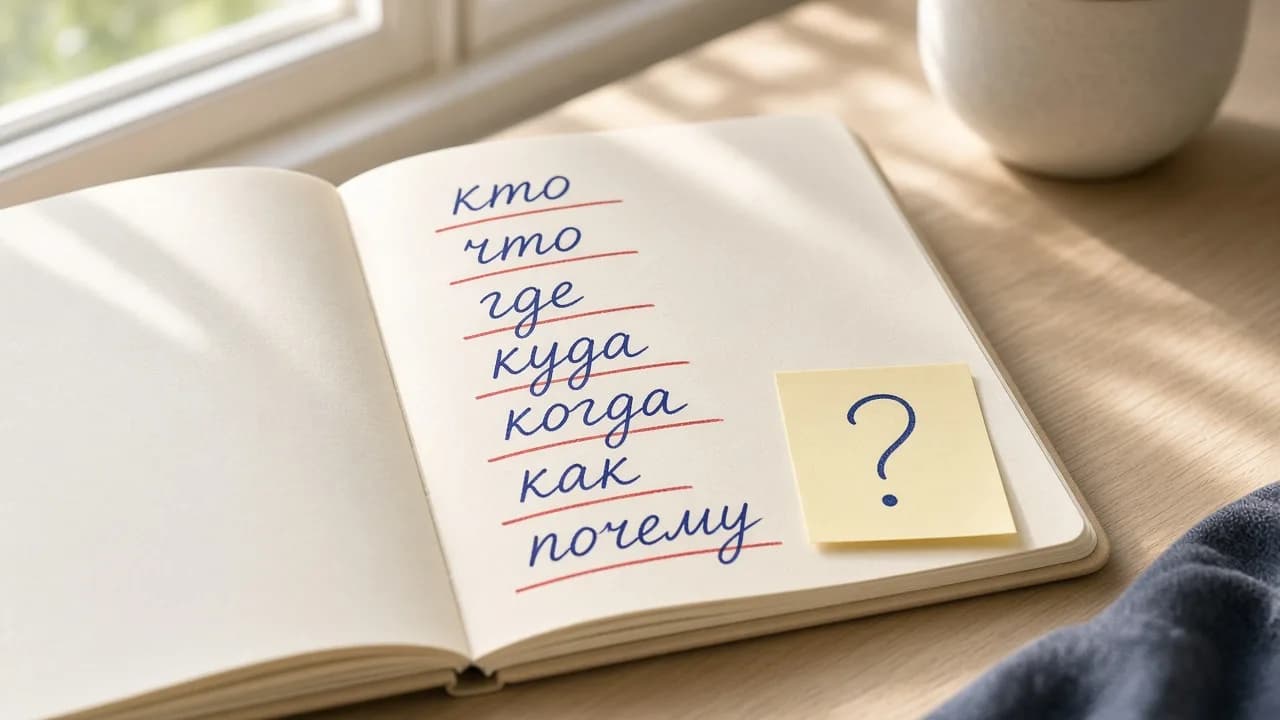
Russian Question Words: Who, What, Where, When & How (Complete Guide)
If you can ask questions in Russian, you can steer almost any conversation. The catch: many Russian question words are tied to cases. Кого? is not just “who?” — it is “whom?” in the genitive/accusative. Сколько? pulls the following noun into the genitive. Где? and куда? look similar in English (“where?”) but demand different grammar.
This guide gives you the full beginner set, shows how кто/что decline, separates где / куда / откуда, covers какой / который / чей, explains сколько + genitive, and ends with 25 ready-to-use questions.

- A complete list of the most useful Russian question words
- How кто and что decline across cases
- Где vs куда vs откуда (location vs direction vs origin)
- Какой, который, and чей — and how they agree
- Сколько and why it takes the genitive
- 25 ready-to-use questions for real conversations
Complete List of Russian Question Words
Start with this overview. Bookmark it, then dig into the sections below for the grammar that each word triggers.
| Russian | Transliteration | English | Grammar note |
|---|---|---|---|
| кто | kto | who | Declines (кого, кому…) |
| что | chto | what | Declines (чего, чему…) |
| где | gde | where (location) | Answer often in prepositional |
| куда | kuda | where to (direction) | Answer often in accusative |
| откуда | otkuda | where from | Answer often from + genitive |
| когда | kogda | when | Time expressions / cases vary |
| почему | pochemu | why (reason) | Often потому что… |
| зачем | zachem | why (purpose) | Goal / what for |
| как | kak | how | Manner; also “what’s … like?” |
| какой / какая / какое / какие | kakoy… | which / what kind | Agrees like an adjective |
| который | kotoryy | which (of a set) / that | Relative / which one |
| чей / чья / чьё / чьи | chey… | whose | Agrees with the noun |
| сколько | skol'ko | how many / how much | Noun in genitive |
| сколько стоит…? | skol'ko stoit | how much does it cost? | Fixed shopping question |
Кто and Что — and How They Decline
Кто? (who?) and Что? (what?) are the foundation. In the nominative they look simple. In other cases they become the forms English speakers forget first: кого, чему, о ком…
Quick examples
Кто это? — Who is that? Кого ты видишь? — Whom do you see? Кому дать книгу? — Who should I give the book to? О чём вы говорите? — What are you talking about? Чем ты пишешь? — What are you writing with?
| Case | кто | что | English cue |
|---|---|---|---|
| Nominative | кто | что | who? / what? (subject) |
| Genitive | кого | чего | of whom? / of what? / нет кого? |
| Dative | кому | чему | to whom? / to what? |
| Accusative | кого | что | whom? / what? (object) |
| Instrumental | кем | чем | with/by whom? / with what? |
| Prepositional | о ком | о чём | about whom? / about what? |
- Кого is both genitive and accusative of кто — context tells you which.
- For pronoun parallels (мне, его, неё…), see [Russian pronouns declension](/learn/articles/russian-pronouns-declension).
Где vs Куда vs Откуда
English often uses one word — “where?” Russian splits location, destination, and origin. Mixing them is one of the most common beginner mistakes.
| Question | Meaning | Typical answer pattern | Example |
|---|---|---|---|
| Где? | Where (at/in)? | в/на + prepositional | Где книга? — На столе. |
| Куда? | Where to? | в/на + accusative | Куда ты идёшь? — В школу. |
| Откуда? | Where from? | из/с/от + genitive | Откуда ты? — Из Франции. |
- Где? → static location (often [prepositional case](/learn/articles/russian-prepositional-case)).
- Куда? → motion toward (often [accusative](/learn/articles/russian-accusative-case) after в/на).
- Откуда? → origin (often [genitive](/learn/articles/russian-genitive-case) after из/с/от).
- Same noun, three shapes: в школе / в школу / из школы.
Какой, Который, and Чей
These three look similar in English translations (“which / what / whose”) but they are not interchangeable.
Какой — what kind / which
Какой? agrees like an adjective: какая, какое, какие + case endings. Какой это фильм? — What kind of film is this? В каком доме ты живёшь? — Which house do you live in?
Который — which one / that (relative)
Который picks from a known set or introduces a relative clause. Который час? — What time is it? Книга, которую я читаю… — The book that I am reading…
Чей — whose
Чей / чья / чьё / чьи agree with the thing possessed, not the owner. Чья это сумка? — Whose bag is this? Чьи это ключи? — Whose keys are these?
- If you need adjective agreement charts, see [adjective declension](/learn/articles/russian-adjective-declension).
- Какой is the everyday workhorse for “what/which + noun.”
Сколько and the Genitive
Сколько? means “how many?” or “how much?” The noun that follows is normally in the genitive.
| Russian | English | Note |
|---|---|---|
| Сколько у тебя братьев? | How many brothers do you have? | братьев = genitive plural |
| Сколько это стоит? | How much does this cost? | Fixed commerce question |
| Сколько времени? | How much time? | времени = genitive |
| Сколько лет тебе? | How old are you? | Age pattern with dative тебе |
- Numbers themselves also interact with genitive — details in the [numbers guide](/learn/articles/russian-numbers-guide) and [genitive case guide](/learn/articles/russian-genitive-case).
- After сколько, do not leave the noun in the nominative: *сколько братья* ✗ → сколько братьев ✓.
25 Ready-to-Use Questions
Memorize these as frames. Swap in your own nouns once the pattern feels automatic.
| # | Russian | English |
|---|---|---|
| 1 | Кто это? | Who is that? |
| 2 | Что это? | What is that? |
| 3 | Как тебя зовут? | What is your name? |
| 4 | Откуда ты? | Where are you from? |
| 5 | Где ты живёшь? | Where do you live? |
| 6 | Куда ты идёшь? | Where are you going? |
| 7 | Когда мы встретимся? | When will we meet? |
| 8 | Почему ты устал? | Why are you tired? |
| 9 | Зачем тебе это? | What do you need that for? |
| 10 | Как дела? | How are you? / How are things? |
| 11 | Какой сегодня день? | What day is it today? |
| 12 | Который час? | What time is it? |
| 13 | Чья это книга? | Whose book is this? |
| 14 | Сколько это стоит? | How much does this cost? |
| 15 | Сколько тебе лет? | How old are you? |
| 16 | Кого ты ждёшь? | Who are you waiting for? |
| 17 | Кому позвонить? | Who should I call? |
| 18 | О чём фильм? | What is the film about? |
| 19 | Чем ты занимаешься? | What do you do? / What are you up to? |
| 20 | В каком городе ты был? | Which city were you in? |
| 21 | Как пройти к метро? | How do I get to the metro? |
| 22 | Где можно купить билет? | Where can I buy a ticket? |
| 23 | Когда открывается музей? | When does the museum open? |
| 24 | Почему здесь так шумно? | Why is it so noisy here? |
| 25 | Сколько остановок до центра? | How many stops to the centre? |
Common Mistakes with Russian Question Words
- Using где for direction: *Где ты идёшь?* ✗ → Куда ты идёшь? ✓.
- Forgetting genitive after сколько: *Сколько братья?* ✗ → Сколько братьев? ✓.
- Leaving кто/что stuck in nominative after prepositions: need о ком / о чём, с кем / с чем.
- Mixing почему and зачем — reason vs purpose.
- Using который when какой is the natural everyday choice for “what kind of…”.
Frequently asked questions
- What are the most important Russian question words for beginners?
- Start with кто, что, где, куда, откуда, когда, почему, как, какой, чей, and сколько. These cover introductions, directions, time, reasons, and shopping.
- What is the difference between где and куда?
- Где asks about location (Where are you?). Куда asks about destination (Where are you going?). Answers usually use different cases: prepositional for где, accusative direction for куда after в/на.
- Do кто and что change with cases?
- Yes. They decline fully: кого/чего, кому/чему, кем/чем, о ком/о чём, and so on. Learning these forms is essential for natural questions.
- Why does сколько take the genitive?
- Because quantity expressions in Russian typically require the genitive of the counted noun: сколько братьев, сколько времени. This is the same family of rules you meet with numbers and нет + genitive.
- When should I use какой vs который?
- Какой is the common question for “what/which/what kind of” with a noun. Который often means “which one” from a set or introduces a relative clause (the book that…).
Question words are vocabulary plus case logic in one package.
- Learn the core list, then the case forms of кто/что
- Never mix где / куда / откуда
- Decline какой / чей like adjectives
- Put nouns after сколько in the genitive
- Drill the 25 frames until they come out automatically
Next, connect these questions to full case drills in our free [practice tool](/practice), and keep the [pronouns](/learn/articles/russian-pronouns-declension) and [genitive](/learn/articles/russian-genitive-case) guides open while the forms settle.