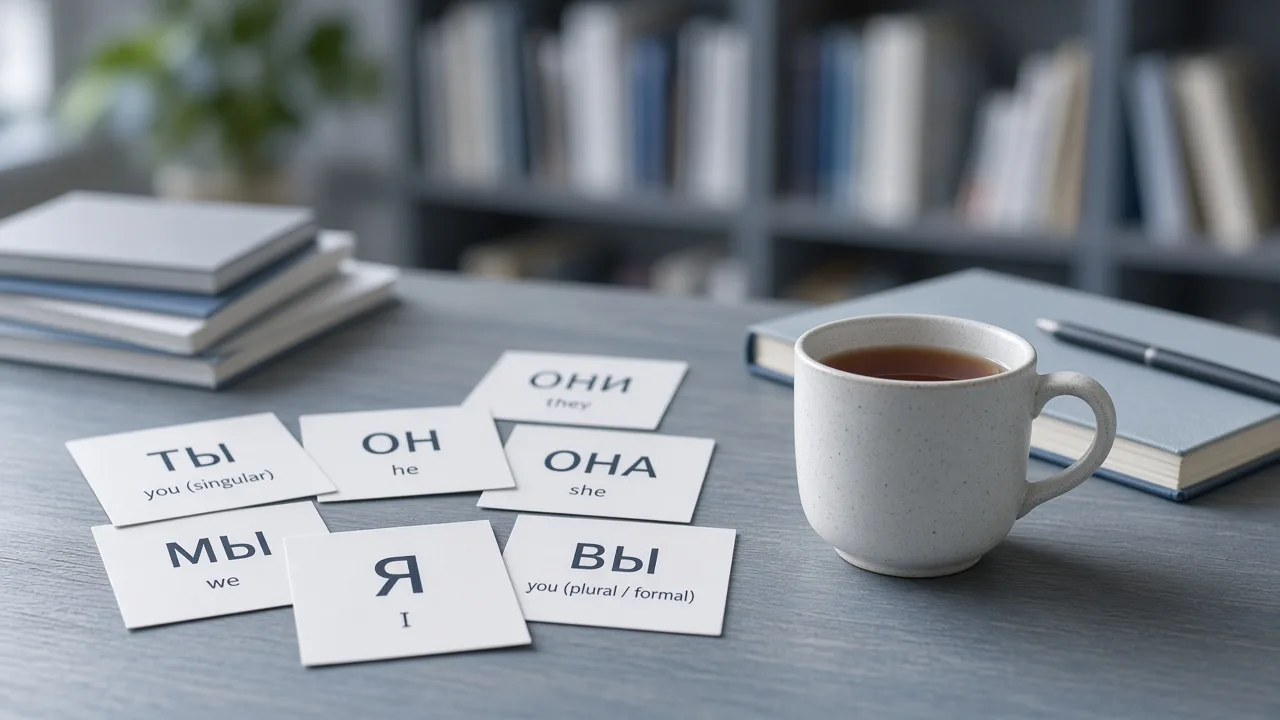
Russian Pronouns Declension: Personal, Possessive & Demonstrative
Nouns and adjectives follow fairly regular ending charts. Pronouns do not. Forms like меня, ему, неё, этом look unrelated to я, он, она, этот — until you see them as a closed system you simply have to learn.
This guide covers the three pronoun groups you need every day: personal (я, ты, он…), possessive (мой, наш, свой…), and demonstrative (этот / тот). You will also get the preposition trap (него / неё / них) and 20 example sentences with transliteration.

- Why pronouns break regular noun patterns
- Full personal-pronoun tables for all 6 cases
- Possessive pronouns and agreement (мой, наш, свой)
- Demonstratives: этот and тот declined
- The preposition trap: него, неё, них
- 20 real example sentences with transliteration
Why Pronouns Don’t Follow Noun Patterns
Russian noun endings are mostly predictable once you know gender. Pronouns are suppletive: many case forms come from older stems, so я → меня → мне → мной is a paradigm you memorize as a set, not build letter by letter.
That sounds worse than it is. There are only a handful of personal pronouns, and you use them constantly — so drilling the tables pays off faster than almost any other grammar chart.
- Personal pronouns change stem across cases (я / меня / мной).
- Possessive and demonstrative pronouns behave more like adjectives — they agree in gender, number, and case.
- After most prepositions, third-person pronouns add н-: него, неё, них (not *его, *её, *их).
Personal Pronouns in All 6 Cases
Learn these as vertical columns. The nominative is the citation form; every other case is a speaking form you will hear in real sentences.
Patterns worth noticing
Genitive = accusative for я, ты, он, она, оно, мы, вы, они (same forms: меня, тебя, его…). That cuts memorisation almost in half.
Dative and prepositional share мне / тебе for first and second person singular.
Вы is both plural “you” and polite singular “you” — the forms are identical; only the verb agreement and social context change.
| Case | я | ты | он | она | оно | мы | вы | они |
|---|---|---|---|---|---|---|---|---|
| Nominative | я | ты | он | она | оно | мы | вы | они |
| Genitive | меня | тебя | его | её | его | нас | вас | их |
| Dative | мне | тебе | ему | ей | ему | нам | вам | им |
| Accusative | меня | тебя | его | её | его | нас | вас | их |
| Instrumental | мной (-ою) | тобой (-ою) | им | ей (-ею) | им | нами | вами | ими |
| Prepositional | мне | тебе | нём | ней | нём | нас | вас | них |
- Instrumental мной / тобой sometimes appear as мною / тобою in formal or poetic style — rare in everyday speech.
- Он / оно share almost all non-nominative forms (его, ему, им, нём).
- Drill with verbs you already know: дай мне, я вижу тебя, мы говорим о нём.
Possessive Pronouns and Agreement
Possessives answer чей? чья? чьё? чьи? (whose?). Unlike English “my,” Russian мой changes with the noun it modifies — exactly like an adjective.
наш / ваш
Наш and ваш follow a soft-looking pattern: нашего, нашей, нашему, наши… Same agreement logic as мой.
свой vs его / её / их
Свой means “one’s own” and refers back to the subject: Он читает свою книгу (his own book).
Его / её / их mean “his / her / their” and do not decline: Я вижу его книгу (I see his book). Only the noun (and any adjectives) change.
| Case | мой (masc.) | моя (fem.) | моё (neut.) | мои (pl.) |
|---|---|---|---|---|
| Nominative | мой | моя | моё | мои |
| Genitive | моего | моей | моего | моих |
| Dative | моему | моей | моему | моим |
| Accusative | мой / моего | мою | моё | мои / моих |
| Instrumental | моим | моей | моим | моими |
| Prepositional | моём | моей | моём | моих |
- Accusative animacy applies: я вижу моего брата, but я вижу мой дом.
- For the full adjective-style logic behind these endings, see [Russian adjective declension](/learn/articles/russian-adjective-declension).
Demonstratives: этот / тот
Этот = this (near); тот = that (far / previously mentioned). Both decline and agree with the noun.
тот in brief
Тот / та / то / те follow the same case logic with different stems: того, той, тому, ту, тем, том, тех…
Useful contrast: Эта книга интересная, а та — скучная. (This book is interesting, and that one is boring.)
это vs этот
Invariant это meaning “this is / these are” does not decline in that role: Это мой брат. Declined этот/эта/это/эти modify a noun: Этот брат живёт в Москве.
| Case | этот | эта | это | эти |
|---|---|---|---|---|
| Nominative | этот | эта | это | эти |
| Genitive | этого | этой | этого | этих |
| Dative | этому | этой | этому | этим |
| Accusative | этот / этого | эту | это | эти / этих |
| Instrumental | этим | этой | этим | этими |
| Prepositional | этом | этой | этом | этих |
The Preposition Trap (него, неё, них)
After most prepositions, third-person pronouns take an initial н-. Forgetting it is one of the most common intermediate mistakes.
| Without preposition | With preposition | English |
|---|---|---|
| я знаю его | я думаю о нём | I know him / I think about him |
| я вижу её | я иду к ней | I see her / I go to her |
| я слушаю их | я говорю с ними | I listen to them / I speak with them |
| это его книга | книга у него | it is his book / he has a book |
- Forms to memorize: него, нему, ним, нём (он/оно); неё, ней (она); них, ним, ними (они).
- The н- appears after prepositions like о, у, к, с, для, без, из, от…
- Possessive его / её / их (“his/her/their”) still do not decline — but as object pronouns after a preposition, use the н- personal forms.
20 Example Sentences
Twenty sentences covering personal, possessive, and demonstrative pronouns. 1–8 personal · 9–14 possessive · 15–20 demonstrative / preposition trap.
| # | Russian | Transliteration | English |
|---|---|---|---|
| 1 | Дай мне книгу. | Day mne knigu. | Give me the book. |
| 2 | Я вижу тебя. | Ya vizhu tebya. | I see you. |
| 3 | Мы говорим о нём. | My govorim o nyom. | We are talking about him. |
| 4 | Скажи ей правду. | Skazhi yey pravdu. | Tell her the truth. |
| 5 | Он идёт с нами. | On idyot s nami. | He is going with us. |
| 6 | Это письмо для вас. | Eto pis'mo dlya vas. | This letter is for you. |
| 7 | Я их не знаю. | Ya ikh ne znayu. | I don’t know them. |
| 8 | У неё есть сестра. | U neyo yest' sestra. | She has a sister. |
| 9 | Это мой брат. | Eto moy brat. | This is my brother. |
| 10 | Я читаю свою книгу. | Ya chitayu svoyu knigu. | I am reading my (own) book. |
| 11 | Где наша машина? | Gde nasha mashina? | Where is our car? |
| 12 | Я вижу моего друга. | Ya vizhu moyego druga. | I see my friend. |
| 13 | Его дом большой. | Yego dom bol'shoy. | His house is big. |
| 14 | Она любит свою работу. | Ona lyubit svoyu rabotu. | She loves her (own) job. |
| 15 | Этот город красивый. | Etot gorod krasivyy. | This city is beautiful. |
| 16 | Я живу в этом доме. | Ya zhivu v etom dome. | I live in this house. |
| 17 | Дай мне ту ручку. | Day mne tu ruchku. | Give me that pen. |
| 18 | Мы говорим об этой проблеме. | My govorim ob etoy probleme. | We are talking about this problem. |
| 19 | Кто это? — Это она. | Kto eto? — Eto ona. | Who is that? — It’s her. |
| 20 | Я иду к нему. | Ya idu k nemu. | I am going to him. |
Common Mistakes with Russian Pronouns
- Using его after a preposition: *о его* ✗ → о нём ✓ (when “him” is the object of the preposition).
- Confusing свой and его: subject’s own thing → свой; someone else’s → его/её/их.
- Forgetting agreement on мой: *мой книга* ✗ → моя книга ✓.
- Treating это (this is) like этот (this + noun): Это мама vs Эта мама.
- Mixing dative and accusative: дай мне (dative) vs вижу меня (accusative).
Frequently asked questions
- Do Russian personal pronouns have different forms for every case?
- Yes. Each personal pronoun has a full six-case paradigm. The good news is that genitive and accusative are identical for all of them, which reduces what you must memorize.
- When do I use него instead of его?
- Use него / неё / них (and related н- forms) after prepositions when the pronoun is the object of that preposition: о нём, у неё, с ними. Bare его / её / их are used without a governing preposition, or as indeclinable possessives meaning his / her / their.
- What is the difference between мой and свой?
- Мой means “my” from the speaker’s point of view. Свой means “one’s own” and refers back to the subject of the clause: Он взял свою сумку (He took his own bag).
- How do этот and это differ?
- Это as “this is / these are” is invariant: Это мой брат. Этот / эта / это / эти are demonstrative adjectives that agree with a noun: Этот брат живёт здесь.
- Is вы always plural?
- Grammatically the forms are the same. Вы can address multiple people or one person politely. Verbs and past-tense forms agree with plural вы even for polite singular: Вы были правы.
Pronoun declension is finite — and it unlocks almost every Russian sentence.
- Memorize personal pronouns as full columns (genitive = accusative)
- Decline мой / твой / свой / наш / ваш like adjectives
- Leave possessive его / её / их unchanged
- Add н- after prepositions: него, неё, них
- Drill этот / тот with real nouns until agreement feels automatic
Next, connect pronouns to questions (кто? кому? о ком?) in everyday speech, and keep drilling cases in our free [practice tool](/practice). For adjective-style endings in more detail, revisit the [adjective declension guide](/learn/articles/russian-adjective-declension).