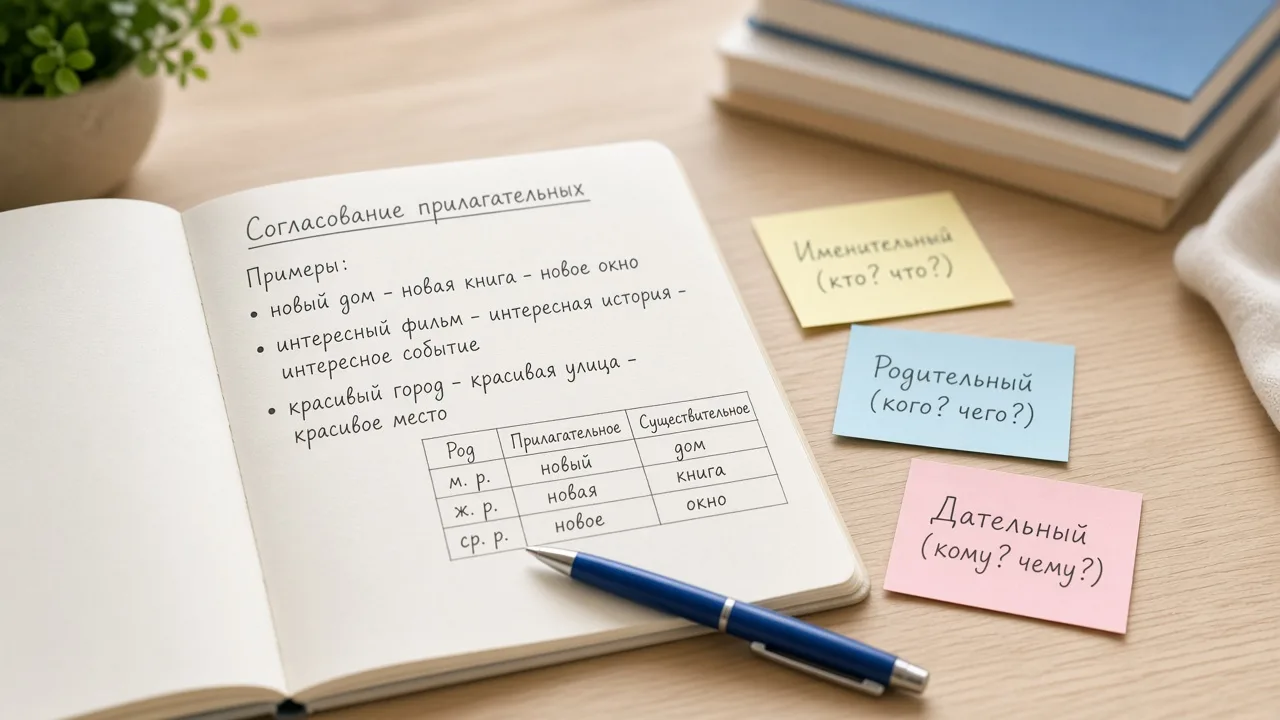
Russian Adjective Declension: Endings Chart for All 6 Cases
Nouns get most of the attention when learners talk about Russian cases — but adjectives decline too, and they must match the noun in gender, number, and case every time. Miss the ending and the sentence sounds wrong even when the noun itself is perfect.
The good news: adjective endings are more regular than noun endings. Once you know the hard-stem pattern (`новый`) and the soft-stem pattern (`синий`), you can decline thousands of adjectives. This guide gives you the full charts, the animate/inanimate accusative rule, short forms, possessives, and the mistakes that trip English speakers most often.

- What Russian adjective agreement means (gender × number × case)
- Full hard-stem endings chart with `новый`
- Full soft-stem endings chart with `синий`
- How animate vs inanimate changes the accusative
- Full noun + adjective phrases declined through all 6 cases
- Short-form (predicative) adjectives vs long-form
- Possessive adjectives: `мой`, `наш`, `свой`
- 8 common mistakes — and how to fix them
What Russian Adjective Agreement Means
In English, adjectives barely change: "a new book," "new books," "about the new book." In Russian, the adjective is a full partner of the noun. If the noun is feminine genitive singular, the adjective must be feminine genitive singular too.
That three-way agreement — gender × number × case — is the whole job of adjective declension.
| Noun phrase | Gender / number / case | English |
|---|---|---|
| новый дом | masc. sing. nominative | a new house |
| новой книги | fem. sing. genitive | of a new book |
| новым окнам | neut. pl. dative | to the new windows |
| о синих глазах | pl. prepositional | about blue eyes |
- Learn the noun’s gender first — without it, you cannot pick the right adjective ending (see our [noun gender guide](/learn/articles/russian-noun-gender-guide)).
- Adjectives answer the same case questions as nouns: какой? какая? какое? какие? plus the declined forms of those questions.
- Spelling rules still apply: after г, к, х, ж, ш, щ, ч, ц, Russian prefers и over ы in many endings — which is why you write хороший, not *хорошый*.
Hard-Stem Adjective Endings Chart (новый)
Hard-stem adjectives are the default pattern. In the nominative masculine they usually end in -ый (новый, красный) or stressed -ой (молодой, большой). All other endings follow the same hard chart.
Quick memory aids
If you remember only three facts about hard adjectives, remember these: masculine/neuter oblique forms share -ого / -ому / -ым / -ом; feminine oblique forms share -ой; plural genitive and prepositional both use -ых.
| Case | Masculine | Neuter | Feminine | Plural |
|---|---|---|---|---|
| Nominative | новый | новое | новая | новые |
| Genitive | нового | нового | новой | новых |
| Dative | новому | новому | новой | новым |
| Accusative | новый / нового | новое | новую | новые / новых |
| Instrumental | новым | новым | новой | новыми |
| Prepositional | новом | новом | новой | новых |
- Masculine and neuter share genitive, dative, instrumental, and prepositional endings — memorize one set, get two genders.
- Feminine collapses genitive, dative, instrumental, and prepositional into -ой (sometimes poetic -ою in the instrumental).
- Stressed -ой adjectives (большой, молодой) look different only in the nominative masculine — every other cell matches the hard chart.
Soft-Stem Adjective Endings Chart (синий)
Soft-stem adjectives end in -ий in the masculine nominative (синий, летний, последний). Their endings swap the hard vowels for soft ones: о→е, ы→и, у→ю, а→я.
| Case | Masculine | Neuter | Feminine | Plural |
|---|---|---|---|---|
| Nominative | синий | синее | синяя | синие |
| Genitive | синего | синего | синей | синих |
| Dative | синему | синему | синей | синим |
| Accusative | синий / синего | синее | синюю | синие / синих |
| Instrumental | синим | синим | синей | синими |
| Prepositional | синем | синем | синей | синих |
- Soft stems are fewer than hard stems, but they include high-frequency words: синий, русский, хороший, последний, летний.
- Хороший looks soft (-ий) and declines soft — a very common beginner adjective.
- If the nominative masculine ends in -ий (not -ый/-ой), start from the soft chart.
Accusative: Animate vs Inanimate Adjectives
Just like nouns, adjectives follow the animacy rule in the accusative for masculine singular and for all plurals. Feminine and neuter singular keep a single accusative form.
| Situation | Adjective form | Example | English |
|---|---|---|---|
| Masc. inanimate | = Nominative | Я вижу новый дом. | I see a new house. |
| Masc. animate | = Genitive | Я вижу нового друга. | I see a new friend. |
| Feminine | -ую / -юю | Я вижу новую книгу. | I see a new book. |
| Neuter | = Nominative | Я вижу новое окно. | I see a new window. |
| Plural inanimate | = Nominative | Я вижу новые дома. | I see new houses. |
| Plural animate | = Genitive | Я вижу новых друзей. | I see new friends. |
- The noun and adjective must agree on animacy — if the noun takes the genitive-shaped accusative, so does the adjective.
- This is the same rule taught in our [accusative case guide](/learn/articles/russian-accusative-case) — adjectives just inherit it.
- Beginners often decline the noun correctly and leave the adjective in the nominative: *Я вижу новый друга* ✗ → нового друга ✓.
Full Noun + Adjective Phrases in All 6 Cases
Charts are useful; full phrases make the system click. Here is новый дом (hard, masc. inanimate), новая книга (hard, fem.), and синий карандаш (soft, masc. inanimate) declined together.
Animate masculine contrast
Replace дом with друг and the accusative (and only the accusative) changes: нового друга, not новый друг. Genitive already looked like that — which is why animate accusative “borrows” the genitive shape.
Where to go deeper by case
Once adjective endings feel familiar, drill them inside each case article: [nominative](/learn/articles/russian-nominative-case), [genitive](/learn/articles/russian-genitive-case), [dative](/learn/articles/russian-dative-case), [accusative](/learn/articles/russian-accusative-case), [instrumental](/learn/articles/russian-instrumental-case), [prepositional](/learn/articles/russian-prepositional-case).
| Case | новый дом | новая книга | синий карандаш |
|---|---|---|---|
| Nominative | новый дом | новая книга | синий карандаш |
| Genitive | нового дома | новой книги | синего карандаша |
| Dative | новому дому | новой книге | синему карандашу |
| Accusative | новый дом | новую книгу | синий карандаш |
| Instrumental | новым домом | новой книгой | синим карандашом |
| Prepositional | о новом доме | о новой книге | о синем карандаше |
Short-Form Adjectives (Predicative)
Russian has a second adjective system: short forms, used mainly as predicates (after an omitted “to be”). They answer “what is X like?” rather than “which X?”
| Long form | Short masc. | Short fem. | Short neut. | Short plural |
|---|---|---|---|---|
| новый | нов | нова | ново | новы |
| красивый | красив | красива | красиво | красивы |
| интересный | интересен | интересна | интересно | интересны |
| занятый | занят | занята | занято | заняты |
- Long form declines by case and sits next to a noun: новая книга (a new book).
- Short form does not decline by case and usually stands alone as the predicate: Книга нова. / more naturally Книга новая. in modern speech.
- Many short forms are common in set phrases: Он занят (He is busy), Мне холодно (I am cold — adverbial neuter short form).
- If you are still mastering cases, prioritize long forms first — they are what you need for agreement inside noun phrases.
Possessive Adjectives: мой, наш, свой
Possessives behave like adjectives: they agree in gender, number, and case. `мой` / `твой` / `свой` share one pattern; `наш` / `ваш` share another. `его` / `её` / `их` (“his / her / their”) do not decline.
| Case | мой (masc.) | моя (fem.) | моё (neut.) | мои (pl.) |
|---|---|---|---|---|
| Nominative | мой | моя | моё | мои |
| Genitive | моего | моей | моего | моих |
| Dative | моему | моей | моему | моим |
| Accusative | мой / моего | мою | моё | мои / моих |
| Instrumental | моим | моей | моим | моими |
| Prepositional | моём | моей | моём | моих |
- Свой refers back to the subject (“one’s own”): Он читает свою книгу (He is reading his own book) vs его книгу (someone else’s).
- Наш / ваш follow soft-looking endings: нашего, нашей, наши…
- Его / её / их never change: о его новой машине — only the adjective and noun decline.
8 Common Mistakes with Russian Adjectives
These are the errors English speakers make most often — each one is fixable with a single rule.
- Leaving the adjective in the nominative while declining the noun: *в новый доме* ✗ → в новом доме ✓.
- Forgetting animacy in the accusative: *Я знаю хороший врача* ✗ → хорошего врача ✓.
- Mixing hard and soft charts: синий takes синего, not *синого*.
- Using -ый after ш/ж/ч/щ/ц: write хороший, свежий (spelling rule).
- Declining его / её / их: they stay fixed — decline only the following words.
- Confusing свой and его: свой = belongs to the subject; его = belongs to someone else already named.
- Treating short forms as case-marked: short forms do not take case endings.
- Ignoring neuter agreement: окно is neuter → новое окно, not *новый окно*.
How to Practice Adjective Declension
Reading charts once is not enough. Use a loop that forces agreement under time pressure:
- Pick one noun you know well and decline adjective + noun through all 6 cases out loud.
- Switch gender (дом → книга → окно) and repeat with the same adjective.
- Add animacy contrast: новый стол vs новый друг in the accusative.
- Drill inside real sentences with our [free case practice tool](/practice) and the [case endings cheat sheet](/learn/articles/russian-case-endings-cheatsheet).
Frequently asked questions
- Do Russian adjectives change with every case?
- Yes. Long-form adjectives agree with the noun in gender, number, and case, so the ending usually changes whenever the noun’s case changes. Short-form adjectives are the exception: they are used predicatively and do not decline by case.
- What is the difference between hard and soft adjective stems?
- Hard-stem adjectives typically end in -ый or -ой in the masculine nominative (новый, большой) and use endings with о/ы/у. Soft-stem adjectives end in -ий (синий, летний) and use е/и/ю instead. The logical pattern is the same; only the vowel set changes.
- Why does новый друга look wrong but нового друга look right?
- Because друг is animate masculine. In the accusative, animate masculines (and animate plurals) take the genitive-shaped ending — and the adjective must match: нового друга, not новый друга.
- Should beginners learn short-form adjectives early?
- Learn a few high-frequency short forms (занят, рад, должен, нужно/можно as related predicatives), but prioritize long-form declension first. Long forms are what you need for noun phrases in all six cases.
- How are possessive words like мой different from его?
- Мой, твой, свой, наш, and ваш decline like adjectives. Его, её, and их never change form; only the noun and any other adjectives around them decline.
Adjective declension looks big on paper, but it compresses into a small set of habits:
- Always match gender × number × case — the adjective never sits in the nominative by default
- Master the hard chart first, then map it onto the soft chart
- Apply the animacy rule in the accusative for masculine and plural
- Use long forms inside noun phrases; keep short forms for predicates
- Decline мой/твой/свой/наш/ваш; leave его/её/их alone
When adjective + noun pairs start to feel automatic, you are ready to push speed in every case. Drill them in our free practice tool — and keep the [Russian case endings cheat sheet](/learn/articles/russian-case-endings-cheatsheet) open while the charts are still settling in.