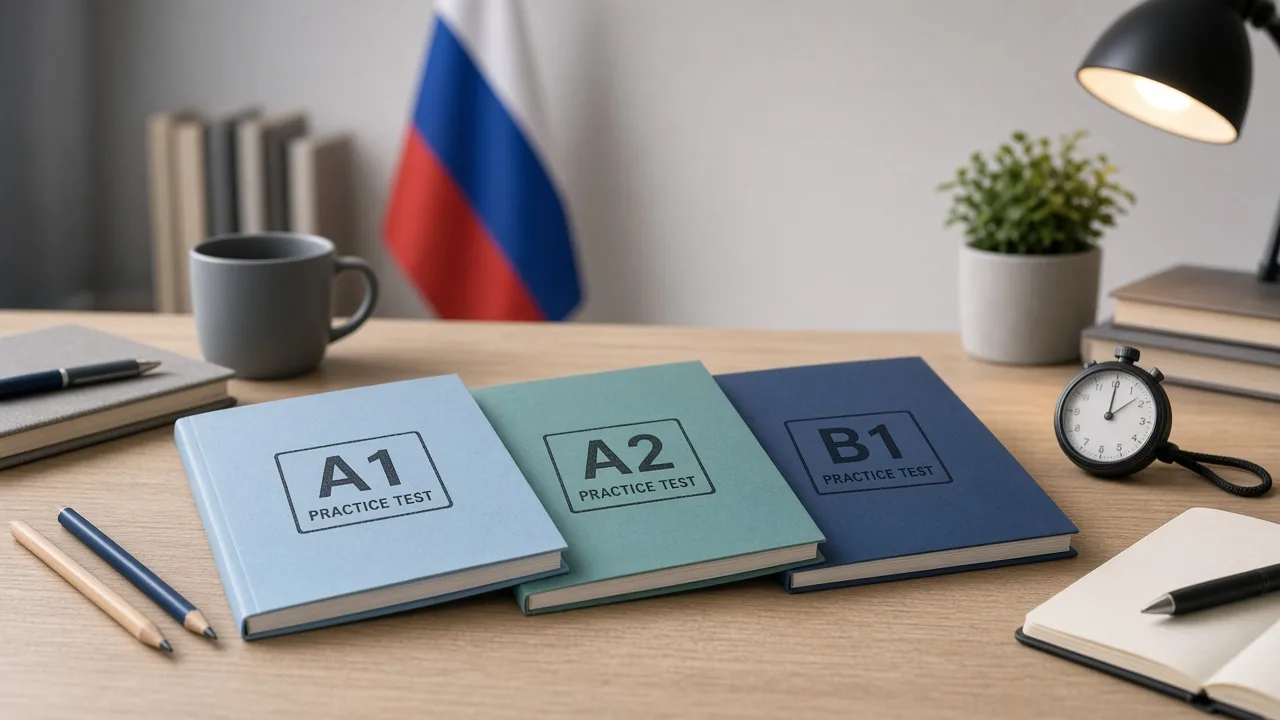
TORFL A1 vs A2 vs B1: Which Level Should You Take First?
The full TORFL system runs from A1 to C2 — but most learners are really choosing between three first steps: A1 (ТЭУ), A2 (ТБУ), and B1 (ТРКИ-1). Register too low and you waste money on a certificate that unlocks almost nothing. Register too high and you fail a paper you were almost ready for.
This guide is the decision layer on top of our complete TORFL exam guide: what each of the first three levels actually requires, how they compare, which one fits your goal, and a realistic prep timeline.
- What A1, A2, and B1 each prove in practice
- Vocab size, cases, and skills expected at each level
- A clear comparison table: A1 vs A2 vs B1
- Which level to pick for residency, citizenship, university, or personal goals
- Common registration mistakes and a 4–12 week prep outline
Quick Recap of TORFL / ТРКИ Levels
TORFL (ТРКИ) is Russia’s official Test of Russian as a Foreign Language. The early ladder looks like this:
| CEFR | Russian name | Common label | Typical use |
|---|---|---|---|
| A1 | ТЭУ — Элементарный | Elementary | Personal milestone |
| A2 | ТБУ — Базовый | Basic | Often tied to temporary residency (РВП) |
| B1 | ТРКИ-1 — Первый | First Certificate | Citizenship & many universities |
- For exam format, centers, and costs, use the [full TORFL guide](/learn/articles/torfl-trki-russian-language-exam-guide).
- This article answers one question only: which of these three should you book first?
What A1 Really Requires
A1 / ТЭУ proves survival Russian: introduce yourself, ask basic questions, understand slow speech and short texts.
- Vocabulary: roughly 700–800 words.
- Cases: mainly nominative + accusative; limited exposure to others.
- Tenses: present; very basic past/future recognition.
- Outcome: confidence milestone more than a career/immigration unlock.
- Choose A1 if you are truly early-stage and want a first official win — not if you already handle everyday errands in Russian.
What A2 Really Requires
A2 / ТБУ is everyday competence: shops, transport, doctor visits, daily routine, simple opinions.
- Vocabulary: around 1,300 words.
- Cases: nominative, accusative, genitive, prepositional used productively; dative/instrumental appear but less deeply.
- Tenses: present, past, and future in common patterns.
- Outcome: often relevant for temporary residency (РВП) pathways — verify current legal requirements for your situation.
- Choose A2 if you can survive daily life in Russian but are not yet ready for extended argument, study, or citizenship-level B1.
What B1 Really Requires
B1 / ТРКИ-1 is the first “serious” certificate for many official goals: you can handle familiar topics in connected speech and writing, including opinions and narration.
- Vocabulary: commonly cited around 2,300+ words (sources vary; treat as order of magnitude).
- Cases: all six cases expected with far fewer basic errors — this is where weak declension fails candidates.
- Skills: describe experiences, explain plans, handle study/work situations at a threshold independent level.
- Outcome: frequently required for Russian citizenship applications and many university tracks.
- Choose B1 if your goal document explicitly asks for ТРКИ-1 / B1 — do not “warm up” with A2 unless you genuinely need A2 for residency first.
Comparison Table: A1 vs A2 vs B1
Use this as a one-screen decision aid.
| Criterion | A1 (ТЭУ) | A2 (ТБУ) | B1 (ТРКИ-1) |
|---|---|---|---|
| CEFR | A1 | A2 | B1 |
| Vocab (approx.) | 700–800 | ~1,300 | ~2,300+ |
| Cases focus | Nom + Acc | Nom Acc Gen Prep | All 6 cases |
| Typical prep after A0 | 1–3 months | 3–6 months | 6–12+ months |
| Main unlock | Milestone | Often residency-related | Citizenship / uni |
| Fail risk if weak at… | Basic phrases | Genitive + prep. location | Full case accuracy |
| Worth paying for? | Sometimes | If required / close | If goal needs B1 |
- Prep times assume steady study; see also [how long to learn Russian](/learn/articles/how-long-learn-russian).
- Always confirm the exact certificate name your embassy, HR, or university lists.
Which Level Should You Register For?
Match the certificate to the unlock — then check readiness honestly.
Pick A1 if…
You are a beginner who wants external proof of progress, or a school/course requires an elementary checkpoint. Skip A1 if you already live daily life in Russian.
Pick A2 if…
You need a basic / ТБУ certificate for a residency-related process, or B1 still feels far (you freeze on genitive plurals, prepositional location, and short narratives).
Pick B1 if…
Citizenship, university admission, or an employer asks for ТРКИ-1 / B1. If that is the requirement, registering for A2 “for practice” usually costs time and fees without satisfying the goal.
A simple readiness check
Can you correctly use нет + genitive, в/на + prepositional vs accusative, and basic dative (мне нужно, дать другу) in speech without translating word-by-word? - Mostly no → A2 lane (or keep preparing). - Mostly yes, and you can narrate past events → B1 lane. - Still stuck on “I / you / this is…” → A1 lane.
Common Registration Mistakes
- Booking B1 because “it sounds prestigious” without the case control B1 demands.
- Sitting A1 when you already function at A2 — easy pass, weak ROI.
- Ignoring the legal/university wording — they may require a specific Russian label (ТБУ vs ТРКИ-1), not just “A2/B1” in conversation.
- Cramming vocab while skipping cases — grammar papers punish declension gaps hardest.
- No timed practice — TORFL is a multi-section exam; stamina matters.
A Realistic Prep Timeline
These are planning ranges, not promises. Adjust for hours per week and prior Slavic languages.
| Target | If you are around… | Focus block (4–12 weeks) |
|---|---|---|
| A1 | Alphabet + basic phrases | Core vocab, Nom/Acc, question words, listening to slow speech |
| A2 | A1-ish / early A2 | Genitive + prepositional, daily-life topics, short writing |
| B1 | Solid A2 | All 6 cases under time pressure, connected speaking, past narration |
- Daily: 15–20 minutes of case SRS (see [Anki vs app](/learn/articles/anki-vs-app-russian-cases-srs)).
- Weekly: one timed reading + one short writing on a TORFL-style topic.
- Grammar core: [case endings cheat sheet](/learn/articles/russian-case-endings-cheatsheet) + [practice quiz](/practice).
Frequently asked questions
- Should I take TORFL A1 or jump to A2?
- Jump to A2 if you already handle everyday errands in Russian and need A2/ТБУ for a practical goal. Take A1 only if you are still at survival level or specifically need an elementary certificate.
- Is TORFL B1 required for Russian citizenship?
- ТРКИ-1 (B1) is commonly cited as the language requirement for many citizenship pathways, but rules can change and exceptions exist. Always verify the current requirement with official sources for your case.
- What is the biggest difference between A2 and B1?
- Breadth and accuracy. B1 expects more vocabulary, more connected speech/writing, and reliable use of all six cases. A2 can still be uneven on dative/instrumental; B1 cannot afford basic case collapse.
- Can I skip A2 and go straight to B1?
- Yes — levels are not mandatory stepping stones. If your goal needs B1 and your skills match, register for B1. Take A2 first only if you need that certificate or you are clearly not B1-ready.
- How important are Russian cases for TORFL?
- Critical from A2 upward, and decisive at B1. Case errors are easy for examiners to spot in writing and speaking. Dedicated case drilling is one of the highest-ROI prep activities.
Choose the level that unlocks your goal — then prepare for the grammar that level actually tests.
- A1 = milestone / survival proof
- A2 = everyday Russian; often residency-related
- B1 = citizenship & many academic doors
- Do not over-register; do not under-register for prestige
- Make cases a daily drill, not a weekend cram
When you know your target level, read the [full TORFL guide](/learn/articles/torfl-trki-russian-language-exam-guide) for format and logistics, then harden declensions with our free [practice tool](/practice).