Anki vs App: Best Way to Drill Russian Case Endings with SRS
If you already know that Russian cases need spaced repetition, the next question is practical: Anki or a dedicated cases app? Both use SRS. They are not the same product.
Anki is a blank engine — infinitely flexible, free (on most platforms), and powerful if you build good decks. A dedicated Russian-cases app ships the drills, sentence context, and feedback already designed for declensions. This article compares both honestly so you can pick a primary tool — or combine them without wasting time.

- Why Russian case endings specifically need SRS (not just “more reading”)
- What Anki does well — and where DIY decks fall short for cases
- What a dedicated cases app adds: context, targeting, less setup
- A clear side-by-side comparison (setup, feedback, audio, cost, curve)
- Who should choose Anki, who should choose an app, and a hybrid stack that works
Why Russian Cases Need Spaced Repetition
Cases are not a “read once, understand forever” topic. You can explain the genitive perfectly and still freeze on нет брата under time pressure. What fails is not intelligence — it is retrieval speed.
SRS fixes that by forcing active recall just before you forget. For endings, that means producing на столе, к другу, без молока again and again until the form arrives before the rule does.
- Passive recognition (“I would know it if I saw it”) ≠ active production in speech or writing.
- Six cases × genders × numbers is too large a matrix for cramming.
- Short daily reviews beat long weekend grammar sessions — see our [practice methods guide](/learn/articles/how-to-practice-russian-cases).
How Anki Works for Case Endings
Anki schedules cards with an SRS algorithm you control. For Russian cases, people usually build (or download) decks like: nominative prompt → declined form, or English → Russian phrase with a highlighted ending.
Strengths
Total control. You decide card format, hints, audio, and tags by case.
Portability. Decks sync across devices; your progress is yours.
Cost. Anki is free on desktop and Android (iOS app is paid). No subscription required for core SRS.
Depth. Power users add cloze deletions, reverse cards, and frequency-sorted noun lists.
Costs and friction
Setup time. A good cases deck takes hours to design — or you inherit someone else’s messy deck.
Weak grammatical feedback. Anki marks “right/wrong” based on what *you* typed or self-graded; it does not explain why брата is genitive after нет.
Isolation risk. Single-word ending cards can create “table knowledge” that does not transfer into sentences.
Maintenance. Bad cards (ambiguous prompts, missing stress, wrong animacy) silently train errors.
- Anki shines if you already enjoy tinkering and will review daily.
- Anki underperforms if you wanted “open app → drill cases” in under a minute.
How a Dedicated Cases App Works
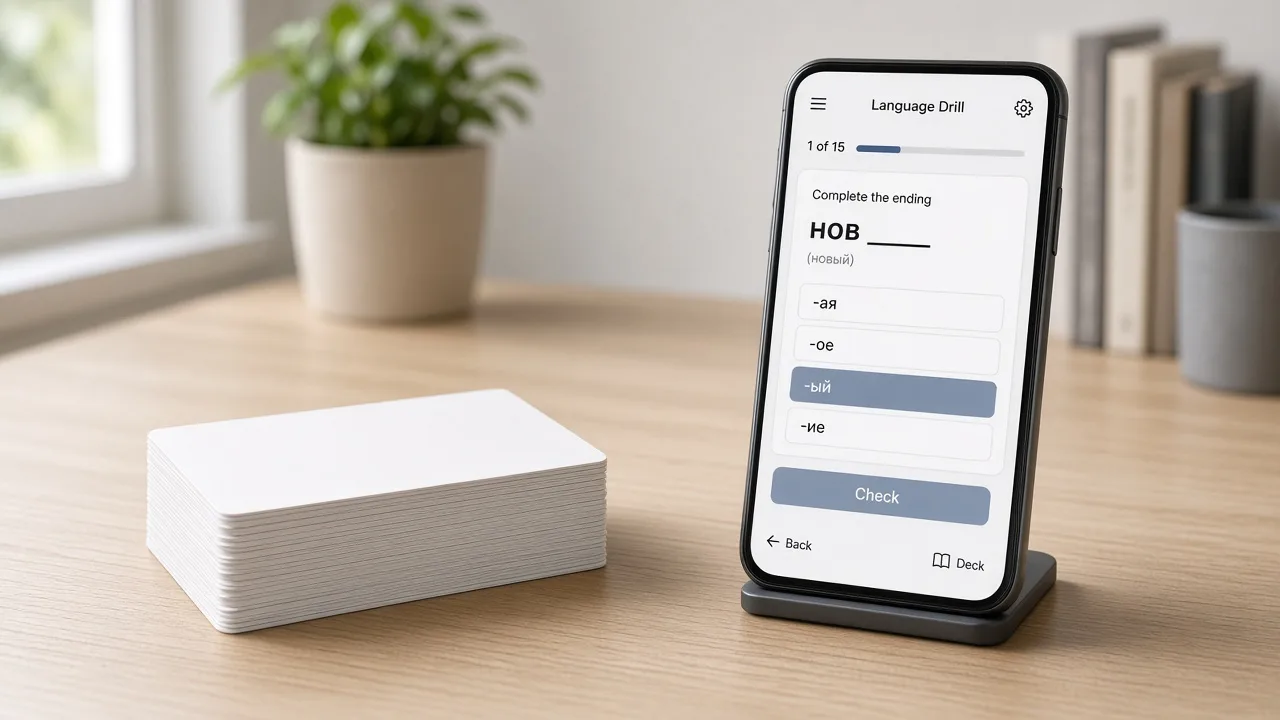
A purpose-built Russian cases app (like Russian Cases with Anna) treats declension as the product: lessons and quizzes already map to the six cases, with prompts designed for agreement, animacy, and preposition+case patterns.
Strengths
Zero deck engineering. Open the app and practise.
Contextual sentences. Endings appear inside real phrases, not only isolated nouns.
Targeted paths. Drill one case, one construction, or mixed review without tagging cards yourself.
Faster feedback loop. Immediate correct/incorrect with the grammar pattern in focus — less self-grading ambiguity.
Lower cognitive overhead. Your energy goes to Russian, not to Anki settings.
Trade-offs
Less infinite customisation than Anki — you follow the app’s pedagogy.
Scope is focused. A cases app will not replace a general vocab mega-deck for every domain of life.
Platform choice. You pick an app that matches your goals (cases-first vs general Russian).
Side-by-Side Comparison
Use this table as a decision snapshot — not a morality judgment. Both tools can work; they optimise for different costs.
| Criterion | Anki | Dedicated cases app |
|---|---|---|
| Setup time | High (build or clean decks) | Low (start immediately) |
| SRS quality | Excellent (if configured well) | Excellent (built for this job) |
| Grammar feedback | Mostly self-graded | Structured around case patterns |
| Sentence context | Only if you add it | Usually built in |
| Customisation | Unlimited | Guided / limited |
| Best for cases specifically | DIY — variable quality | Purpose-built |
| Cost model | Free* (+ time) | Free tier / app download |
| Risk | Bad cards train bad habits | Less flexible outside cases |
- *Anki iOS client is paid; desktop/Android are free.
- If your bottleneck is consistency, reduce friction (app). If your bottleneck is weird custom needs, use Anki.
Who Should Choose Anki
Pick Anki as your primary SRS tool if most of these sound like you:
- You already use Anki daily for other languages or med school–style study.
- You enjoy building cards and will maintain deck quality.
- You need custom lists (your textbook chapter, TORFL vocab, personal notes).
- You will add full-sentence cards, not only bare endings.
- You accept that grammar explanations live elsewhere (blog, tutor, textbook).
Who Should Choose an App
Pick a dedicated cases app as your primary drill tool if most of these sound like you:
- You want maximum practice per minute with minimal setup.
- Cases — not general flashcard hobbyism — are your main pain point.
- You learn better with sentence context and clear case targeting.
- Past Anki attempts died in the “I’ll make decks later” phase.
- You want a path that pairs naturally with reading guides on this site and then drilling.
A Hybrid Study Stack That Works
You do not have to pick a tribe. Many strong learners combine both:
A simple weekly rhythm
Mon–Fri: app reviews + optional Anki. Saturday: one focused case writing sprint. Sunday: light review only — protect the streak, do not binge.
- Primary daily drill (10–15 min): dedicated cases app for endings in context.
- Secondary SRS (5–10 min): Anki for personal weak spots — tricky plurals, your job vocab, TORFL lists.
- Weekly output: write 10–20 sentences for one case; correct them (see [practice methods](/learn/articles/how-to-practice-russian-cases)).
- Input: short reading where you highlight case endings you drilled that week.
Common Mistakes When Using SRS for Cases
- Ending-only cards with no context — you recognise -е but cannot place на столе in a sentence.
- Adding 200 cards on day one — backlog death; add small, review daily.
- Self-grading generously — if unsure, mark wrong; SRS only works with honest retrieval.
- Skipping animacy and gender — half of accusative “exceptions” are just missing metadata on the card.
- Replacing all study with flashcards — SRS builds recall; speaking/writing builds use.
Frequently asked questions
- Is Anki good for learning Russian cases?
- Yes — if your decks use clear prompts, correct forms (including animacy), and ideally full sentences. Anki’s SRS algorithm is excellent. The weak point is usually deck quality and the lack of built-in grammar feedback, not the software itself.
- What is better for Russian cases: Anki or an app?
- If you want the fastest path to consistent case drills with minimal setup, a dedicated cases app is usually better. If you already live in Anki and will maintain high-quality sentence cards, Anki is excellent. Many learners use an app for daily case drilling and Anki for personal vocabulary.
- Can I memorize Russian case endings without SRS?
- You can learn the charts without SRS, but automatic recall under time pressure almost always needs repeated retrieval over days and weeks. SRS is simply the most efficient scheduling method for that repetition.
- How many minutes a day should I drill cases?
- Fifteen focused minutes daily beats two hours once a week. Keep sessions short enough that you never dread opening the app or Anki — streaks matter more than heroic weekends.
- Should beginners start with Anki?
- Only if they already like Anki. Many beginners quit during deck setup. Starting with a guided cases app, then adding Anki later for custom needs, is often the smoother path.
SRS is non-negotiable for case endings. The tool is a means.
- Use SRS daily — algorithm matters less than showing up
- Choose Anki for control and custom decks
- Choose a cases app for speed, context, and less setup
- Hybrid works: app for declensions, Anki for personal weak spots
- Always prefer sentence-level practice over bare ending lists
If your goal is specifically to make the six cases automatic, start drilling with a tool built for that job — then keep reading deep guides like our [case endings cheat sheet](/learn/articles/russian-case-endings-cheatsheet) when you need the “why.”