Russian Plural Nouns: The Complete Formation Guide
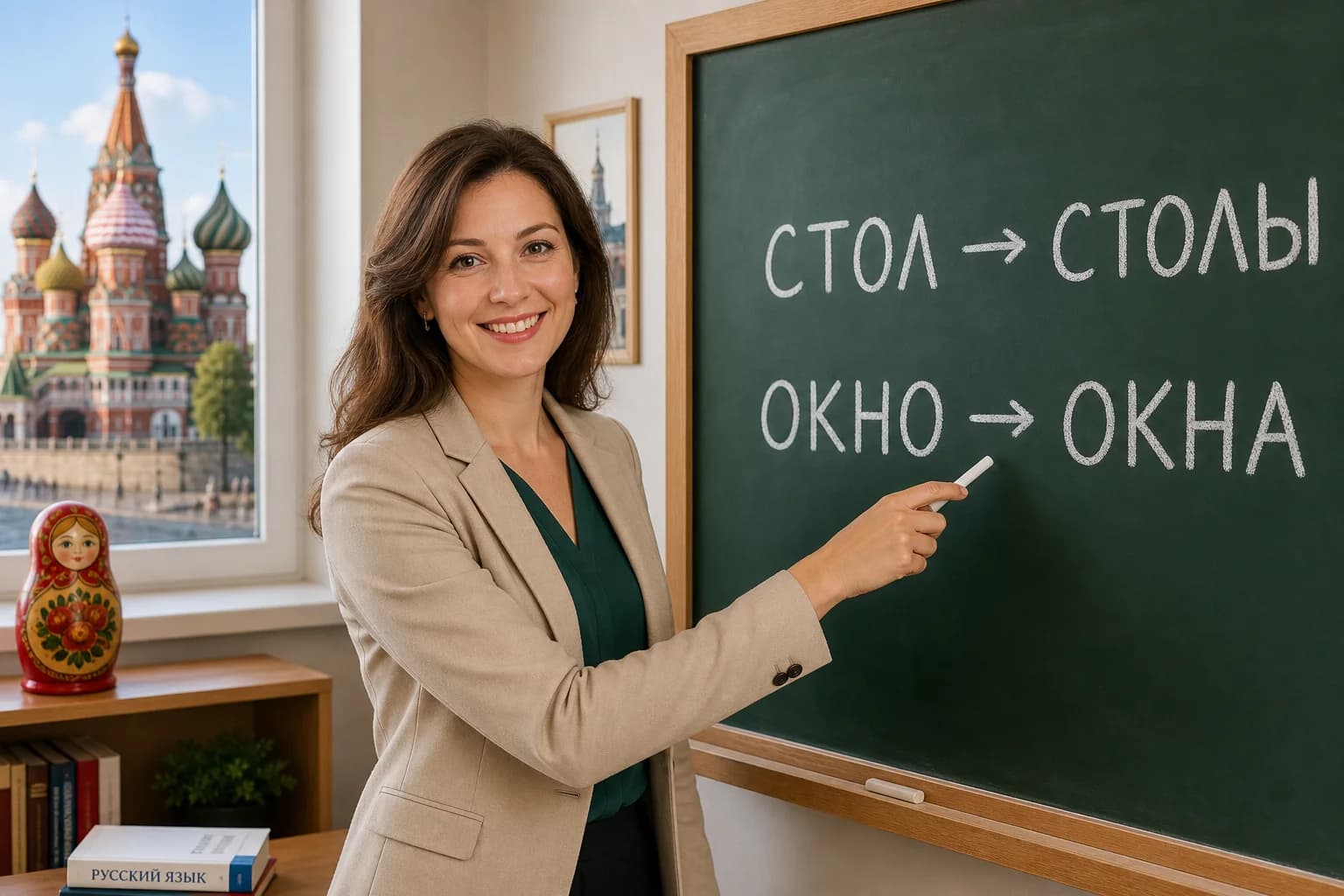
One noun, two forms: стол (a table) becomes столы (tables), окно (a window) becomes окна (windows). Most of the time the rule is simple and mechanical — swap the singular ending for a plural one based on gender. But a handful of extremely common nouns break the pattern completely: друг (a friend) becomes друзья, not "другы," and человек (a person) becomes люди, a completely different word.
This guide covers the regular plural endings for each gender, the spelling rule that overrides them after certain consonants, and the irregular plurals worth memorizing by heart — plus how plural nouns then decline across all six Russian cases.

- The regular nominative plural endings: -ы, -и, -а, -я
- Which ending applies to masculine, feminine, and neuter nouns
- The 7-letter spelling rule that forces -и instead of -ы
- Common masculine nouns with a stressed -а/-я plural (дом → дома)
- Irregular and suppletive plurals: друг → друзья, ребёнок → дети
- Nouns that only exist in the plural, and nouns with no plural at all
The Basic Rule: One Ending per Gender
Russian nominative plurals are built by replacing the singular ending with a plural one. Which ending you use depends on the noun’s gender and final letter, not on its meaning. Learn these four pairs first — they cover the large majority of Russian nouns.
| Gender / ending | Plural ending | Singular | Plural |
|---|---|---|---|
| Masculine, consonant | -ы | стол (table) | столы |
| Masculine, -й or -ь | -и | музей (museum) / словарь (dictionary) | музеи / словари |
| Feminine, -а | -ы | газета (newspaper) | газеты |
| Feminine, -я or -ь | -и | неделя (week) / тетрадь (notebook) | недели / тетради |
| Neuter, -о | -а | окно (window) | окна |
| Neuter, -е | -я | море (sea) | моря |
- A hard-stem masculine or feminine noun (ending in a plain consonant or -а) takes a hard plural ending: -ы.
- A soft-stem noun (ending in -й, -ь, or -я) takes a soft plural ending: -и.
- Neuter nouns swap their whole final vowel: -о → -а, -е → -я — there is no -ы/-и option for neuter.
The 7-Letter Spelling Rule
Russian spelling forbids writing ы after seven specific letters: г, к, х, ж, ш, щ, ч, ц. Whenever a plural ending would produce -ы after one of these, it is automatically replaced with -и instead — the pronunciation barely changes, only the spelling does.
| Singular | Expected (wrong) | Actual plural | Why |
|---|---|---|---|
| книга (book) | книгы | книги | г is a spelling-rule letter |
| рука (hand/arm) | рукы | руки | к is a spelling-rule letter |
| подруга (friend, f.) | подругы | подруги | г is a spelling-rule letter |
| карандаш (pencil) | карандашы | карандаши | ш is a spelling-rule letter |
| врач (doctor) | врачы | врачи | ч is a spelling-rule letter |
- Memorize the seven letters as one block: г, к, х (velars) and ж, ш, щ, ч, ц (hushing/hissing sounds).
- This same rule also affects adjective endings and the genitive singular of feminine nouns — it is one of the most useful spelling patterns in all of Russian grammar.
Masculine Nouns with a Stressed -а / -я Plural
A sizable group of common, mostly one-syllable masculine nouns does not follow the regular -ы/-и rule. Instead, they take a stressed -а (or, for soft stems, -я) in the plural. There is no shortcut — these have to be learned as a list, but they are all high-frequency words worth memorizing early.
| Singular | Plural | Meaning |
|---|---|---|
| дом | дома́ | house(s) |
| го́род | города́ | city / cities |
| глаз | глаза́ | eye(s) |
| по́езд | поезда́ | train(s) |
| па́спорт | паспорта́ | passport(s) |
| а́дрес | адреса́ | address(es) |
| ве́чер | вечера́ | evening(s) |
| но́мер | номера́ | number(s) / room(s) |
| учи́тель | учителя́ | teacher(s) |
| до́ктор | доктора́ | doctor(s) |
- Notice the stress always lands on the plural ending itself: до́ктор → доктора́, not "до́ктора."
- Not every masculine noun behaves this way — most still take the regular -ы/-и (стол → столы́, телефо́н → телефо́ны). There is no rule to predict which nouns take -а/-я; frequency of use is the only guide.
Truly Irregular Plurals: Different Word, Different Pattern
A small set of everyday nouns forms the plural in a way that isn’t just a different ending — the whole stem changes, or the plural comes from a completely different root. These are worth memorizing individually since they appear constantly in conversation.
Suppletive plurals (a different word entirely)
Ребёнок (a child) → дети (children) — an unrelated stem, not a regular ending swap. Человек (a person) → люди (people) in most contexts, though человек itself is kept unchanged after numbers (пять человек, "five people").
The -ья plural class
A handful of masculine (and one neuter) nouns take an old collective plural in -ья, with extra consonant changes: друг (friend) → друзья, брат (brother) → братья, стул (chair) → стулья, сын (son) → сыновья, муж (husband) → мужья, лист (leaf) → листья (compare листы, "sheets of paper," a regular plural of the same word with a different meaning), and the neuter дерево (tree) → деревья.
Nouns in -анин / -янин
Nouns describing nationality or membership that end in -анин/-янин drop that suffix entirely in the plural and take -ане/-яне instead: россия́нин (a Russian citizen) → россия́не, граждани́н (a citizen) → гра́ждане, англича́нин (an Englishman) → англича́не, крестья́нин (a peasant) → крестья́не.
Nouns That Only Exist in the Plural (or Never Do)
A few common Russian nouns have no singular form at all — they name things that are conceptually "sets" of parts. A smaller group of mass and abstract nouns goes the other way and has no plural in everyday use.
| Plural-only nouns (pluralia tantum) | Meaning |
|---|---|
| де́ньги | money |
| очки́ | glasses (eyewear) |
| брю́ки | trousers |
| но́жницы | scissors |
| часы́ | clock / watch |
| кани́кулы | school holidays |
| воро́та | gate |
- A plural-only noun still agrees with a plural verb: Мои очки лежат на столе ("My glasses are on the table"), never "лежит."
- Mass nouns like молоко (milk), сахар (sugar), and abstract nouns like любовь (love) or счастье (happiness) are normally used only in the singular — a plural would imply "types of" the thing, a special and less common meaning.
Plural Nouns Decline Too: All Six Cases
Forming the nominative plural is only the starting point. Once a noun is plural, it still changes for all six Russian cases — and several of those plural endings (especially the genitive plural) are notoriously irregular.
| Case | стол (table) — plural | книга (book) — plural |
|---|---|---|
| Nominative | столы́ | кни́ги |
| Genitive | столо́в | книг |
| Dative | стола́м | кни́гам |
| Accusative | столы́ | кни́ги |
| Instrumental | стола́ми | кни́гами |
| Prepositional | о стола́х | о кни́гах |
- Every plural noun in Russian shares the same dative (-ам/-ям), instrumental (-ами/-ями), and prepositional (-ах/-ях) endings, regardless of gender — this is one of the few places where the three genders truly converge.
- The genitive plural is the hard exception: it has no single ending and includes a "zero ending" for many feminine and neuter nouns (кни́га → книг). See our full [genitive case guide](/learn/articles/russian-genitive-case) for the complete breakdown.
Common Mistakes with Russian Plural Nouns
These four mix-ups account for most of the plural-noun errors we see from learners.
MISTAKE #1: Writing -ы After a Spelling-Rule Letter
MISTAKE #2: Regularizing an Irregular -а/-я Plural
MISTAKE #3: Treating друг and ребёнок as Regular Nouns
MISTAKE #4: Using a Singular Verb with a Plural-Only Noun
Frequently asked questions
- What are the plural endings in Russian?
- The four regular nominative plural endings are -ы (hard masculine/feminine, e.g. столы, газеты), -и (soft masculine/feminine, e.g. музеи, недели), -а (neuter -о nouns, e.g. окна), and -я (neuter -е nouns, e.g. моря). The spelling rule can turn an expected -ы into -и after г, к, х, ж, ш, щ, ч, ц.
- Why does книга become книги and not "книгы"?
- Russian spelling never allows the letter ы directly after г, к, х, ж, ш, щ, ч, or ц. Since книга’s stem ends in г, the regular -ы ending is automatically replaced with -и, giving книги.
- Why do дом, город, and глаз become дома, города, and глаза?
- These are part of a group of common, mostly one-syllable masculine nouns that take a stressed -а/-я plural instead of the regular -ы/-и. There is no rule to predict which nouns belong to this group — they are learned individually, starting with the most frequent ones.
- What is the plural of человек and ребёнок?
- Ребёнок (child) has the suppletive plural дети (children), an entirely different stem. Человек (person) uses люди (people) as its plural in most contexts, but keeps the form человек unchanged after numbers, e.g. пять человек ("five people").
- Do all Russian plural nouns decline the same way across the six cases?
- The dative (-ам/-ям), instrumental (-ами/-ями), and prepositional (-ах/-ях) plural endings are the same for all genders. The genitive plural is the main exception, with several competing patterns including a "zero ending" for many feminine and neuter nouns.
Most Russian plurals follow one of four predictable endings — but the exceptions are common, everyday words you will use from your very first conversations.
- Match the ending to the gender and stem: -ы/-и for masculine and feminine, -а/-я for neuter
- Apply the spelling rule: -ы becomes -и after г, к, х, ж, ш, щ, ч, ц
- Memorize the stressed -а/-я group: дом, город, глаз, поезд, учитель, and friends
- Learn друг → друзья and ребёнок → дети as fixed, irregular forms
- Remember plural-only nouns like деньги and очки always take a plural verb
Once you can form the plural confidently, the next step is declining it across all six cases — practice both together with our [genitive case](/learn/articles/russian-genitive-case) and [case endings cheat sheet](/learn/articles/russian-case-endings-cheatsheet) guides, or drill real sentences in the free [practice tool](/practice).