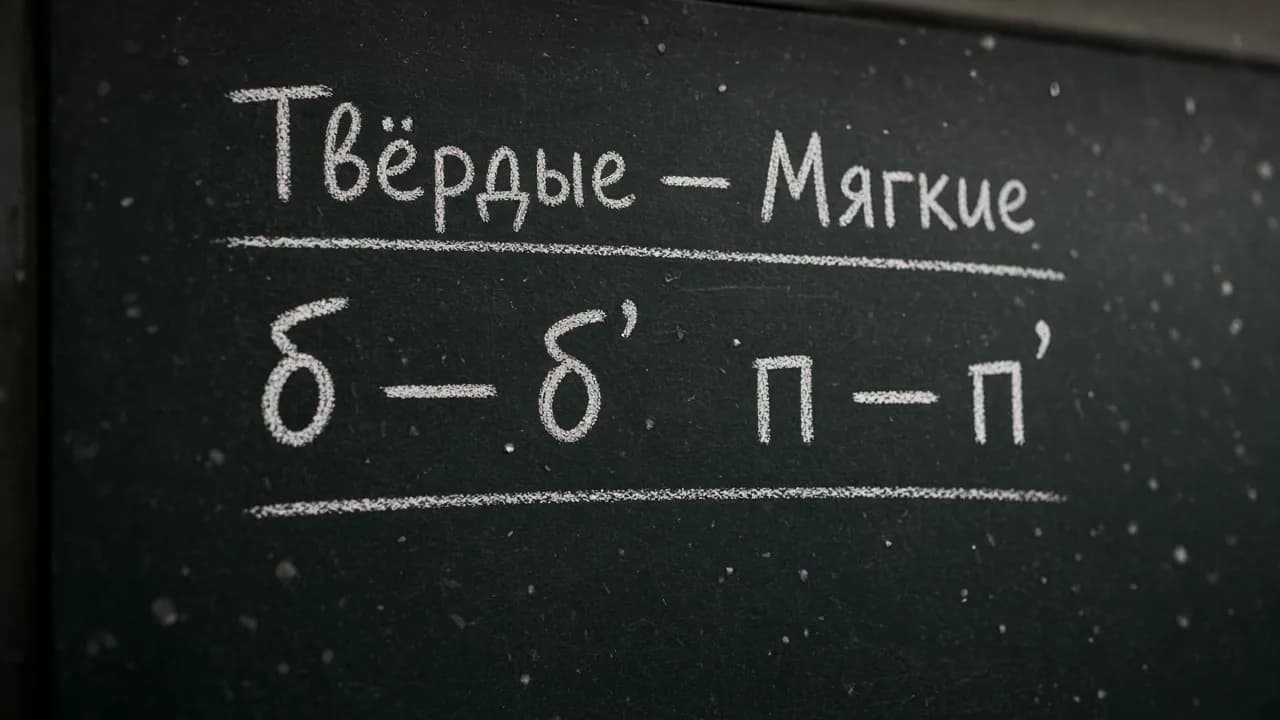
Russian Hard vs Soft Consonants: The Pronunciation Guide Beginners Skip
Most beginners learn the Cyrillic alphabet, then rush to vocabulary — and skip the one pronunciation system that makes Russian *sound* Russian: hard vs soft consonants.
Softness (palatalization) is not decoration. It can change meaning (угол “corner” vs уголь “coal”), it decides whether you write ы or и, and it explains why soft-stem adjectives and nouns take different endings. This guide gives you the pairs, the soft-sign / soft-vowel rules, the ы vs и trap, minimal pairs, and short reading practice.

- What “hard” and “soft” mean in Russian pronunciation
- The hard/soft consonant pairs (with approximate English anchors)
- How the soft sign, soft vowels, and й create softness
- How softness shows up in word endings (grammar link)
- Ы vs и — the classic confusion
- Minimal pairs and a short reading drill
What “Hard” and “Soft” Mean in Russian
In Russian, many consonants come in pairs: a hard version and a soft version. Soft consonants are pronounced with the middle of the tongue raised toward the palate — a light “y” quality without adding a full extra syllable.
English only does this occasionally (the n in “onion” is closer to soft than the n in “no”). Russian does it systematically, on most consonants, in almost every word.
- Hard ≠ “loud” and soft ≠ “quiet.” Soft means palatalized.
- The same letter shape can represent hard or soft sound depending on what follows (or a soft sign).
- Some consonants are always hard or always soft — they do not pair.
The Hard/Soft Consonant Pairs
These are the paired consonants. Learn them as twins: same place of articulation, different softness.
Always hard (no soft twin in standard pairing)
ж, ш, ц are hard. Even when spelling looks “soft,” pronunciation stays hard: жить, шире, цикл.
Always soft
ч, щ, й are soft. Чай, щека, мой never harden into a hard twin of the same letter.
| Hard | Soft | Rough English anchor | Example hard → soft |
|---|---|---|---|
| б | б' | b / by | был → бил |
| п | п' | p / py | пыль → пить |
| м | м' | m / my | мы → мир |
| в | в' | v / vy | вы → вид |
| ф | ф' | f / fy | факт → фильм |
| д | д' | d / dy | дышать → диван |
| т | т' | t / ty | ты → тихо |
| н | н' | n / ny | ныть → низ |
| з | з' | z / zy | зыбкий → зима |
| с | с' | s / sy | сын → синий |
| л | л' | l / ly (dark vs clear) | лыжи → лиса |
| р | р' | rolled r / soft r | рынок → рис |
| г | г' | g / gy | гусь → гимн |
| к | к' | k / ky | куст → кино |
| х | х' | loch / softer kh | хата → химия |
Soft Sign, Soft Vowels, and Й
Russian marks softness in three main ways. You need all three to read accurately.
1. Soft vowels: е, ё, и, ю, я
After a consonant, these usually signal that the consonant is soft: нет (n soft), мёд, пила, люблю, мяч.
At the start of a word (or after a vowel), they often include a y-glide: ель, ёлка, юбка, яблоко.
2. Soft sign ь
The soft sign has no sound of its own. It softens the consonant before it: мать, день, соль, словарь.
It also appears in the middle of words to keep a consonant soft before another letter: семья.
3. Hard sign ъ
The hard sign also has no sound. It blocks softening / separates a prefix from a soft vowel: объект, съесть. Beginners meet it less often than ь — learn it as a separator, not a “hard pronunciation button.”
4. Й
Й is the consonant “y” sound (as in “boy”). It is always soft in quality and common in endings and diphthong-like sequences: мой, русский, чай.
- Hard vowels that typically follow hard consonants: а, о, у, ы, э.
- If you only memorize letters without softness, Russian will sound “flat” and stress/ending cues will be harder to hear.
How Softness Changes Word Endings
Softness is not only pronunciation — it feeds grammar. Soft stems take the “soft” ending set.
| Hard-stem example | Soft-stem example | What changes |
|---|---|---|
| новый (adj.) | синий (adj.) | Adjective endings: -ого vs -его, -ым vs -им… |
| стол → стола | словарь → словаря | Noun genitive: -а vs -я |
| карта → карте | земля → земле | Soft feminine stems favor -е/-и patterns |
| мы | милиция | ы appears after hard stems; и after soft |
- This is why soft adjectives are covered separately in our [adjective declension guide](/learn/articles/russian-adjective-declension).
- Noun gender + hard/soft stem together choose the ending chart — see also [noun gender](/learn/articles/russian-noun-gender-guide) and the [case endings cheat sheet](/learn/articles/russian-case-endings-cheatsheet).
Ы vs И: The Classic Confusion
English speakers often hear ы and и as the same “ee.” Native Russian ears do not.
Spelling rule (practical)
After г, к, х, ж, ш, щ, ч, Russian writes и, not ы (жир, шить, чистый) — even when ж/ш stay hard in pronunciation. This is a spelling convention you must memorize.
| Letter | When it appears | Feel / tip | Example |
|---|---|---|---|
| и | After soft consonants; default “ee” | Tongue forward, smile slightly | мир, синий, пить |
| ы | After hard consonants | Tongue pulled back, darker “ee” | мы, сын, ты |
- Minimal contrast: бил (he beat) vs был (he was) — soft б+и vs hard б+ы.
- If your ы sounds identical to и, record yourself and compare to native audio; the tongue position is the fix, not volume.
Minimal Pairs to Train Your Ear
Train with contrasts. Say each pair slowly, then at conversation speed.
| Hard-leaning | Soft-leaning | Meaning contrast |
|---|---|---|
| угол | уголь | corner / coal |
| был | бил | was / beat |
| мат | мать | mat (vulgar slang also exists) / mother |
| мол | моль | breakwater / moth |
| рад | ряд | glad / row |
| нос | нёс | nose / carried (past of нести) |
- Not every pair is a perfect dictionary twin — the goal is hearing and producing the soft gesture.
- Add audio from any dictionary with sound; visual charts alone will not fix the ear.
Reading Practice
Read these aloud. Mark soft consonants with a mental apostrophe as you go.
| Russian | Focus | English |
|---|---|---|
| Синий словарь на столе. | soft с, н, р in словарь | A blue dictionary is on the table. |
| Мать и дочь дома. | soft soft-sign words | Mother and daughter are at home. |
| Мы были в кино. | ы vs и; soft н in кино | We were at the cinema. |
| Холодный день в январе. | hard д/н vs soft д in день; я- | A cold day in January. |
| Русский язык трудный, но красивый. | always-soft ч; soft к in русский | Russian is hard but beautiful. |
- Re-read daily for a week; speed comes after accuracy.
- Then revisit the [alphabet guide](/learn/articles/russian-alphabet-cyrillic-guide) and [word stress guide](/learn/articles/russian-word-stress-guide) — stress + softness together create real Russian rhythm.
Common Mistakes with Hard and Soft Consonants
- Ignoring ь — reading мать like мат.
- Making ы = и — мы and ми merge into one sound.
- Softening ж/ш — they stay hard even before и.
- Hardening ч/щ — they stay soft.
- Learning endings without softness — soft-stem charts will feel random until the ear catches up.
Frequently asked questions
- What are hard and soft consonants in Russian?
- Many Russian consonants come in pairs: a hard (non-palatalized) sound and a soft (palatalized) sound. Soft consonants are pronounced with the tongue raised toward the palate. The difference can change meaning and affects spelling and grammar endings.
- How do I know if a consonant is soft?
- Look at what follows it. Soft vowels е, ё, и, ю, я usually mark a soft consonant; the soft sign ь also softens the previous consonant. Some letters are always soft (ч, щ, й) or always hard (ж, ш, ц).
- What is the difference between ы and и?
- И is a front “ee” sound that typically follows soft consonants. Ы is a darker, more retracted vowel that follows hard consonants (мы, сын). English speakers often merge them at first; tongue position is the key distinction.
- Does the soft sign make a sound?
- No. The soft sign ь has no sound of its own. It softens the consonant before it (and can separate sounds inside a word). The hard sign ъ is also silent and mainly separates a prefix from a following soft vowel.
- Why does softness matter for Russian cases?
- Soft-stem nouns and adjectives take different ending vowels than hard stems (for example -я/-ю/-е patterns vs -а/-у/-о patterns, and soft adjective endings like -его/-ему). Hearing softness helps you choose the right declension chart automatically.
Hard vs soft is the hidden layer under Cyrillic reading — and under many endings.
- Treat paired consonants as hard/soft twins
- Read softness from soft vowels, ь, and always-soft letters
- Separate ы (hard) from и (soft / front)
- Connect softness to ending charts for nouns and adjectives
- Train with minimal pairs and short daily reading aloud
When softness starts to feel automatic, grammar charts stop looking arbitrary. Keep going with the [alphabet](/learn/articles/russian-alphabet-cyrillic-guide), [stress](/learn/articles/russian-word-stress-guide), and [adjective endings](/learn/articles/russian-adjective-declension) guides — then drill forms in our free [practice tool](/practice).