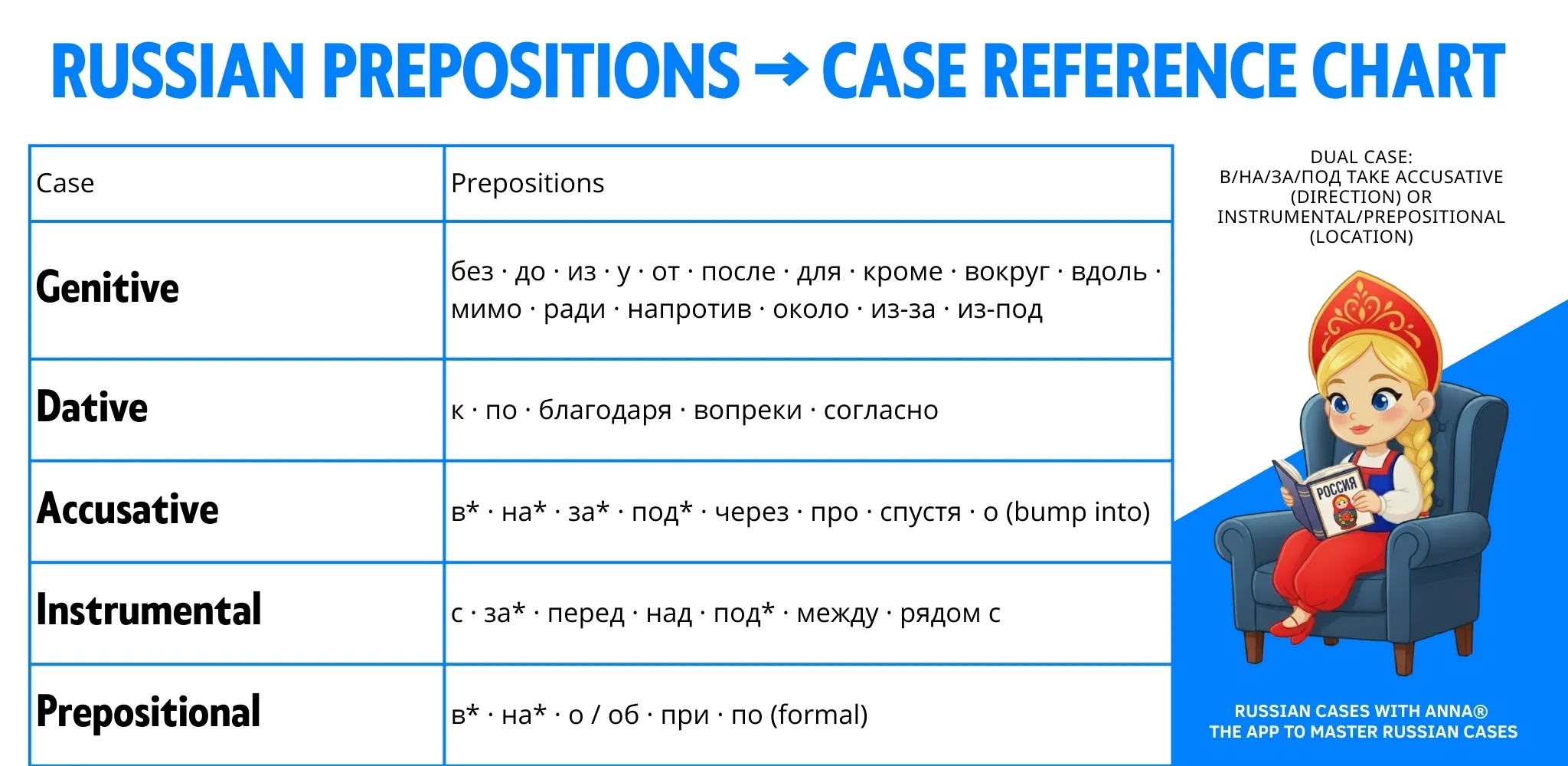
Russian Prepositions and Cases: Which Case Does Each Preposition Take?
One of the most practical skills in Russian is knowing which case each preposition requires. Once you know that без always takes genitive, that к always takes dative, and that с can take either genitive OR instrumental depending on meaning — your accuracy jumps dramatically.
This is the complete reference guide. Every major Russian preposition is listed with its required case, its meaning, and a real example. Use this as a lookup tool whenever you're unsure, and gradually these pairings will become automatic.

- Complete master table: every Russian preposition mapped to its required case
- Genitive prepositions (18 prepositions)
- Dative prepositions (6 prepositions)
- Accusative prepositions (8 prepositions)
- Instrumental prepositions (7 prepositions)
- Prepositional prepositions (5 prepositions)
- Dual-case prepositions — prepositions that take 2 different cases depending on meaning
- В vs. НА — the most important location/direction pair explained
- Memory strategies to lock in preposition-case pairings
The Master Table: Every Russian Preposition and Its Case
The table below lists all major Russian prepositions, organized by the case they require. Color-coded by case for easy reference.
Color key: Genitive (navy) · Dative (violet) · Accusative (red) · Instrumental (teal) · Prepositional (orange).
| Case | Prep. | Meaning | With noun | Full example + translation |
|---|---|---|---|---|
| Genitive | без | without | без молока | Я пью кофе без молока. — I drink coffee without milk. |
| Genitive | до | until / before / up to | до урока | Позвони мне до урока. — Call me before the lesson. |
| Genitive | из | from (inside of) | из России | Она приехала из России. — She came from Russia. |
| Genitive | с | from (off a surface) | с полки | Книга упала с полки. — The book fell off the shelf. |
| Genitive | у | at / near / by | у меня | У меня есть кошка. — I have a cat. |
| Genitive | от | from (a person/source) | от друга | Письмо от друга. — A letter from a friend. |
| Genitive | после | after | после работы | После работы я устал. — After work I was tired. |
| Genitive | для | for (benefit of) | для тебя | Это подарок для тебя. — This is a gift for you. |
| Genitive | кроме | except / besides | кроме меня | Все кроме меня пришли. — Everyone except me came. |
| Genitive | вокруг | around | вокруг города | Мы ехали вокруг города. — We drove around the city. |
| Genitive | мимо | past / by | мимо школы | Он прошёл мимо школы. — He walked past the school. |
| Genitive | вместо | instead of | вместо кофе | Выпей воды вместо кофе. — Drink water instead of coffee. |
| Genitive | напротив | opposite / across from | напротив банка | Кафе напротив банка. — The café is across from the bank. |
| Genitive | из-за | because of / from behind | из-за дождя | Из-за дождя мы остались дома. — Because of the rain we stayed home. |
| Genitive | из-под | from under | из-под стола | Кот вылез из-под стола. — The cat crawled out from under the table. |
| Genitive | ради | for the sake of | ради тебя | Ради тебя я на всё готов. — For your sake I'm ready for anything. |
| Genitive | около | near / around | около школы | Встретимся около школы. — Let's meet near the school. |
| Genitive | вдоль | along | вдоль реки | Мы шли вдоль реки. — We walked along the river. |
| Dative | к | toward / to (person or goal) | к врачу, к морю | Иди к врачу! — Go to the doctor! |
| Dative | по | along / around / according to | по улице, по закону | Мы гуляли по парку. — We walked around the park. |
| Dative | благодаря | thanks to | благодаря тебе | Благодаря тебе всё получилось! — Thanks to you, everything worked out! |
| Dative | вопреки | contrary to / despite | вопреки прогнозу | Вопреки прогнозу, погода была хорошей. — Despite the forecast, weather was good. |
| Dative | согласно | according to (formal) | согласно закону | Согласно закону, это запрещено. — According to the law, this is forbidden. |
| Dative | навстречу | toward / to meet | навстречу ветру | Она шла навстречу ветру. — She walked into the wind. |
| Accusative | в | into / to (direction) | в школу | Я иду в школу. — I am going to school. |
| Accusative | на | onto / to (direction) | на работу | Она едет на работу. — She is going to work. |
| Accusative | за | behind (motion) / for | за угол | Он зашёл за угол. — He went around the corner. |
| Accusative | под | under (motion) | под стол | Кот залез под стол. — The cat crawled under the table. |
| Accusative | через | across / through / in (time) | через час | Приходи через час. — Come in an hour. |
| Accusative | про | about (informal) | про тебя | Он рассказал про тебя. — He talked about you. |
| Accusative | спустя | after / later (time) | спустя год | Спустя год он вернулся. — A year later he returned. |
| Accusative | о/об | against (bump into) | о камень | Он споткнулся о камень. — He stumbled over a stone. |
| Instrumental | с | with / together with | с другом | Я иду с другом. — I am going with a friend. |
| Instrumental | за | behind / at (position) | за столом | Он сидит за столом. — He is sitting at the table. |
| Instrumental | перед | in front of / before | перед домом | Стой перед домом. — Stand in front of the house. |
| Instrumental | над | above / over | над городом | Самолёт летит над городом. — The plane flies above the city. |
| Instrumental | под | under (position) | под столом | Книга под столом. — The book is under the table. |
| Instrumental | между | between | между нами | Это между нами. — This is between us. |
| Instrumental | рядом с | next to / beside | рядом с банком | Кафе рядом с банком. — The café is next to the bank. |
| Prepositional | в | in / inside (location) | в Москве | Я живу в Москве. — I live in Moscow. |
| Prepositional | на | on / at (location) | на столе | Книга на столе. — The book is on the table. |
| Prepositional | о/об | about / concerning | о работе | Мы говорим о работе. — We are talking about work. |
| Prepositional | при | in the presence of / under | при Сталине | При Сталине жизнь была трудной. — Life under Stalin was hard. |
| Prepositional | по | upon / after (formal) | по приезде | По приезде он позвонил. — Upon arriving he called. |
Dual-Case Prepositions: Prepositions That Take Two Different Cases
Some Russian prepositions can take two different cases, with the meaning changing depending on which case is used. These are the most important prepositions to master because a single wrong case changes the meaning of your sentence.
| Prep. | Case 1 | Example 1 | Case 2 | Example 2 |
|---|---|---|---|---|
| в | Accusative | в школу (to school) | Prepositional | в школе (at school) |
| на | Accusative | на работу (to work) | Prepositional | на работе (at work) |
| за | Accusative | сесть за стол (sit down at table) | Instrumental | за столом (sitting at table) |
| под | Accusative | положить под стол (put under table) | Instrumental | под столом (under the table) |
| о/об | Accusative | споткнуться о порог (trip over threshold) | Prepositional | говорить о работе (talk about work) |
- The В/НА direction vs. location rule — the most tested dual-case pattern:
- В/НА + Accusative = DIRECTION (motion toward): Я иду в школу. (I am going TO school.) Положи книгу на стол. (Put the book ON/ONTO the table.)
- В/НА + Prepositional = LOCATION (being somewhere, static): Я нахожусь в школе. (I am AT school.) Книга лежит на столе. (The book is ON the table.)
Genitive Prepositions — Deep Dive
The genitive case has more prepositions than any other case. Here are the most important ones grouped by semantic function.
Origin and Separation: из, с, от
из — from inside a place: из России (from Russia), из дома (from the house), из школы (from school). с — from off a surface: с полки (from the shelf), с работы (from work — colloquial), с крыши (from the roof). от — from a person or as a source: от друга (from a friend), от врача (from the doctor), от боли (from pain). Key distinction: из vs. от — из is for places (interior); от is for people and sources. Я вернулся из Москвы (I returned from Moscow — a place) vs. Я получил письмо от Ивана (I received a letter from Ivan — a person).
Time Prepositions: до, после, с (…до)
до — until / before: до урока (before the lesson), до свидания (goodbye — until the meeting). после — after: после работы (after work), после дождя (after rain). с … до — from … until: с утра до вечера (from morning until evening).
Spatial Prepositions: у, около, вокруг, вдоль, мимо, напротив
у — at/near/by (proximity): у окна (by the window), у меня (at my place / I have). около — near/around: около школы (near the school), около часа (about an hour). вокруг — around (encircling): вокруг стола (around the table), вокруг города (around the city). вдоль — along: вдоль реки (along the river), вдоль дороги (along the road). мимо — past/by: мимо нас (past us), пройти мимо (to walk past). напротив — opposite/across from: напротив банка (across from the bank).
Dative Prepositions — Deep Dive
К — Direction Toward
К expresses movement or orientation toward a person, object, or abstract goal — it is the dative counterpart of в/на for direction: к врачу (to the doctor), к другу (to a friend's place), к окну (to/toward the window), стремиться к цели (to strive toward a goal) — abstract direction.
По — The Multi-Purpose Preposition
Along/around a surface: гулять по парку (to walk around the park), идти по улице (to walk along the street). Means of communication: по телефону (by phone), по почте (by mail), по интернету (online). Field/subject: урок по математике (math lesson), книга по истории (history book). Recurring time: по понедельникам (on Mondays), по вечерам (in the evenings). According to: по закону (according to the law), по правилам (by the rules).
Accusative Prepositions — Deep Dive
В and НА for Direction
В and на are the primary accusative prepositions for direction. The same contrast applies as for location (see dual-case table above), but here they express motion. В = motion into an enclosed space: в школу, в Россию, в магазин. НА = motion onto a surface or to certain locations: на стол, на работу, на Кубу.
ЧЕРЕЗ — Across / In (Time)
Across/through: переплыть через реку (to swim across the river), пройти через лес (to walk through the forest). In (time): через час (in an hour), через неделю (in a week), через год (in a year).
ЗА and ПОД for Motion
За + accusative = motion to behind: зайти за угол (go around the corner), сесть за стол (sit down at the table). Под + accusative = motion under: положить под стол (put under the table), залезть под кровать (crawl under the bed).
Instrumental Prepositions — Deep Dive
С — With
С + instrumental is one of the most frequent constructions in Russian. It expresses: Accompaniment: с другом (with a friend), с семьёй (with the family). Ingredients/components: кофе с молоком (coffee with milk), суп с грибами (mushroom soup).
Spatial Position Prepositions
За + instrumental = position behind/at: за столом (at the table), за горой (behind the mountain). Перед + instrumental = in front of: перед домом (in front of the house), перед сном (before sleep — temporal). Над + instrumental = above/over: над городом (above the city), над столом (over the table). Под + instrumental = below (position): под столом (under the table), под землёй (underground). Между + instrumental = between: между нами (between us), между домами (between the houses).
Prepositional Prepositions — Deep Dive
В and НА for Location
В and на with the prepositional case express static location — where something already is, as opposed to direction: В (in/inside): в Москве, в школе, в доме, в России. НА (on/at): на столе, на работе, на улице, на Кубе.
О/ОБ — About
О + prepositional expresses the topic of mental or communicative engagement: говорить о (to talk about), думать о (to think about), мечтать о (to dream about), писать о (to write about). О чём? = About what? | О ком? = About whom? Use об before vowels: об этом (about this), об Иване (about Ivan).
Memory Strategies for Russian Preposition-Case Pairings
Strategy 1: Learn Prepositions in Case Groups
Rather than learning each preposition individually, learn them in case clusters. This reinforces the case system at the same time. Start with the genitive cluster (без, до, из, у, от, после, для, кроме) and drill until it's automatic before moving to dative (к, по).
Strategy 2: Create Sentences for Every Preposition
For each preposition, create one memorable personal sentence using it correctly. Your own examples are far more memorable than textbook examples. Без тебя мне плохо (I feel bad without you) will stick longer than без + noun.
Strategy 3: Pay Special Attention to Dual-Case Prepositions
В, на, за, and под each take two cases. Create paired sentences for each: Я иду в школу (going, accusative) / Я в школе (being there, prepositional). Я поставил книгу за шкаф (accusative) / Книга за шкафом (instrumental). Learn the pairs together.
Strategy 4: Use the "Where?" vs. "Where to?" Test
For в and на: ask yourself — is this answering "Where?" (prepositional) or "Where to?" (accusative)? This single question eliminates the most common preposition-case error.
Frequently asked questions
- Which Russian prepositions take the genitive case?
- The main genitive prepositions are: без, до, из, с, у, от, после, для, кроме, вокруг, мимо, вместо, напротив, из-за, из-под, ради, около, вдоль. Use the acronym БДИ-УОП-ДК (Без · До · Из · У · От · После · Для · Кроме) for the most frequent ones.
- What is the difference between в + accusative and в + prepositional?
- в + Accusative = direction (motion toward): Я иду в школу (I am going TO school). в + Prepositional = location (being somewhere): Я в школе (I am AT school). The same rule applies to на.
- How do I know when с takes genitive vs. instrumental?
- с + genitive = "from" (off a surface): книга упала с полки (the book fell off the shelf). с + instrumental = "with" (accompaniment): я иду с другом (I am going with a friend). The meaning is completely different.
- Genitive has the most prepositions (18) — learn the cluster без, до, из, у, от, после, для, кроме.
- В/НА + Accusative = direction (where to?). В/НА + Prepositional = location (where?).
- Dual-case prepositions (в, на, за, под) — motion vs. position changes the case.
- Use the master table as a lookup tool until pairings become automatic.