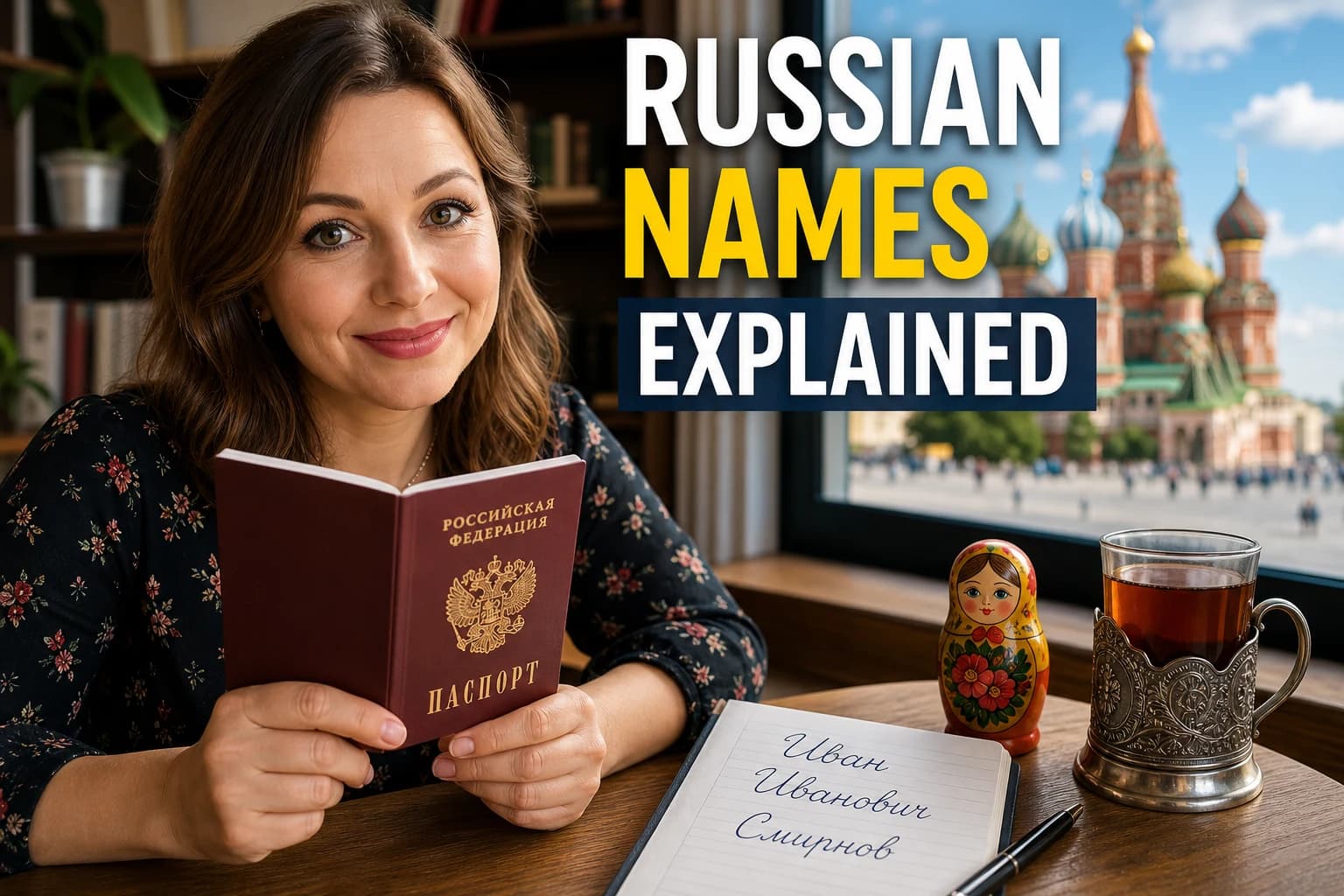
Russian Names Explained: First Name, Patronymic, Surname (and How They Decline)
A Russian name is not one word — it is three: a first name (имя), a patronymic (отчество, built from the father’s first name), and a surname (фамилия). Get the combination wrong and you can sound rude to a stranger or oddly formal with a friend. And once you start using names in real sentences, they behave like every other Russian noun: they decline.
This guide walks through how the three-part system works, how patronymics and nicknames are built, which surname ending to use for a woman versus a man, and how a name like Иван changes across all six cases.

- How the three-part имя / отчество / фамилия system works
- Building a patronymic from a father’s first name
- Common nicknames for popular Russian first names
- Surname endings and why they change with gender
- When to use ты vs. formal name + patronymic
- How names decline across the six Russian cases
How the Russian Naming System Works
Official documents, school registers, and formal introductions all use three parts: имя (first name), отчество (patronymic, from the father’s first name), and фамилия (surname). Together they identify a person the way a full legal name does in English — but the middle part is not a "middle name," it is generated from your father.
| Part | Russian term | Example (son of Иван) |
|---|---|---|
| First name | имя | Пётр |
| Patronymic | отчество | Иванович |
| Surname | фамилия | Соколов |
- The patronymic literally means "son of Иван" or "daughter of Иван" — Иванович / Ивановна.
- All three parts appear on a passport; only the first two are used in polite spoken address.
- Surnames are inherited from the family, like in English — they don’t depend on either parent’s first name.
First Names and Their Nicknames
Russians use short, affectionate forms constantly — with friends, family, and children the full name can even sound cold. Each first name has one or more standard nicknames.
| Full name | Common nicknames | Gender |
|---|---|---|
| Александр | Саша, Саня, Шура | Masculine |
| Александра | Саша, Шура | Feminine |
| Дмитрий | Дима, Митя | Masculine |
| Мария | Маша, Маруся | Feminine |
| Иван | Ваня | Masculine |
| Екатерина | Катя, Катюша | Feminine |
| Николай | Коля | Masculine |
| Наталья | Наташа | Feminine |
| Михаил | Миша | Masculine |
| Елена | Лена, Алёна | Feminine |
- Nicknames are for informal ты contexts — never combine a nickname with a patronymic (no "Саша Иванович").
- Adding suffixes like -очка/-енька makes names even more affectionate: Машенька, Ванечка.
- For gender rules behind these endings, see the [noun gender guide](/learn/articles/russian-noun-gender-guide).
Building the Patronymic (Отчество)
The patronymic is formed from the father’s first name plus a suffix that depends on gender: -ович / -евич for sons, -овна / -евна for daughters. Names ending in a soft consonant or vowel take a slightly different suffix.
| Father’s name | Son’s patronymic | Daughter’s patronymic |
|---|---|---|
| Иван | Иванович | Ивановна |
| Сергей | Сергеевич | Сергеевна |
| Александр | Александрович | Александровна |
| Дмитрий | Дмитриевич | Дмитриевна |
| Никита | Никитич | Никитична |
| Илья | Ильич | Ильинична |
- The patronymic is used together with the first name — Иван Иванович, not alone in most contexts.
- Among older generations, using the patronymic by itself (e.g., calling someone just "Ивановна") is a mark of familiar respect, common for older women in a village or workplace.
- You never choose your own patronymic — it comes automatically from your father’s name.
Surnames and Gender Agreement
Unlike English surnames, most Russian surnames change form depending on whether they belong to a man or a woman — because many surnames are grammatically adjectives.
| Masculine surname | Feminine surname | Pattern |
|---|---|---|
| Иванов | Иванова | -ов / -ова |
| Смирнов | Смирнова | -ов / -ова |
| Достоевский | Достоевская | -ский / -ская |
| Толстой | Толстая | -ой / -ая |
- Surnames ending in -ский/-ская decline exactly like adjectives — see the [adjective declension guide](/learn/articles/russian-adjective-declension).
- Surnames ending in -ов/-ев/-ин decline like nouns, with a few adjective-style endings mixed in (instrumental -ым).
- Some surnames are indeclinable: foreign-origin names and those ending in -ко, -их, -ых (e.g., Шевченко, Седых) never change, for any gender or case.
Formal vs. Informal Address: Ты, Вы, and Name Forms
Choosing the right name form is as much about the relationship as the grammar. Mixing a nickname with вы, or a full name+patronymic with ты, sounds off to a Russian ear.
| Context | Address form | Example |
|---|---|---|
| Stranger, doctor, official | Имя + Отчество + вы | Иван Иванович, вы не подскажете...? |
| New colleague, teacher | Имя + Отчество + вы | Мария Сергеевна, у меня вопрос. |
| Close friend, family | Nickname + ты | Ваня, ты идёшь? |
| Child speaking to a peer | Nickname + ты | Саша, пойдём! |
- When in doubt, default to Имя + Отчество + вы — it is never rude, only ever safe.
- Foreigners are often forgiven for skipping the patronymic, but attempting it is genuinely appreciated.
- Workplaces are shifting toward first-name-only address for younger staff — follow the room’s lead.
Declining Names by Case
Names are nouns, so they take case endings like everything else in a Russian sentence. First names follow regular noun patterns; patronymics and adjective-type surnames combine noun and adjective endings.
What about surnames like Толстой or Достоевская?
These decline exactly like adjectives: Толстого (genitive), Толстому (dative), Толстым (instrumental). If you already know adjective endings, you already know these surnames.
| Case | Иван (first name) | Ивановна (patronymic) | Иванов (surname) |
|---|---|---|---|
| Nominative | Иван | Ивановна | Иванов |
| Genitive | Ивана | Ивановны | Иванова |
| Dative | Ивану | Ивановне | Иванову |
| Accusative | Ивана | Ивановну | Иванова |
| Instrumental | Иваном | Ивановной | Ивановым |
| Prepositional | об Иване | об Ивановне | об Иванове |
- Я иду к Ивану ("I’m going to Ivan’s") uses the dative, just like any other noun after к.
- Я говорю об Ивановне ("I’m talking about Ivanovna") uses the prepositional after об.
- For the full pattern behind each case, see our [genitive](/learn/articles/russian-genitive-case), [dative](/learn/articles/russian-dative-case), and [prepositional](/learn/articles/russian-prepositional-case) guides.
Common Mistakes with Russian Names
A few habits give away a beginner immediately — and are easy to fix.
- Саша Иванович ✗ — never pair a nickname with a patronymic; use either Иван Иванович or just Ваня.
- Мария Ивановна for a woman whose father is Иван ✓ — but check gender: a father named Илья gives Ильинична, not "Ильевна".
- Forgetting that surnames like Достоевский must agree in gender: a woman is Достоевская, never "Достоевский".
- Using вы with a nickname ("Ваня, вы...") — pick one register: either full name + вы, or nickname + ты.
Frequently asked questions
- What is a Russian patronymic (отчество)?
- It is a name built from your father’s first name, used as the middle part of a formal Russian name. Sons get -ович/-евич (e.g., Иванович); daughters get -овна/-евна (e.g., Ивановна).
- Do I need to use someone’s patronymic?
- In formal, professional, or first-meeting contexts, yes — use first name + patronymic with вы. With friends and family, a nickname with ты is normal and patronymics are dropped entirely.
- Why do Russian surnames change between men and women?
- Many Russian surnames are grammatically adjectives or adjective-like nouns, so they agree in gender: Иванов (he) / Иванова (she), Достоевский (he) / Достоевская (she).
- Do Russian first names decline by case?
- Yes. First names follow regular noun declension: Иван → Ивана (genitive/accusative), Ивану (dative), Иваном (instrumental), об Иване (prepositional).
- Is it rude to use a nickname with a stranger?
- Yes, it can come across as overly familiar. Default to first name + patronymic + вы until the other person invites a more informal register.
Three parts, two genders, six cases — but a handful of patterns cover almost everyone you’ll meet.
- Use имя + отчество + вы with strangers and in formal settings
- Switch to a nickname + ты with friends and family
- Match surname endings to gender: -ов/-ова, -ский/-ская
- Remember names decline like any other Russian noun
- When unsure, the formal form is always the safe choice
Once these forms feel natural, harden the case endings behind them with our [genitive](/learn/articles/russian-genitive-case) and [dative](/learn/articles/russian-dative-case) guides, and drill declension patterns in the free [practice tool](/practice).