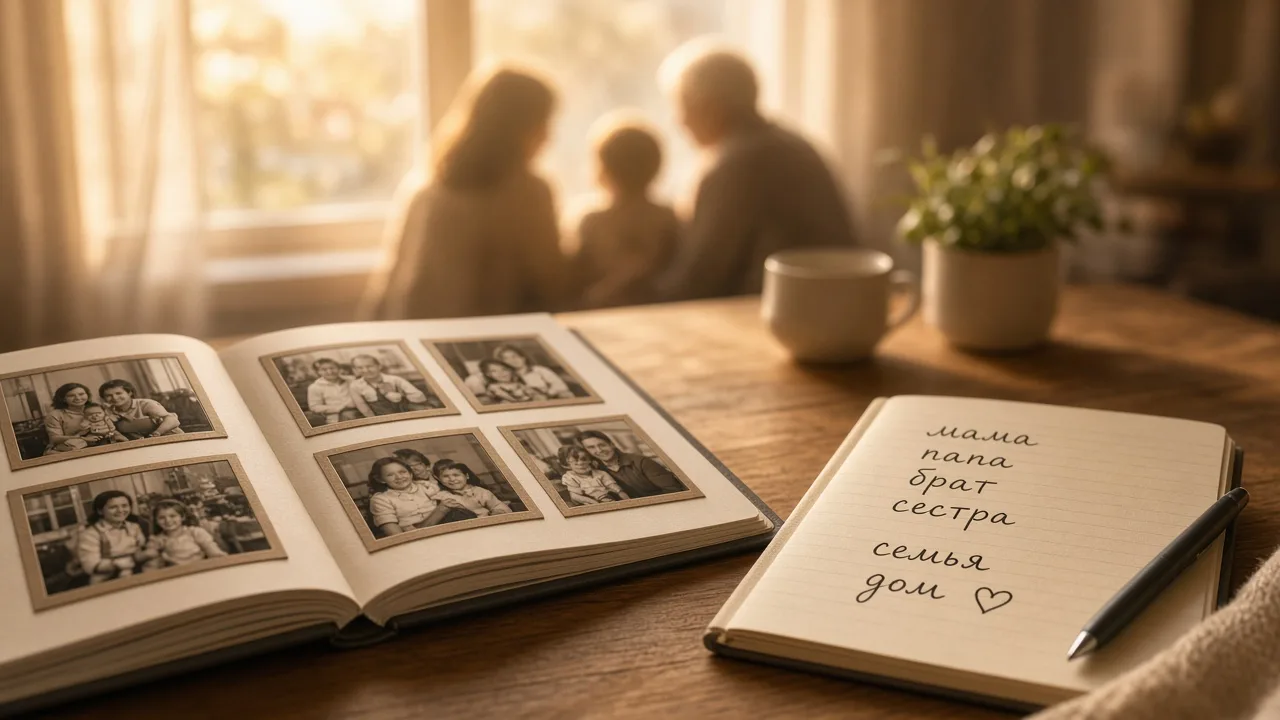
Russian Family Vocabulary: Words for Mom, Dad, Siblings & Relatives
Family words are some of the first nouns you need in Russian — and some of the most useful. You will use them to introduce yourself, ask about other people, and talk about everyday life. They also pull you straight into real grammar: irregular plurals like брат → братья, and the classic possession pattern у меня есть… with the genitive.
This guide gives you immediate and extended family vocabulary, the plurals that break the regular pattern, ready-made introduction sentences, and a short dialogue you can practise out loud.

- Core immediate-family words (parents, siblings, children, spouse)
- Extended-family vocabulary (grandparents, aunts, uncles, in-laws)
- Irregular plurals you must memorize (братья, сёстры, дети…)
- How to say "I have a…" with у + genitive
- Useful sentences for introducing your family
- A mini-dialogue you can reuse in real conversations
Immediate Family Words
Start here. These are the highest-frequency family nouns in everyday Russian — the ones you will hear in almost every personal introduction.
| Russian | Transliteration | English | Gender |
|---|---|---|---|
| мама / мать | mama / mat' | mom / mother | Feminine |
| папа / отец | papa / otets | dad / father | Masculine |
| родители | roditeli | parents | Plural |
| сын | syn | son | Masculine |
| дочь | doch' | daughter | Feminine |
| ребёнок / дети | rebyonok / deti | child / children | Masc. / Plural |
| брат | brat | brother | Masculine |
| сестра | sestra | sister | Feminine |
| муж | muzh | husband | Masculine |
| жена | zhena | wife | Feminine |
| семья | sem'ya | family | Feminine |
- Мама / папа are the everyday forms; мать / отец sound more formal or official (documents, formal speech).
- Ребёнок is singular “child”; the plural is irregular дети — not *ребёнки*.
- Семья (“family”) is feminine singular even though it means a group: моя семья большая (My family is big).
- Natural-gender override: папа, мужчина, дедушка end in -а/-я but are grammatically masculine — they take masculine adjectives (мой папа, not *моя папа*).
Extended Family Words
Once the core set is solid, add the relatives you need for storytelling, holidays, and longer introductions.
| Russian | Transliteration | English | Gender |
|---|---|---|---|
| бабушка | babushka | grandmother | Feminine |
| дедушка | dedushka | grandfather | Masculine |
| бабушка и дедушка | babushka i dedushka | grandparents | — |
| внук | vnuk | grandson | Masculine |
| внучка | vnuchka | granddaughter | Feminine |
| дядя | dyadya | uncle | Masculine |
| тётя | tyotya | aunt | Feminine |
| двоюродный брат | dvoyurodnyy brat | cousin (male) | Masculine |
| двоюродная сестра | dvoyurodnaya sestra | cousin (female) | Feminine |
| племянник | plemyannik | nephew | Masculine |
| племянница | plemyannitsa | niece | Feminine |
| свекровь | svekrov' | mother-in-law (husband's mother) | Feminine |
| тёща | tyoshcha | mother-in-law (wife's mother) | Feminine |
| свёкор | svyokor | father-in-law (husband's father) | Masculine |
| тесть | test' | father-in-law (wife's father) | Masculine |
- Russian often distinguishes whose parent an in-law is — English “mother-in-law” splits into свекровь vs тёща.
- Дядя and дедушка look feminine (-я/-а) but are masculine: мой дядя, добрый дедушка.
- “Cousin” is usually двоюродный брат / двоюродная сестра — Russian does not rely on one gender-neutral everyday word the way English does.
Irregular Plurals You Must Memorize
Several family nouns refuse the regular plural pattern. Learn these as fixed pairs — they appear constantly in conversation.
| Singular | Plural | English | Note |
|---|---|---|---|
| брат | бра́тья | brother → brothers | Irregular -ья plural |
| сын | сыновья́ / сыны́ | son → sons | сыновья is the common spoken plural |
| друг | друзья́ | friend → friends | Same -ья pattern; not family but same trap |
| ребёнок | де́ти | child → children | Suppletive plural (different root) |
| человек | лю́ди | person → people | Suppletive; useful when talking about family size |
| мать | ма́тери | mother → mothers | Stem changes |
| дочь | до́чери | daughter → daughters | Stem changes |
| сестра | сёстры | sister → sisters | Stress + ё |
| муж | мужья́ | husband → husbands | Irregular -ья |
| жена | жёны | wife → wives | Stress + ё |
- Брат → братья is one of the highest-value irregulars in beginner Russian — drill it early.
- Дети is the only normal plural of ребёнок in everyday speech.
- For more on irregular nominative plurals, see the [nominative case guide](/learn/articles/russian-nominative-case).
Talking About Your Family with У + Genitive
English “I have…” is usually у + genitive + есть in Russian. The possessor goes in the genitive after у; the thing possessed stays in the nominative.
The pattern in one line
У + me/you/him… (genitive) + есть + person/thing (nominative).
So: у меня (genitive of я), у тебя, у него / у неё, у нас, у вас, у них. After a preposition, он/она/они take the н- forms: него, неё, них.
Negation uses genitive for the thing possessed
Positive: У меня есть брат. (брат = nominative) Negative: У меня нет брата. (брата = genitive)
This is one of the first places learners feel why the [genitive case](/learn/articles/russian-genitive-case) matters so much.
| Russian | Transliteration | English |
|---|---|---|
| У меня есть брат. | U menya yest' brat. | I have a brother. |
| У меня есть сестра. | U menya yest' sestra. | I have a sister. |
| У него есть жена. | U nego yest' zhena. | He has a wife. |
| У неё есть дети. | U neyo yest' deti. | She has children. |
| У нас большая семья. | U nas bol'shaya sem'ya. | We have a big family. |
| У вас есть дети? | U vas yest' deti? | Do you have children? (formal/plural) |
- Do not say *Я имею брата* for normal “I have a brother” — it sounds unnatural in this meaning.
- Есть can drop in casual speech when an adjective is present: У нас большая семья.
- Ask follow-ups with the same pattern: А у тебя? (And you?).
Useful Sentences for Introductions
Memorize a small set of full sentences. They recycle the vocabulary above and sound natural in first meetings.
| Russian | English |
|---|---|
| Это моя семья. | This is my family. |
| Это мой папа и моя мама. | This is my dad and my mom. |
| У меня два брата и одна сестра. | I have two brothers and one sister. |
| Мой младший брат студент. | My younger brother is a student. |
| Моя старшая сестра живёт в Москве. | My older sister lives in Moscow. |
| Мы из большой семьи. | We are from a big family. |
| Знакомьтесь: это мой муж / моя жена. | Meet my husband / my wife. |
| У нас трое детей. | We have three children. |
- Старший / младший (older / younger) agree like adjectives: старшая сестра, младший брат.
- Numbers trigger case rules: два брата, три сестры, пять детей — details in the [numbers guide](/learn/articles/russian-numbers-guide) and genitive article.
- Pointing with это keeps the following noun in the nominative: Это моя мама.
Mini-Dialogue: Meet My Family
A short conversation you can adapt. Read it aloud, then swap in your own relatives.
| Speaker | Russian | English |
|---|---|---|
| Anna | Привет! Расскажи о своей семье. | Hi! Tell me about your family. |
| Ivan | У меня есть мама, папа и младшая сестра. | I have a mom, a dad, and a younger sister. |
| Anna | А братья у тебя есть? | And do you have any brothers? |
| Ivan | Нет, у меня нет братьев. А у тебя? | No, I don’t have brothers. And you? |
| Anna | У меня два брата. Старший брат женат. | I have two brothers. The older one is married. |
| Ivan | Круто. А родители где живут? | Cool. And where do your parents live? |
| Anna | В Казани. А моя бабушка живёт с нами. | In Kazan. And my grandmother lives with us. |
- Notice нет братьев — negation puts “brothers” in the genitive plural.
- Женат (married, for a man) / замужем (married, for a woman) are high-value follow-ups after family talk.
- Swap names and cities, keep the grammar frame.
Common Mistakes with Russian Family Vocabulary
- Saying *моя папа*. Папа is masculine → мой папа.
- Using *ребёнки* as the plural. Use дети.
- Forgetting genitive after нет: *У меня нет брат* ✗ → У меня нет брата ✓.
- Mixing свекровь and тёща — they are not interchangeable.
- Translating “I have” as я имею in casual family talk — prefer у меня есть.
Frequently asked questions
- What are the most important Russian family words for beginners?
- Start with мама, папа, брат, сестра, сын, дочь, муж, жена, ребёнок/дети, and семья. Add бабушка, дедушка, дядя, and тётя next. These cover almost every beginner introduction.
- How do you say “I have a brother” in Russian?
- Say У меня есть брат. The possessor (меня) is genitive after у, and брат stays nominative. For “I don’t have a brother,” say У меня нет брата — брата is genitive.
- Why is папа masculine if it ends in -а?
- Because natural gender wins for male people. Words like папа, дедушка, дядя, and мужчина look feminine in spelling but take masculine agreement: мой папа, добрый дедушка.
- What is the plural of брат and ребёнок?
- Брат → братья (irregular). Ребёнок → дети (a different root entirely). Both are must-memorize forms for family conversations.
- How do Russians say “cousin”?
- Usually двоюродный брат for a male cousin and двоюродная сестра for a female cousin. There is no single everyday gender-neutral word that works like English “cousin” in all contexts.
Family vocabulary is a perfect beginner package: useful words plus grammar that actually shows up in speech.
- Learn immediate family first, then extended relatives and in-laws
- Memorize the irregular plurals: братья, дети, мужья, сёстры…
- Build every “I have…” sentence with у + genitive + (есть) + nominative
- Use нет + genitive for “I don’t have…”
- Practise with a short dialogue until the frames feel automatic
When these sentences feel easy, push the grammar further with our [genitive case guide](/learn/articles/russian-genitive-case) and free [declension practice](/practice) — family talk is one of the fastest ways to make cases feel real.