Russian Dative Case: Rules, Endings, нравиться & 30 Examples | Russian Cases with Anna
The Russian dative case is one of the most versatile — and most fascinating — cases in the Russian language. While its textbook role is to mark the indirect object (the recipient of an action), the dative goes far beyond "giving things to people".
It is the case of experience, sensation, age, permission, and personal relevance. If you've ever wondered how to say "I like", "I am cold", "I need", "I am allowed to", or "I am 25 years old" in Russian — the answer in every case involves the dative.
What you'll learn:
- What the Russian dative case is and its 6 core uses
- Dative endings for nouns (all genders, singular & plural)
- Dative endings for adjectives
- Personal pronouns in the dative (мне, тебе, ему, ей, нам, вам, им)
- The НРАВИТЬСЯ construction — how to say "I like" in Russian
- Age expressions (Мне 25 лет.)
- Impersonal expressions (нужно, можно, нельзя, холодно, скучно…)
- Prepositions к, по, благодаря, вопреки…
- 15 verbs that take dative indirect objects
- 30 real examples with transliteration
- Dative vs. other cases — how to tell them apart
Quick Answer
The Russian dative case answers Кому? (To whom?) and Чему? (To what?).
- Indirect objects — the recipient of an action
- Age expressions — Мне 25 лет (I am 25 years old)
- Experiencer of emotions — мне нравится (I like), мне холодно (I am cold)
- Required after prepositions — к (toward) and по (along/according to)
What Is the Russian Dative Case?
The dative case (Дательный падеж — from дать, "to give") is the third of the six Russian cases. Its name reflects its original function: it marks the recipient of giving.
In modern Russian, it does far more.
The dative case is used for:
- Indirect objects — the recipient (Я дал маме цветы — I gave mom flowers)
- The НРАВИТЬСЯ construction — "to like" (Мне нравится… — I like…)
- Age expressions (Мне двадцать лет. — I am twenty years old.)
- Impersonal/modal expressions (Мне нужно, мне можно, мне холодно, мне скучно)
- After prepositions К (toward) and ПО (along/according to/after)
- After verbs of communication, help, instruction, belief, envy
Russian Dative Case Endings — Nouns
The dative is one of the most regular cases in Russian.
The endings follow clear patterns based on gender and stem type:
Dative noun endings — all genders, singular & plural
| Noun type | Ending | Formation | Result | Example in context | | --- | --- | --- | --- | --- | | Masc. hard (consonant) | -у | брат → брат+у | брату | Я дал книгу брату. — I gave the book to my brother. | | Masc. soft (-й) | -ю | музей → музе+ю | музею | Подари это музею. — Donate this to the museum. | | Masc. soft (-ь) | -ю | словарь → словар+ю | словарю | Я доверяю словарю. — I trust the dictionary. | | Fem. hard (-а) | -е | сестра → сестр+е | сестре | Я звоню сестре. — I am calling my sister. | | Fem. soft (-я) | -е | земля → земл+е | земле | Привет земле! — Hello to the earth! | | Fem. in -ия | -ии | станция → станци+и | станции | Иди к станции метро. — Go to the metro station. | | Fem. (-ь) | -и | ночь → ноч+и | ночи | К ночи похолодало. — It got cold by night. | | Neuter (-о) hard | -у | окно → окн+у | окну | Подойди к окну. — Come to the window. | | Neuter (-е) soft | -ю | море → мор+ю | морю | Мы едем к морю. — We are going to the sea. | | Neuter (-ие) | -ию | здание → здани+ю | зданию | Иди к зданию. — Go to the building. | | Masc./Neuter plural | -ам/-ям | братья → брать+ям | братьям | Я помогаю братьям. — I help my brothers. | | Fem. plural | -ам/-ям | сёстры → сёстр+ам | сёстрам | Я пишу сёстрам. — I am writing to my sisters. |
- Masc. & Neuter (hard stem) — -У: брат→брату, окно→окну
- Masc. & Neuter (soft stem) — -Ю: музей→музею, море→морю
- Feminine -а — -Е: сестра→сестре
- Feminine -я — -Е: земля→земле
- Feminine -ия — -ИИ: станция→станции
- Feminine -ь — -И: ночь→ночи
- Plural (hard stem) — -АМ: братья→братьям
- Plural (soft stem) — -ЯМ: сёстры→сёстрам
Russian Dative Case Endings — Adjectives
Adjectives must agree with their noun in gender, number, and case.
In the dative:
5 adjective forms with full sentence examples
| Gender/Number | Ending | Example form | Meaning | Sentence | | --- | --- | --- | --- | --- | | Masc./Neuter hard | -ому | новый → новому брату | new brother (dat.) | Я помогаю новому брату. | | Masc./Neuter soft | -ему | синий → синему морю | blue sea (dat.) | Мы едем к синему морю. | | Fem. hard | -ой | красивая → красивой | beautiful (dat.) | Я звоню красивой подруге. | | Fem. soft | -ей | летняя → летней | summer (dat.) | В летней школе нравится. | | Plural all genders | -ым/-им | новые → новым | new ones (dat. pl.) | Помоги новым студентам. |
- Masc./Neuter hard → -ому (новый → новому брату)
- Masc./Neuter soft → -ему (синий → синему морю)
- Feminine hard → -ой (красивая → красивой подруге)
- Feminine soft → -ей (летняя → летней школе)
- Plural (all genders) → -ым/-им (новые → новым студентам)
- Example: Я пишу старому другу — I am writing to my old friend.
Personal Pronouns in the Dative Case
Personal pronouns have unique dative forms that must be memorized.
These are among the most frequently used words — you'll need them for нравиться, age expressions, and impersonal sentences.
7 forms with нравится examples
| я (I) | ты (you) | он/оно (he/it) | она (she) | мы (we) | вы (you pl.) | они (they) | | --- | --- | --- | --- | --- | --- | --- | | мне | тебе | ему | ей | нам | вам | им | | Мне нравится. | Тебе нравится. | Ему нравится. | Ей нравится. | Нам нравится. | Вам нравится. | Им нравится. |
- After к: к нему, к ней, к ним (add Н- to third-person pronouns)
- After по: по нему, по ней (add Н- to third-person pronouns)
- Never: к ему, к ей — always add the Н- prefix
The НРАВИТЬСЯ Construction: How to Say "I Like" in Russian
The most important use of the dative is нравиться (to like / to please). In English: subject LIKES object.
In Russian: object PLEASES dative person → Мне нравится музыка. (Music pleases me.)
The #1 mistake with нравиться
The verb НРАВИТЬСЯ agrees with the SUBJECT (the thing that is liked), not the person. Мне нравится музыка. (singular) Мне нравятся фильмы. (plural) The person goes in the DATIVE — never nominative! ✗ Я нравится музыка. ✓ Мне нравится музыка.
10 forms: present, past, future, negation
| English | Russian (нравиться) | Notes | | --- | --- | --- | | I like | Мне нравится музыка. | нравится agrees with музыка — singular | | You like | Тебе нравятся фильмы. | нравятся agrees with фильмы — plural | | He likes | Ему нравится эта книга. | He likes this book. | | She likes | Ей нравится твой голос. | She likes your voice. | | We like | Нам нравится здесь. | здесь = here, no subject noun | | You (pl.) like | Вам нравятся эти места. | You like these places. | | They like | Им нравится русский язык. | They like the Russian language. | | I liked | Мне понравился фильм. | perfective past, masc. agreement | | I will like | Мне понравится этот город. | future perfective | | I don't like | Мне не нравится шум. | negation: не + нравится |
- Нравиться = spontaneous appreciation. Любить = deeper, habitual love. Both common. Нравиться more neutral; любить stronger.
Age Expressions: How to Say How Old Someone Is in Russian
Russian expresses age using the dative case: [Person in dative] + [number] + [год/года/лет].
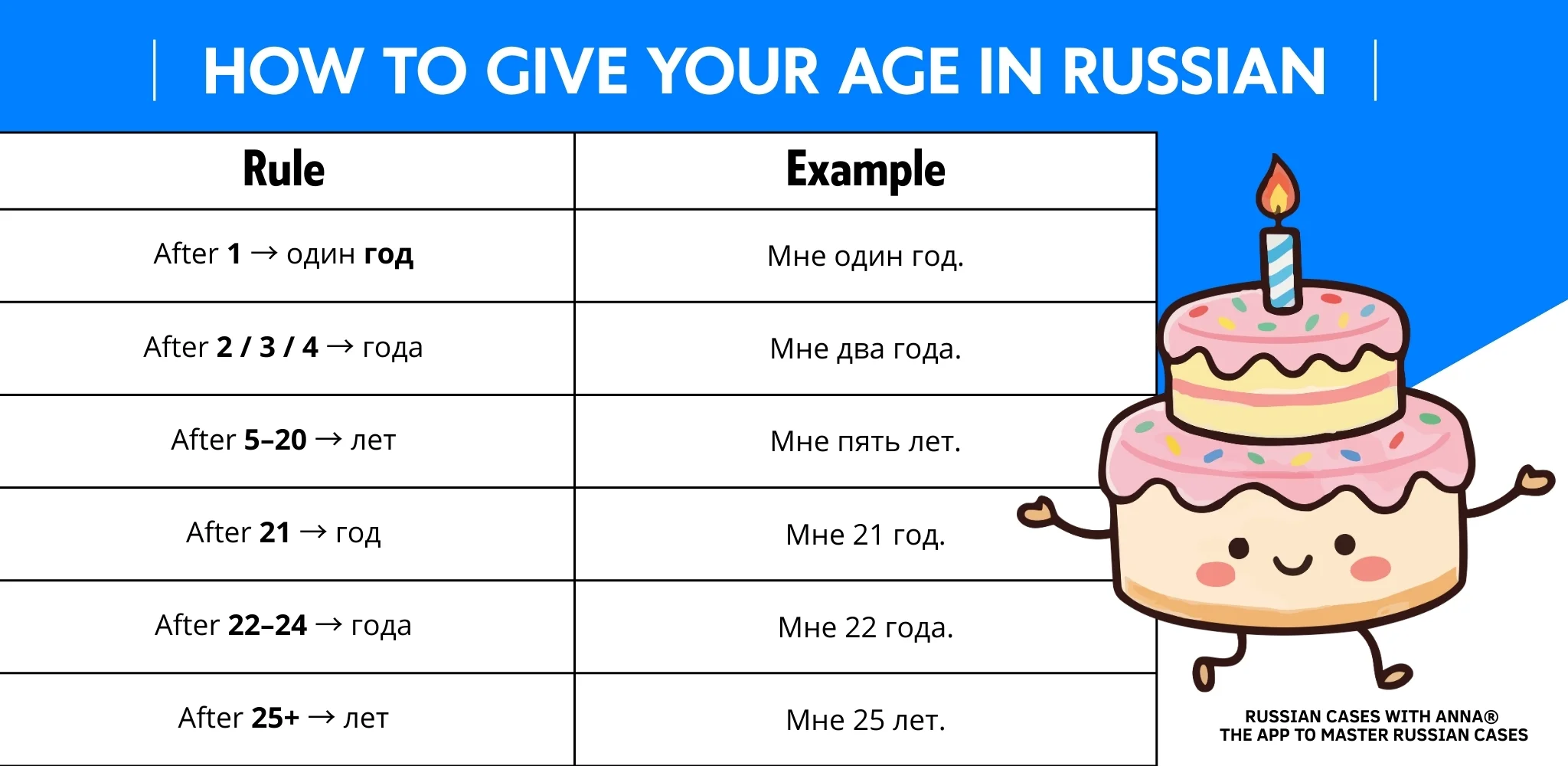
9 examples covering 1/2-4/5+ + questions and birthdays
| English | Russian | Grammar note | | --- | --- | --- | | I am 10 years old | Мне десять лет. | Мне (dative of я) + 10 + лет | | You are 25 years old | Тебе двадцать пять лет. | Тебе (dative of ты) | | He is 30 years old | Ему тридцать лет. | Ему (dative of он) | | She is 18 years old | Ей восемнадцать лет. | Ей (dative of она) | | We are 40 years old | Нам сорок лет. | Нам (dative of мы) | | Ivan is 2 years old | Ивану два года. | Ивану + 2 + года (gen. sg. after 2) | | Anna is 5 years old | Анне пять лет. | Анне + 5 + лет (gen. pl.) | | The cat is 3 years old | Коту три года. | Works for animals too! | | How old are you? | Сколько тебе лет? | Сколько + dative pronoun + лет |
- 1 year → год (Мне один год. — I am one year old.)
- 2–4 years → года (Мне два года. Тебе четыре года.)
- 5+ years → лет (Мне двадцать пять лет. — I am 25 years old.)
- Birthdays: Ивану исполнилось тридцать лет. — Ivan turned 30. Когда тебе исполнится восемнадцать? — When will you turn 18?
Impersonal and Modal Expressions with the Dative
Some of the most common everyday Russian expressions use the dative to mark the person who experiences a state, feeling, or obligation.
These are impersonal constructions — no grammatical subject.
12 constructions: нужно, можно, нельзя, etc.
| Expression | Russian example | Translation | Grammar note | | --- | --- | --- | --- | | нужно / надо | Мне нужно работать. | I need to work. | Dative = person who needs | | можно | Тебе можно идти. | You may go. | Dative = person who is allowed | | нельзя | Ему нельзя есть сахар. | He must not eat sugar. | Dative = person forbidden | | нужен/нужна/нужно | Мне нужна помощь. | I need help. | Agrees with the needed thing | | интересно | Мне интересно. | I find it interesting. | Dative = interested person | | скучно | Ей скучно на уроке. | She is bored in class. | Dative = bored one | | весело | Нам было весело. | We had fun. | Past: было + dative | | грустно | Ему грустно без тебя. | He is sad without you. | Emotional state | | холодно / жарко | Мне холодно. | I am cold. | Physical sensation | | стыдно | Мне стыдно за тебя. | I am ashamed of you. | Dative experiencer | | трудно | Ей трудно учиться. | It is hard for her to study. | Difficulty | | лучше / хуже | Мне лучше сегодня. | I feel better today. | Health/state |
- Obligation / permission — мне нужно (I need), тебе можно (you may), ему нельзя (he must not)
- Physical sensations — мне холодно (I am cold), мне жарко (I am hot)
- Emotions / states — ей скучно (she is bored), ему грустно (he is sad), нам весело (we have fun)
- Difficulty / evaluation — ей трудно (it is hard for her), мне лучше (I feel better)
- Pattern: [Person in dative] + [predicative word] + [optional infinitive] — Мне нужно купить продукты. Тебе можно отдохнуть. Ему нельзя курить.
Dative Case Prepositions: К and ПО (and Others)
Two major Russian prepositions always require the dative case: к and по.
Several others also take the dative:
К (Toward / To) — Direction Preposition
К expresses movement toward a person, place, or goal. It is the dative equivalent of в/на for direction — but к is used when moving toward a person or object, not into an enclosed space.
Иди к врачу. Подойди к доске. Мы стремимся к цели.
ПО — The Multi-Purpose Preposition
По is one of the most versatile prepositions in Russian. With the dative:
- Movement along — гулять по парку (to walk around the park)
- Distribution — по одному яблоку (one apple each)
- Means / channel — по телефону, по почте (by phone, by mail)
- Subject / topic — урок по математике (math lesson)
- Recurring time — по понедельникам (on Mondays, every Monday)
- According to — по закону (according to the law)
- По + dative plural = every [day]: по понедельникам — on Mondays | в понедельник — on (a specific) Monday
8 prepositions with meaning and full examples
| Prep. | Meaning | With a noun | Full example + translation | | --- | --- | --- | --- | | к | toward / to (person or place) | к другу, к врачу, к окну | Иди к врачу! — Go to the doctor! | | по | along / around / according to / by | по улице, по правилам, по почте | Мы гуляли по парку. — We walked around the park. | | благодаря | thanks to (positive) | благодаря тебе | Благодаря тебе всё получилось! — Thanks to you! | | вопреки | contrary to / despite | вопреки правилам | Вопреки прогнозу, погода была хорошей. | | согласно | according to (formal) | согласно закону | Согласно закону, это запрещено. | | навстречу | toward / to meet | навстречу ветру | Она шла навстречу ветру. — She walked into the wind. | | наперекор | in defiance of | наперекор судьбе | Наперекор судьбе он добился успеха. | | подобно | similar to / like (literary) | подобно птице | Подобно птице, он был свободен. |
15 Essential Verbs That Take the Dative Case
These verbs take their indirect object in the dative. Essential to learn with their dative object.
15 verbs with examples and notes
| Verb | Example | Translation | Note | | --- | --- | --- | --- | | давать / дать | Я дал ему книгу. | I gave him a book. | Classic indirect object | | говорить / сказать | Скажи мне правду. | Tell me the truth. | Telling to someone | | писать / написать | Я написал тебе письмо. | I wrote you a letter. | Writing to someone | | звонить / позвонить | Позвони маме. | Call your mother. | Calling someone | | помогать / помочь | Помоги мне! | Help me! | Helping someone | | нравиться / понравиться | Мне нравится музыка. | I like music. | Dative = experiencer | | показывать / показать | Покажи мне карту. | Show me the map. | Showing to someone | | объяснять / объяснить | Объясни мне это. | Explain this to me. | Explaining to someone | | отвечать / ответить | Ответь мне на вопрос. | Answer my question. | Answering to someone | | разрешать / разрешить | Разреши мне уйти. | Allow me to leave. | Giving permission | | мешать / помешать | Не мешай мне! | Don't bother me! | Disturbing someone | | советовать | Советую тебе поехать. | I advise you to go. | Giving advice | | верить / поверить | Я верю тебе. | I believe you. | Trusting someone | | завидовать | Он завидует другу. | He envies his friend. | Feeling envy | | принадлежать | Это принадлежит мне. | This belongs to me. | Belonging to someone |
- Giving & transferring — давать/дать (to give), показывать (to show)
- Communication — говорить/сказать (to tell), писать (to write), звонить (to call), объяснять (to explain), отвечать (to answer)
- Help & permission — помогать (to help), разрешать (to allow), советовать (to advise)
- Feelings & states — нравиться (to like), верить (to believe), завидовать (to envy), мешать (to bother)
- Possession — принадлежать (to belong to)
30 Real Russian Dative Case Examples
Below are 30 authentic sentences demonstrating every major use of the dative.
30 examples grouped by usage
| # | Russian | Transliteration | Translation & notes | | --- | --- | --- | --- | | 1 | Я дал маме цветы. | Ya dal mame tsvety. | I gave flowers to my mother. (мама → маме) | | 2 | Скажи мне правду. | Skazhi mne pravdu. | Tell me the truth. (мне = dative of я) | | 3 | Он написал другу длинное письмо. | On napisal drugu dlinnoye pismo. | He wrote a long letter to his friend. | | 4 | Помогите мне, пожалуйста! | Pomogite mne, pozhaluysta! | Please help me! | | 5 | Я позвонила бабушке. | Ya pozvonila babushke. | I called my grandmother. (бабушка → бабушке) | | 6 | Преподаватель объяснил нам грамматику. | Prepodavatel obyasnil nam grammatiku. | The teacher explained grammar to us. | | 7 | Мне нравится русская музыка. | Mne nravitsya russkaya muzyka. | I like Russian music. (мне = experiencer) | | 8 | Тебе понравился фильм? | Tebe ponravilsya film? | Did you like the film? (понравился agrees with фильм) | | 9 | Ей не нравятся эти правила. | Ey ne nravyatsya eti pravila. | She doesn't like these rules. | | 10 | Нам понравилась Москва. | Nam ponravilas Moskva. | We liked Moscow. (понравилась agrees with Москва) | | 11 | Мне двадцать три года. | Mne dvadtsat tri goda. | I am 23 years old. | | 12 | Брату исполнилось пять лет. | Bratu ispolnilos pyat let. | My brother turned five. | | 13 | Сколько лет вашей маме? | Skolko let vashey mame? | How old is your mother? | | 14 | Иди к врачу немедленно! | Idi k vrachu nemedlenno! | Go to the doctor! (к + dat.) | | 15 | Мы подошли к морю на закате. | My podoshli k moryu na zakate. | We came to the sea at sunset. | | 16 | Она шла навстречу судьбе. | Ona shla navstrechu sudbe. | She walked toward her destiny. | | 17 | Благодаря вам проект удался. | Blagodarya vam proyekt udalsya. | Thanks to you, the project succeeded. | | 18 | Вопреки ожиданиям, всё получилось. | Vopreki ozhidaniyam, vsyo poluchilos. | Contrary to expectations. | | 19 | По правилам, это запрещено. | Po pravilam, eto zapreshcheno. | According to the rules. | | 20 | Мне нужно поговорить с тобой. | Mne nuzhno pogovorit s toboy. | I need to talk to you. | | 21 | Тебе можно идти домой. | Tebe mozhno iti domoy. | You may go home. | | 22 | Ему нельзя пить кофе. | Emu nelzya pit kofe. | He must not drink coffee. | | 23 | Мне холодно, закрой окно. | Mne holodno, zakroy okno. | I am cold, close the window. | | 24 | Ей скучно одной дома. | Ey skuchno odnoy doma. | She is bored at home alone. | | 25 | Нам было очень весело на вечеринке. | Nam bylo ochen veselo na vecherinke. | We had a great time at the party. | | 26 | Мне стыдно за своё поведение. | Mne stydno za svoyo povedeniye. | I am ashamed of my behavior. | | 27 | Советую вам прочитать эту книгу. | Sovetuyu vam prochitat etu knigu. | I advise you to read this book. | | 28 | Он завидует нашему успеху. | On zaviduyet nashemu uspekhu. | He envies our success. | | 29 | Я верю каждому его слову. | Ya veryu kazhdomu yego slovu. | I believe his every word. | | 30 | Желаю вам счастья и здоровья! | Zhelayu vam schastya i zdorovya! | I wish you happiness and health! |
- 1–6: Indirect objects (giving, telling, helping, etc.)
- 7–10: Нравиться construction
- 11–13: Age expressions
- 14–19: Prepositions (к, навстречу, благодаря, вопреки, по)
- 20–26: Impersonal expressions (нужно, можно, холодно, скучно…)
- 27–30: Other verbs (советовать, завидовать, верить, желать)
Dative vs. Other Cases: How to Tell Them Apart
The dative is sometimes confused with the genitive (possession) and accusative (direct objects).
This table will help:
Dative vs. other cases comparison
| Context | Russian example | Case explanation | | --- | --- | --- | | Indirect object → Dative | Я дал книгу другу. | DATIVE: другу (to a friend). Book given TO the friend. | | Direct object → Accusative | Я купил книгу. | ACCUSATIVE: книгу (the book itself). | | Possession → Genitive | Это книга друга. | GENITIVE: друга (the friend's book). | | Liking (нравиться) → Dative | Мне нравится книга. | DATIVE: мне. Do NOT use я here. | | Need (нужен) → Dative | Мне нужна эта книга. | DATIVE: мне (I am the one who needs it). | | Direction к → Dative | Иди к другу. | DATIVE after к: другу (toward the friend). | | Location у → Genitive | Я у друга. | GENITIVE after у: друга (at the friend's place). | | Age expression → Dative | Другу двадцать лет. | DATIVE: другу (the friend is 20). |
- Key question: Is the noun the RECEIVER of an action (→ dative)? Or OWNED (→ genitive), ACTED UPON (→ accusative), or LOCATION (→ prepositional)?
Top 6 Dative Case Mistakes (And How to Fix Them)
- Using nominative for the "liker" — Я нравится музыка ✗ → Мне нравится музыка ✓
- Verb agreement with нравиться — Мне нравится фильмы ✗ → Мне нравятся фильмы ✓ (agrees with subject)
- Wrong pronoun after preposition — к ей ✗ → к ней ✓ (add Н- to third-person pronouns)
- Confusing к with в/на — Иди к школу ✗ → Иди в школу ✓ (к = toward person/object; в = into space)
- Forgetting -ии for -ия nouns — к станце ✗ → к станции ✓ (станция → станции)
- нужен agreement — Мне нужен помощь ✗ → Мне нужна помощь ✓ (agrees with the THING needed)
Practice Russian dative case exercises on your phone
Our mobile app drills all 6 Russian cases — with special focus on нравиться, age expressions, impersonal constructions, and indirect objects. Available on Android and iOS.
Download the app and start drilling today
- Uses: indirect object, experiencer of нравиться, age, impersonal expressions (мне нужно, мне холодно), after prepositions к and по
- Noun endings: Masc./Neut. hard→-У, soft→-Ю | Fem. -а/-я→-Е, -ия→-ИИ, -ь→-И | Plural hard→-АМ, soft→-ЯМ
- Personal pronouns: мне, тебе, ему, ей, нам, вам, им
- НРАВИТЬСЯ: person in dative; verb agrees with thing liked
- Age: [dative] + number + год/года/лет
- After prepositions: add Н- to third-person pronouns (к нему, к ней, к ним)
Continue with the rest of our Russian grammar series:
Related guides:
- The Complete Guide to Russian Cases
- Russian Case Endings: The Ultimate Cheat Sheet
- Russian Genitive Case: Rules, Endings & 32 Real Examples
- Russian Accusative Case: Direct Objects, Animate vs. Inanimate
- How to Decline in the Dative Case in Russian
Frequently Asked Questions
What is the dative case used for in Russian?
The Russian dative case is used for: indirect objects (Я дал маме цветы), the нравиться construction (Мне нравится — I like), age expressions (Мне 25 лет), impersonal expressions (Мне нужно, Мне холодно), and after prepositions к (toward) and по (along/according to).
How do you say "I like" in Russian?
Use [person in dative] + нравится/нравятся + [subject]. Мне нравится музыка (Music appeals to me = I like music). Нравится for singular, нравятся for plural. For stronger preference: Я люблю классическую музыку.
How do you express age in Russian?
[Person in dative] + [number] + год/года/лет. один год (1), два/три/четыре года (2-4), пять лет (5+). Мне двадцать пять лет. To ask: Сколько тебе лет?
What is the difference between к and в/на for direction?
К + dative = toward a person or object: Иди к врачу. В/НА + accusative = into/onto a place: Иди в магазин. К is for people/objects; в/на for locations and spaces.
What does по mean in Russian?
По with dative expresses: movement along (гулять по парку), distribution (по одному), means (по телефону), subject (урок по математике), recurring time (по понедельникам), conformity (по закону).
Which verbs take the dative case in Russian?
давать/дать, говорить/сказать, писать, звонить, помогать, показывать, объяснять, советовать, верить, завидовать, мешать, принадлежать. Нравиться takes the experiencer in the dative.