Russian Prepositional Case: Endings, в vs на, о чём & 30 Examples | Russian Cases with Anna
The Russian prepositional case has a distinction no other case can claim: it is the only Russian case that is never used without a preposition. Every other case can appear in a sentence on its own — a noun in the nominative is simply the subject, a noun in the instrumental can be a tool. But a noun in the prepositional? It always comes attached to в, на, о, при, or по.
This makes it paradoxically one of the easiest to master: if you see one of those five prepositions, you know the prepositional case follows. And the endings themselves are among the most consistent in Russian grammar.
What you'll learn:
- What makes the prepositional case unique among the 6 Russian cases
- Its 3 core uses: location, topic, and conditions
- Complete endings table for nouns (all genders, singular & plural)
- The special -ИИ ending for nouns in -ий/-ие/-ия
- The locative remnant: irregular -У endings (в лесу, на полу, в году)
- В vs. НА — when to use each for location
- О/ОБ — the "about" preposition and how to use it correctly
- О чём? — how to ask "about what?" in Russian
- 10 key verbs that use о + prepositional
- 30 real Russian example sentences with transliteration
Quick Answer
The prepositional case answers О ком? (About whom?) and О чём? (About what?) — and also Где? (Where?) when expressing location.
It is used for location (в школе — at school), topic (о работе — about work), and conditions (при Сталине — under Stalin).
What Is the Russian Prepositional Case?
The prepositional case (Предложный падеж — literally 'the proposed/prepositional case') is the sixth and last of the Russian cases. Unlike the other five cases which can sometimes function without a preposition, the prepositional is always preceded by one of five prepositions: в, на, о/об, при, or по (in certain constructions).
Core examples: Я живу в Москве. — I live in Moscow. | Мы говорим о работе. — We talk about work.
The prepositional case is used with:
- В + location (in/inside a place): Я в школе. — I am at school.
- НА + location (on/at a place): Книга на столе. — The book is on the table.
- О/ОБ + topic (about): Мы говорим о погоде. — We talk about the weather.
- ПРИ + conditions/presence (under/in the presence of): при Сталине, при свидетелях
- ПО + certain fixed expressions (upon, after): по приезде (upon arrival)
Key rule
The prepositional NEVER appears without one of these prepositions — guaranteed!
Russian Prepositional Case Endings — Complete Table
The prepositional case has some of the most regular endings in Russian. Most nouns simply take -Е in the singular.
The key exceptions are nouns ending in -ий, -ие, -ия (which take -ИИ) and a small group with irregular locative -У forms.
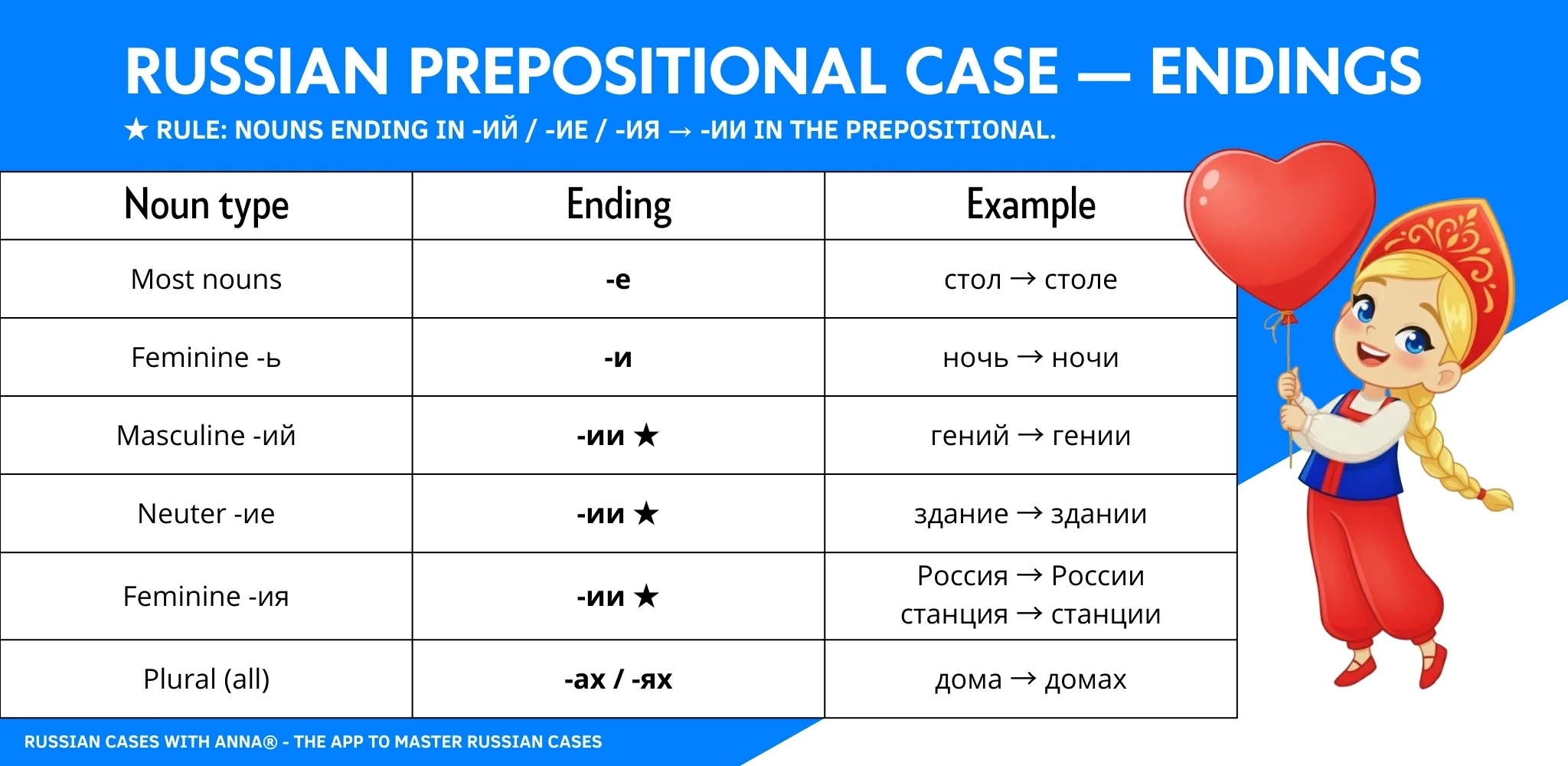
Prepositional case endings by noun type
| Noun type | Ending | Formation | Result | Example in context | | --- | --- | --- | --- | --- | | Masc. hard (consonant) | -е | стол → стол+е | столе | книга на столе — book on the table | | Masc. soft (-й) | -е | музей → музе+е | музее | в музее — in the museum | | Masc. soft (-ь) | -е | словарь → словар+е | словаре | в словаре — in the dictionary | | Masc./Neut. in -ий/-ие | -ии | гений → гени+и / здание → здани+и | гении / здании | в здании — in the building | | Fem. hard (-а) | -е | страна → стран+е | стране | в стране — in the country | | Fem. soft (-я) | -е | земля → земл+е | земле | на земле — on the ground | | Fem. in -ия | -ии | станция → станци+и | станции | на станции — at the station | | Fem. (-ь) | -и | ночь → ноч+и | ночи | в ночи — in the night | | Neuter (-о) | -е | окно → окн+е | окне | в окне — in the window | | Neuter (-е) | -е | море → мор+е | море | в море — in the sea | | Neuter in -ие | -ии | здание → здани+и | здании | в здании — in the building | | Plural (all genders) | -ах/-ях | столы→столах / моря→морях | столах / морях | в домах — in the houses |
- The golden rule: almost everything takes -Е in the prepositional singular.
- Masculine -ий — -ИИ: гений → о гении
- Neuter -ие — -ИИ: здание → в здании, упражнение → в упражнении
- Feminine -ия — -ИИ: станция → на станции, Россия → в России
- Feminine -ь — -И: ночь → о ночи
- Plural (hard stem) — -АХ: в домах
- Plural (soft stem) — -ЯХ: в морях, о людях
The Special -ИИ Ending: Nouns in -ий, -ие, -ия
The most important exception to the standard -Е ending is the group of nouns ending in -ий (masculine), -ие (neuter), and -ия (feminine). These take -ИИ in the prepositional case instead of the expected -Е.
This is a very common source of errors.
The -ИИ rule — examples you MUST know:
- Masculine -ий — гений → о гении (not о гение)
- Neuter -ие — здание → в здании, упражнение → в упражнении, путешествие → о путешествии
- Feminine -ия — станция → на станции, Россия → в России, революция → о революции, Италия → в Италии
Memory trick
-ий/-ие/-ия all end in И — they keep that И in the prepositional.
The Locative Case Remnant: Irregular -У Endings
A small but very common group of masculine nouns have an irregular prepositional ending: -У (or -Ю for soft stems) instead of the standard -Е. This special form is called the 'locative' (местный падеж) — a remnant of an older Russian case, used exclusively with в and на when expressing location (not topic).
These nouns have TWO prepositional forms: the -У form for location (в/на + place) and the regular -Е form for topic (о + subject).
Locative -У vs regular prepositional -Е
| Noun | Locative (в/на + location) | Regular prep. (о + topic) | Example sentence | | --- | --- | --- | --- | | лес (forest) | в лесу | о лесе | Мы заблудились в лесу. — We got lost in the forest. | | сад (garden) | в саду | о саде | Дети играют в саду. — Children play in the garden. | | год (year) | в году | о годе | Сколько дней в году? — How many days in a year? | | пол (floor) | на полу | о поле | Кот лежит на полу. — The cat lies on the floor. | | берег (shore) | на берегу | о береге | Мы отдыхали на берегу. — We rested on the shore. | | угол (corner) | в углу | об угле | Стол стоит в углу. — The table stands in the corner. | | нос (nose/bow) | на носу | о носе | Очки на носу. — Glasses are on the nose. | | порт (port) | в порту | о порте | Корабль в порту. — The ship is in port. | | мост (bridge) | на мосту | о мосте | Встретимся на мосту. — Let's meet on the bridge. | | снег (snow) | в снегу | о снеге | Дети играли в снегу. — Children played in the snow. |
- В/НА + [locative -У] = physical location (where something IS): в лесу, на полу, в порту
- О + [regular -Е] = topic, subject of discussion: о лесе, о поле, о порте
- These nouns are common and high-frequency — worth memorizing as a set.
В vs. НА — Which to Use for Location?
Two prepositions — в and на — can both mean 'at' or 'in' for location in the prepositional case.
Choosing the right one is one of the trickiest aspects of Russian location grammar.
В vs. НА for location and direction
| Location type | В/НА + prepositional (location) | В/НА + accusative (direction) | Example | | --- | --- | --- | --- | | Country | в России, в Германии, в Китае | в Россию (acc.) | В России холодно зимой. — It is cold in Russia in winter. | | City | в Москве, в Лондоне, в Париже | в Москву (acc.) | Он живёт в Москве. — He lives in Moscow. | | Building | в школе, в банке, в больнице | в школу (acc.) | Дети в школе. — The children are at school. | | Island/peninsula | на Кубе, на Сахалине | на Кубу (acc.) | Они отдыхают на Кубе. — They vacation in Cuba. | | Open space | на улице, на площади | на улицу (acc.) | Дети играют на улице. — Children play outside. | | Event | на концерте, на конференции | на концерт (acc.) | Я был на концерте. — I was at the concert. | | Work/institution | на работе, на заводе, на почте | на работу (acc.) | Она на работе. — She is at work. | | Floor/surface | на полу, на столе, на крыше | на пол (acc.) | Кот сидит на полу. — The cat sits on the floor. |
- В (in/inside) is used for enclosed spaces: rooms, buildings, countries, cities.
- НА (on/at) is used for surfaces, open spaces, events, and certain institutions by convention.
- Tricky НА locations (use на, not в): на работе, на почте, на заводе, на рынке, на вокзале, на стадионе, на Украине, на Кубе, на Сахалине.
О/ОБ: The "About" Preposition in Russian
The preposition о (or об before words starting with a vowel sound) followed by the prepositional case is used to express the topic of conversation, thought, writing, or any form of mental engagement.
О vs. ОБ
Use ОБ when the next word starts with a vowel (а, е, ё, и, о, у, э, ю, я) or with Ъ or Ь. In all other cases, use О.
- о работе (about work) — standard О
- об этом (about this) — ОБ before э
- о ней (about her) — standard О
- об Иване (about Ivan) — ОБ before И
- об ошибке (about the mistake) — ОБ before О
О чём? — How to Ask "About What?" in Russian
The question form О чём? (About what?) is the prepositional form of что (what).
This is one of the most useful question words in Russian.
- О чём вы говорите? — What are you talking about?
- О чём эта книга? — What is this book about?
- О чём ты думаешь? — What are you thinking about?
- О чём ты мечтаешь? — What do you dream about?
- О ком вы говорите? — Who are you talking about? (О ком = about whom)
- О ком написана эта статья? — Who is this article about?
10 Key Verbs That Use О + Prepositional
These verbs all take their object in the prepositional case with о.
They are high-frequency verbs in everyday Russian.
10 verbs + о + prepositional
| Verb + о | Russian example | Translation + notes | | --- | --- | --- | | говорить о (to talk about) | Мы говорим о политике. | We are talking about politics. (политика → о политике) | | думать о (to think about) | Она думает о будущем. | She thinks about the future. (будущее → о будущем) | | мечтать о (to dream about) | Я мечтаю о путешествии. | I dream about travelling. (путешествие → о путешествии) | | заботиться о (to take care of) | Он заботится о детях. | He takes care of the children. (дети → о детях) | | беспокоиться о (to worry about) | Мама беспокоится о нас. | Mom worries about us. (мы → о нас) | | спрашивать о (to ask about) | Она спросила о тебе. | She asked about you. (ты → о тебе) | | знать о (to know about) | Ты знаешь об этом? | Do you know about this? (это → об этом — об before vowel) | | писать о (to write about) | Он пишет о войне. | He writes about war. (война → о войне) | | читать о (to read about) | Я читал о Гагарине. | I read about Gagarin. (proper name — prepositional) | | рассказывать о (to tell about) | Расскажи мне о себе. | Tell me about yourself. (себя → о себе, reflexive) |
30 Real Russian Prepositional Case Examples
Here are 30 authentic Russian sentences showing the prepositional case in action. 1–8: Location with В | 9–15: О/ОБ (about) | 16–18: ПРИ and ПО | 19–30: Mixed location (НА) and special forms.
30 prepositional case examples
| # | Russian sentence | Transliteration | Translation & Grammar Notes | | --- | --- | --- | --- | | 1 | Я живу в Москве. | Ya zhivu v Moskve. | I live in Moscow. (Москва → в Москве — location in a city) | | 2 | Книга лежит на столе. | Kniga lezhit na stole. | The book is on the table. (стол → на столе — on a surface) | | 3 | Он учился в университете. | On uchilsya v universitete. | He studied at university. (университет → в университете) | | 4 | Кошка спит на диване. | Koshka spit na divane. | The cat is sleeping on the sofa. (диван → на диване) | | 5 | Мы отдыхаем на море. | My otdykhaem na more. | We are on holiday at the sea. (море → на море) | | 6 | Дети играют в саду. | Deti igrayut v sadu. | Children are playing in the garden. (сад → в саду — locative!) | | 7 | Машина стоит на улице. | Mashina stoit na ulitse. | The car is parked on the street. (улица → на улице) | | 8 | Я работаю в офисе. | Ya rabotayu v ofise. | I work in an office. (офис → в офисе) | | 9 | Мы говорим о погоде. | My govorim o pogode. | We are talking about the weather. (погода → о погоде) | | 10 | Она думает о тебе. | Ona dumayet o tebe. | She thinks about you. (ты → о тебе — pronoun) | | 11 | Я мечтаю о путешествии. | Ya mechtayu o puteshestvii. | I dream about travelling. (-ие noun → о путешествии with -ии) | | 12 | Расскажи мне о себе. | Rasskazhi mne o sebe. | Tell me about yourself. (себя → о себе — reflexive pronoun) | | 13 | Он написал книгу о войне. | On napisal knigu o voyne. | He wrote a book about war. (война → о войне) | | 14 | Ты знаешь об этом? | Ty znayesh ob etom? | Do you know about this? (это → об этом — об before vowel) | | 15 | Мы говорили о ваших планах. | My govorili o vashikh planakh. | We talked about your plans. (планы → о планах — prep. pl.) | | 16 | При советской власти жизнь была иной. | Pri sovetskoy vlasti zhizn byla inoy. | Under Soviet rule, life was different. (при + prepositional) | | 17 | Не говори об этом при детях. | Ne govori ob etom pri detyakh. | Don't talk about this in front of the children. (при + prep.) | | 18 | По приезде в Москву он позвонил. | Po priyezde v Moskvu on pozvonil. | Upon arriving in Moscow he called. (по + prepositional, formal) | | 19 | Самолёт был в воздухе три часа. | Samolyot byl v vozdukhe tri chasa. | The plane was in the air for three hours. (воздух → в воздухе) | | 20 | Он заблудился в лесу. | On zabludilsya v lesu. | He got lost in the forest. (лес → в лесу — locative form!) | | 21 | Картина висит на стене. | Kartina visit na stene. | The painting hangs on the wall. (стена → на стене) | | 22 | Встреча состоится в конференц-зале. | Vstrecha sostoyitsya v konferents-zale. | The meeting will take place in the conference room. | | 23 | Она нашла ошибку в тексте. | Ona nashla oshibku v tekste. | She found an error in the text. (текст → в тексте) | | 24 | Что написано в книге? | Chto napisano v knige? | What is written in the book? (книга → в книге) | | 25 | Мы живём на третьем этаже. | My zhivyom na tretyem etazhe. | We live on the third floor. (этаж → на этаже; adj: третьем) | | 26 | В этом году исполняется 100 лет. | V etom godu ispolnyaetsya 100 let. | This year marks 100 years. (год → в году — locative!) | | 27 | Он стоит на мосту. | On stoit na mostu. | He is standing on the bridge. (мост → на мосту — locative!) | | 28 | Они живут в Санкт-Петербурге. | Oni zhivut v Sankt-Peterburge. | They live in Saint Petersburg. (prepositional of proper name) | | 29 | На станции метро было много людей. | Na stantsii metro bylo mnogo lyudey. | There were many people at the metro station. (-ия → на станции) | | 30 | О чём вы думаете? | O chom vy dumayete? | What are you thinking about? (что → о чём — question form) |
Prepositional vs. Accusative with В and НА
The most important contrast involving the prepositional case is the direction (accusative) vs. location (prepositional) distinction with в and на.
Summary of the contrast:
- В/НА + Accusative = DIRECTION (motion toward): Я иду в школу. | Она едет на работу. | Он положил книгу на стол.
- В/НА + Prepositional = LOCATION (being somewhere, static): Я нахожусь в школе. | Она работает на заводе. | Книга лежит на столе.
Key question
Is something MOVING there (accusative) or IS IT THERE (prepositional)?
Top 5 Prepositional Case Mistakes (And How to Fix Them)
- Forgetting -ИИ for -ий/-ие/-ия nouns — в здание ✗ → в здании ✓ | в Россие ✗ → в России ✓
- Using accusative for location — Я в школу сейчас. ✗ → Я в школе сейчас. ✓
- Using В instead of НА for certain locations — в работе ✗ → на работе ✓ | в вокзале ✗ → на вокзале ✓
- Forgetting the locative -У form — в лесе ✗ → в лесу ✓ | на полу ✓ (not на поле — поле is a different word!)
- Using О before a vowel without ОБ — о этом ✗ → об этом ✓ | о Иване ✗ → об Иване ✓
Practice Russian location grammar and the prepositional case
Our mobile app drills all 6 Russian cases — including в/на location and о + topic — with real sentences and instant feedback. Available on Android and iOS.
Download the app and start drilling today
The Russian prepositional case is arguably the most beginner-friendly case to start with — its endings are regular, it always appears with a preposition (so you always know when to use it), and its uses are clear and logical.
- Prepositional singular: almost everything → -Е
- Exception -ИИ: nouns in -ий/-ие/-ия (гений→о гении, здание→в здании, станция→на станции)
- Exception -И: feminine -ь nouns (ночь → о ночи)
- Locative -У: small set of masc. nouns with в/на (в лесу, на полу, в году)
- Plural: hard → -АХ, soft → -ЯХ
- В = in/inside | НА = on/at — both take prepositional for location, accusative for direction
- О/ОБ = about — always prepositional | О чём? = about what?
Practice Russian location grammar and the prepositional case with our mobile app. All 6 cases drilled with real sentences — Android and iOS.
Related guides:
- The Complete Guide to Russian Cases: All 6 Cases Explained with Examples
- Russian Case Endings: The Ultimate Cheat Sheet
- Russian Prepositions and Cases: Which Case Does Each Preposition Take?
Frequently Asked Questions
Why is it called the "prepositional" case?
The Russian prepositional case gets its name because it is the only case that always requires a preposition. No other Russian case has this property — the nominative, genitive, dative, accusative, and instrumental can all appear without a preposition. The prepositional, by definition, cannot.
What is the difference between в and на for location in Russian?
В (in) is used for enclosed or interior spaces: countries, cities, buildings, and rooms. НА (on/at) is used for surfaces, open spaces, islands, and a set of specific institutions by convention (на работе, на почте, на вокзале). Both take the prepositional for location and the accusative for direction.
What is о чём in Russian?
О чём is the prepositional form of что (what), used with the preposition о (about). It means "about what" and is used to ask what something is about: О чём эта книга? (What is this book about?), О чём вы думаете? (What are you thinking about?). The related form О ком? (about whom?) uses the prepositional form of кто.
What are locative forms in Russian?
Locative forms are irregular prepositional endings (-У/-Ю instead of -Е) used with a small group of masculine nouns when expressing physical location with в or на. Examples: в лесу (in the forest), на полу (on the floor), в году (in the year), на берегу (on the shore). These same nouns use the standard -Е ending when used with о to express topic: о лесе (about the forest), о поле (about the field).